
Patients researching this treatment often get stuck on the same questions: How long does it actually take? What's recovery really like? And what will it cost once every fee is added up? This guide breaks down the process step-by-step.
We'll cover how All-on-4 works from consultation to final teeth, who makes a good candidate, what factors influence your results, and when a different treatment might serve you better.
TL;DR
- Four angled implants support a fixed full-arch bridge, often with same-day temporary teeth
- Full healing (osseointegration) takes 3-6 months before permanent teeth are attached
- Best suited for patients missing most or all teeth in an arch or frustrated with removable dentures
- Results depend most on bone density, materials, and provider experience
- All-on-6 or traditional implants may be better when bone volume or bite forces need more support
What Is the All-on-4 Procedure?
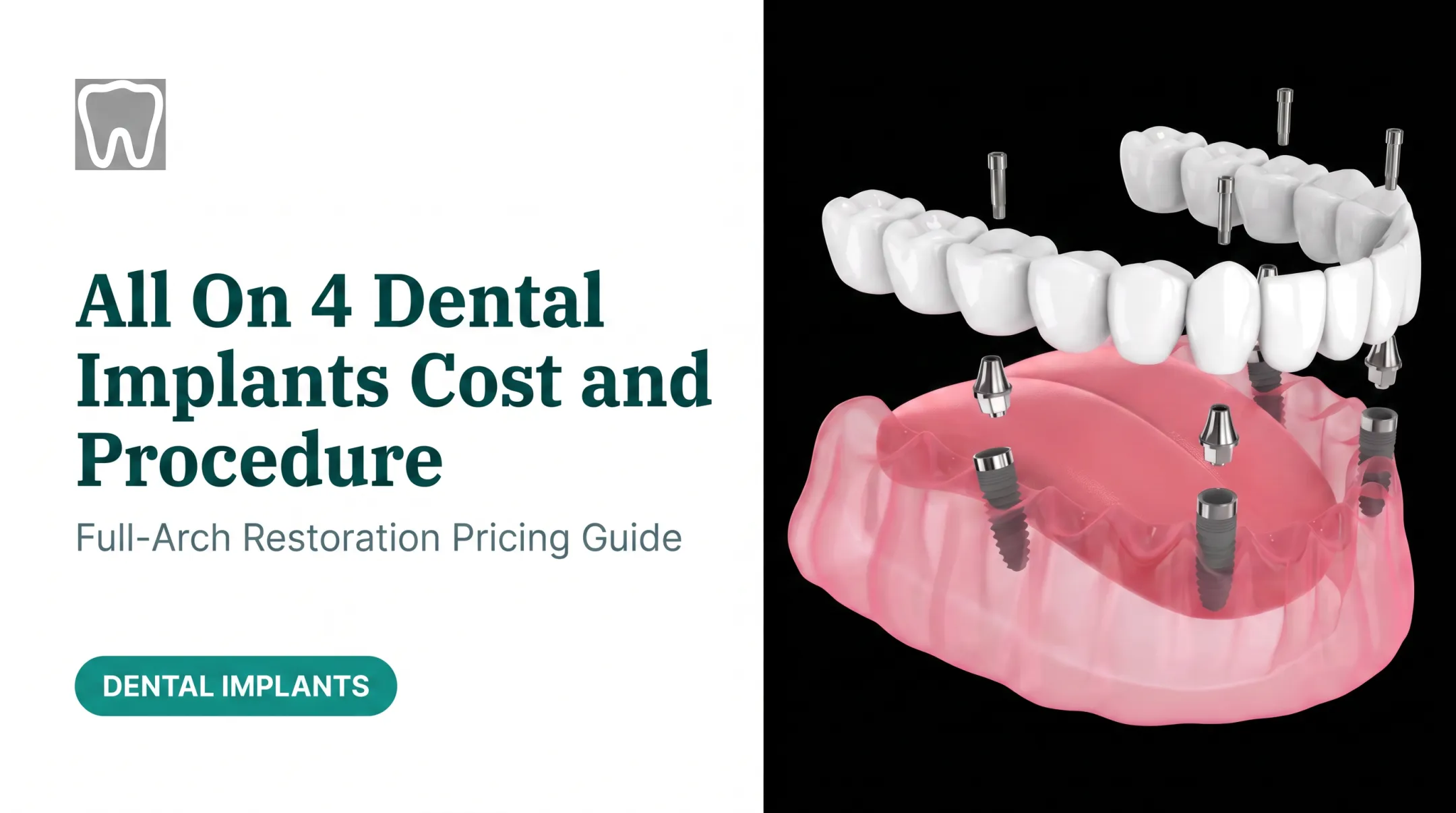
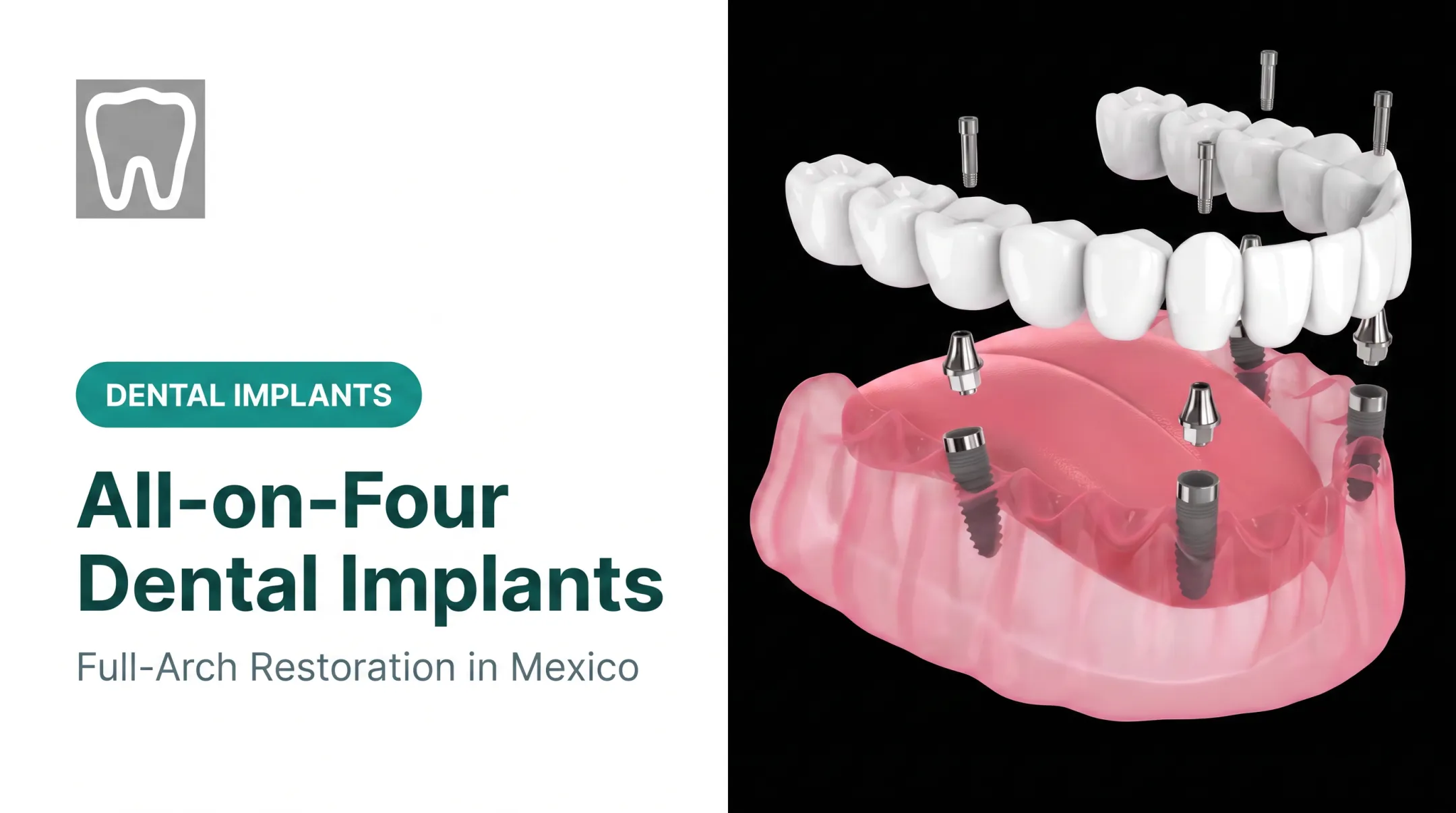
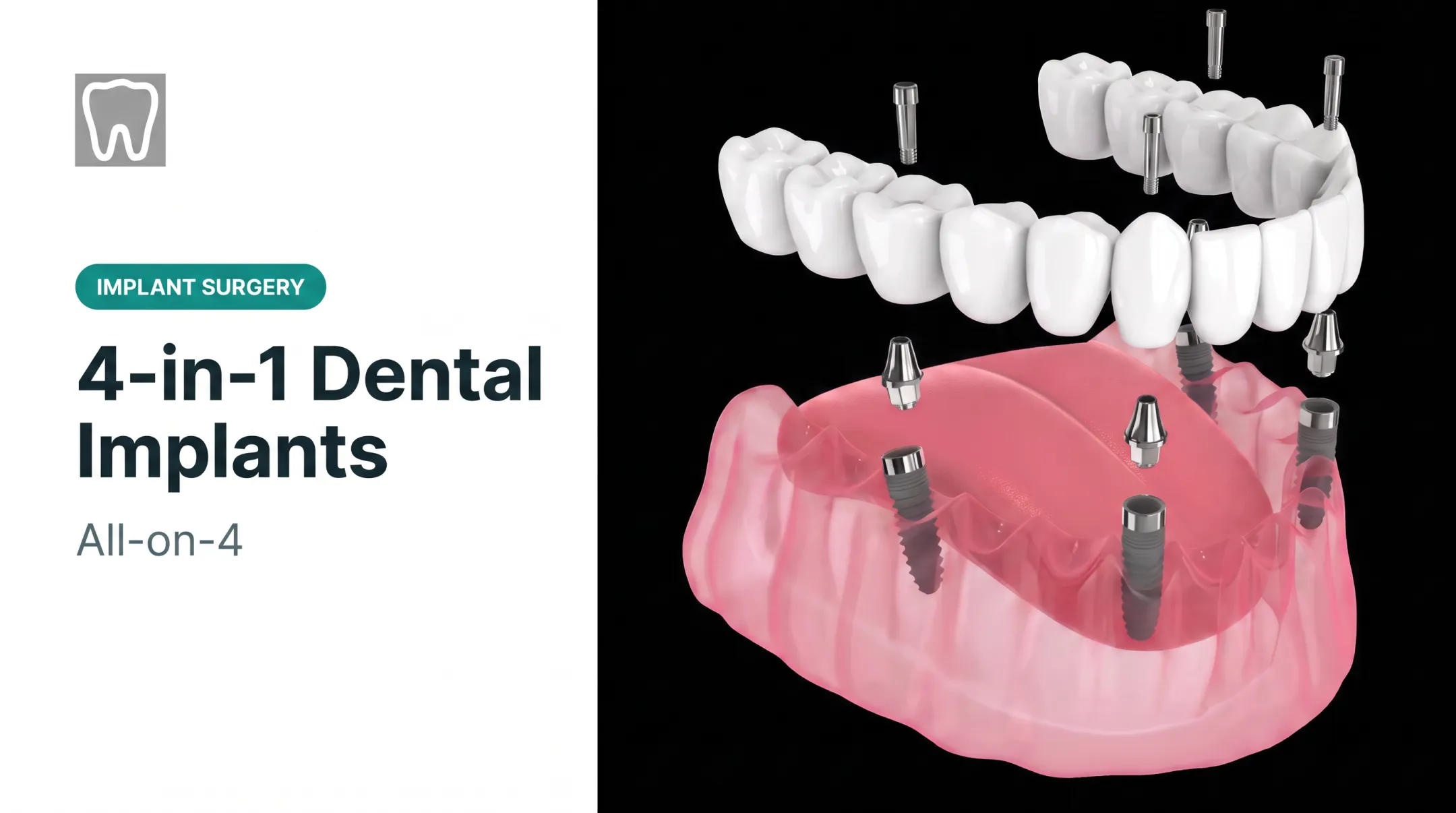
All-on-4 is a full-arch, implant-supported prosthetic solution. Two implants go in vertically at the front of the jaw; two more are angled into the back, typically at 30-45 degrees.
All four anchor a single fixed bridge that replaces an entire row of teeth. Nobel Biocare describes this tilted placement as a way to work around anatomical limits like the sinus cavity, without necessarily requiring bone grafting.
The goal: a fixed, non-removable set of teeth that functions like natural teeth, without the drawn-out grafting process traditional implants sometimes need.
How it differs from similar options:
| Approach | Implants Used | Bone Requirement |
|---|---|---|
| All-on-4 | 4 (2 straight, 2 angled) | Works with limited bone via angulation |
| All-on-6 | 6 | Needs more bone width and density |
| Traditional full-mouth reconstruction | Varies, often more | May need grafting or segmented prosthetics |
A 2025 retrospective study of nearly 6,000 implants found four and six-implant approaches had comparable survival rates at both two and five years. More implants aren't automatically better. It depends on your anatomy.

Why the All-on-4 Procedure Is Used
Traditional implants often demand a certain volume of healthy jawbone. Patients with significant bone loss, or long-term denture wearers, frequently don't have that bone volume without grafting first. The angled posterior placement in All-on-4 sidesteps this by using denser bone at the front of the jaw.
What tends to go wrong with removable dentures:
- They slip during eating or speaking, which erodes confidence
- Bone resorption continues underneath them over time
- Chewing force drops noticeably compared with natural teeth
Research on complete-denture wearers found bite force can run 15-20% lower than in people with natural teeth, particularly with tougher foods. A separate study linked residual ridge resorption to poor denture stability and lower satisfaction, especially among women.
All-on-4 is used to replace that unstable, bone-wasting cycle with a fixed arch on four implants. A systematic review found All-on-4 implants had a 99.8% survival rate beyond 24 months, though the same review cautioned that high-quality long-term data is still limited.
At Dental Implants in Mexico, board-certified periodontist Dr. José Moguel applies the standard four-implant, dual-angulation protocol. With over 38 years of experience and more than 17,000 implants placed, he uses high-resolution CBCT imaging to plan each case individually.
How the All-on-4 Procedure Works (Step-by-Step)
The journey runs from consultation to final teeth in five stages. Here's how each step works.
Step 1: Consultation, Imaging & Treatment Planning
A full oral exam plus a CBCT 3D scan determines whether you're a candidate and exactly where the four implants should go. The surgeon maps bone density, nerve pathways, and sinus position in three dimensions before any drilling. Digital smile design then maps out your future bite and appearance before surgery day.
Step 2: Extraction & Implant Placement Surgery
Failing teeth are removed if needed. The surgeon then places four implants under sedation—typically in a single appointment lasting a few hours. Angled posterior implants avoid the sinus cavity and nerve areas while making full use of existing bone.
Step 3: Same-Day Temporary Bridge
For patients who qualify for immediate loading, the team attaches a fixed provisional bridge the same afternoon. This is "teeth in a day," not the permanent restoration. Low bone density can rule this out when it prevents adequate implant stability at placement.
Step 4: Osseointegration/Healing Period
Implants fuse with the jawbone over 3-6 months. You'll need a soft-food diet during this window while bone integrates around the titanium posts.
Step 5: Final Permanent Restoration
Once healing is confirmed, a custom zirconia or ceramic-hybrid bridge replaces the temporary one for long-term daily use. Zirconia resists chipping, cracking, and staining better than acrylic-based alternatives. A systematic review noted survival rates around 97% for full-arch zirconia, though direct comparison data against acrylic remains limited.

Key Factors That Affect Cost, Recovery, and Long-Term Success
Several variables shape both your price tag and your outcome:
- Bone density and quality — determines implant angulation and whether grafting is still needed despite the tilted approach
- Bridge material — zirconia versus acrylic or ceramic-hybrid affects upfront cost and long-term durability
- Surgeon experience — high-volume implant providers generally report fewer complications
- Smoking — a meta-analysis found smokers face more than double the odds of implant failure, plus extra bone loss at the site
- Bruxism (teeth grinding) — linked to higher failure risk and more mechanical complications in a 2025 umbrella review
- Treatment location — Mexico-based care with a board-certified periodontist often costs far less than comparable US treatment
Those location differences show up clearly in the numbers. CareCredit's 2024 research put the US average at $15,176 per jaw, ranging from $11,640 to $27,500. At Dental Implants in Mexico, All-on-4 starts around $6,000–$9,000 per arch, typically 60–70% less than comparable US treatment.

Common Misconceptions and When All-on-4 May Not Be Appropriate
"All-on-4 always means exactly four implants." Not quite. Some full-arch cases use five or six implants for added stability, depending on jaw structure and bite force. When six implants are used specifically, that's typically classified as All-on-6, a separate protocol chosen when there's sufficient bone width and density.
"Final teeth go in on day one." The bridge you leave with on surgery day is a provisional (temporary) bridge. The definitive zirconia or ceramic-hybrid bridge follows several months later, once the implants have fused to the bone (osseointegration).
All-on-4 isn't for everyone. You may need bone grafting first, or another option entirely, if you have:
- Uncontrolled diabetes (linked to higher implant failure rates in a 2022 meta-analysis)
- Heavy smoking habits without plans to quit
- Minimal remaining bone even with angled placement
If you still have healthy natural teeth you want to keep, a partial implant bridge is often a better fit than full-arch replacement. Combined tooth-and-implant bridges can work well in select cases, though long-term comparative studies remain limited.
Frequently Asked Questions
What is the average cost of All-on-4 dental implants?
Cost varies by location, bridge material, and provider experience. A personalized consultation with a transparent quote is the only reliable way to price your specific case.
How long does All-on-4 implant surgery take?
The surgery itself typically takes a few hours in a single appointment. Full treatment, including healing and final restoration, spans several months.
How long does it take to recover from All-on-4 implants?
Initial soft-tissue recovery runs about 1-2 weeks. Full osseointegration, where implants fuse with the jawbone, takes 3-6 months.
How long after All-on-4 dental implants can I eat normally?
Soft foods are recommended for several weeks after surgery. A normal diet returns gradually as healing progresses, guided by your provider's check-ins.
Are All-on-4 dental implants worth it?
For eligible candidates, long-term stability and chewing function typically justify the higher upfront cost compared with removable dentures.
What are the alternatives to All-on-4 dental implants?
All-on-6, traditional multi-implant full-mouth reconstruction, and implant-retained dentures are common alternatives, chosen based on bone volume, budget, and personal needs.