
Teeth-in-a-Day, also called All-on-4, has changed that timeline dramatically. This proven technique lets patients walk out with a fixed, functional smile the same day as surgery. In this guide, we'll cover the process, realistic costs, who qualifies, and the risks worth understanding before you commit.
Increasingly, patients from the US and Canada are crossing the border to Los Algodones, Mexico for this exact treatment, often for a fraction of what they'd pay at home.
Key Takeaways
- Same-day fixed temporary teeth for a full arch, supported by four to six implants
- Final permanent restoration follows after 3-6 months of healing (osseointegration)
- Candidacy depends on bone density, gum health, and overall medical history
- Save about 60-70% by treating in Mexico with a board-certified periodontist
What Is Teeth-in-a-Day (All-on-4)?
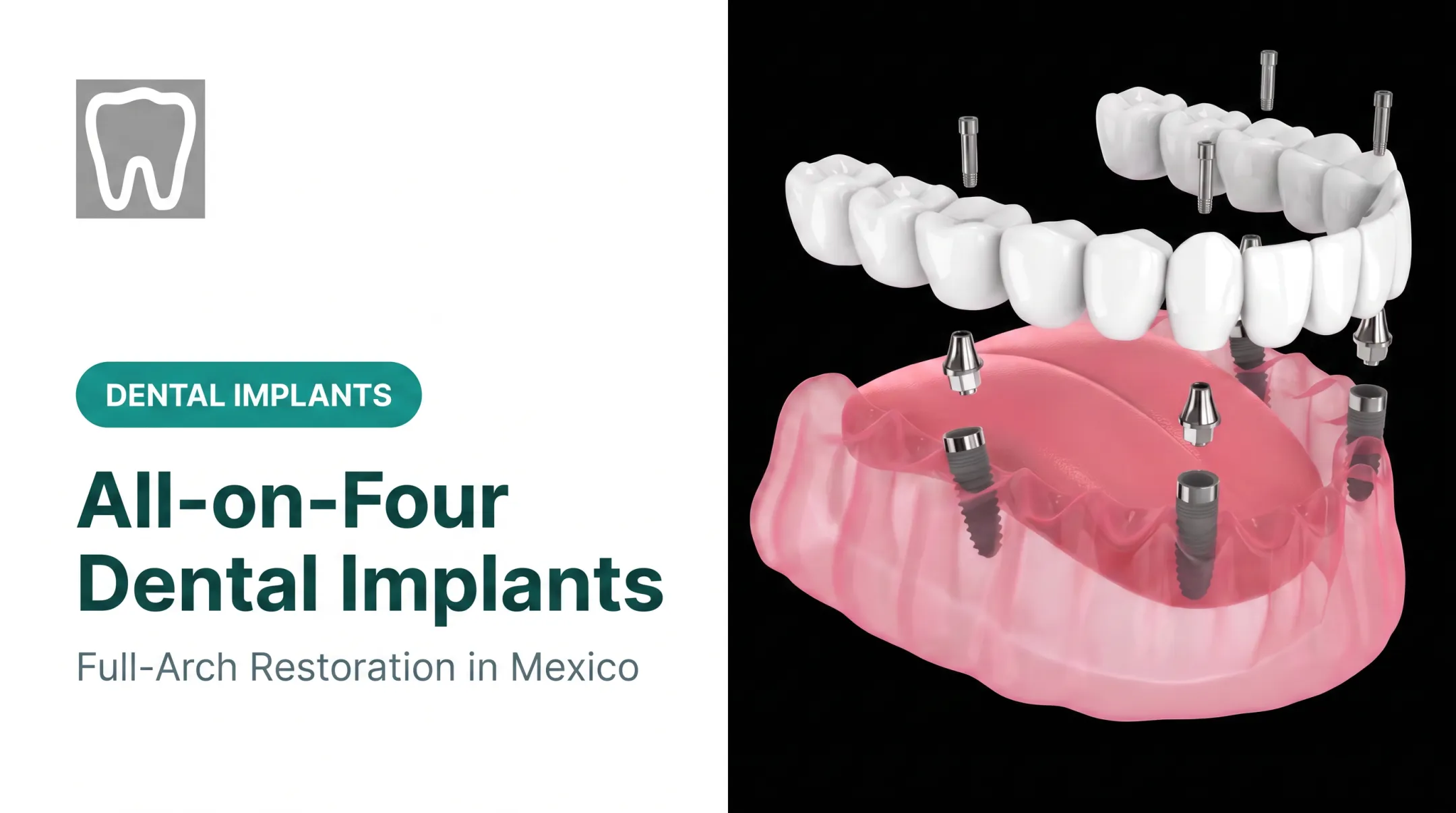
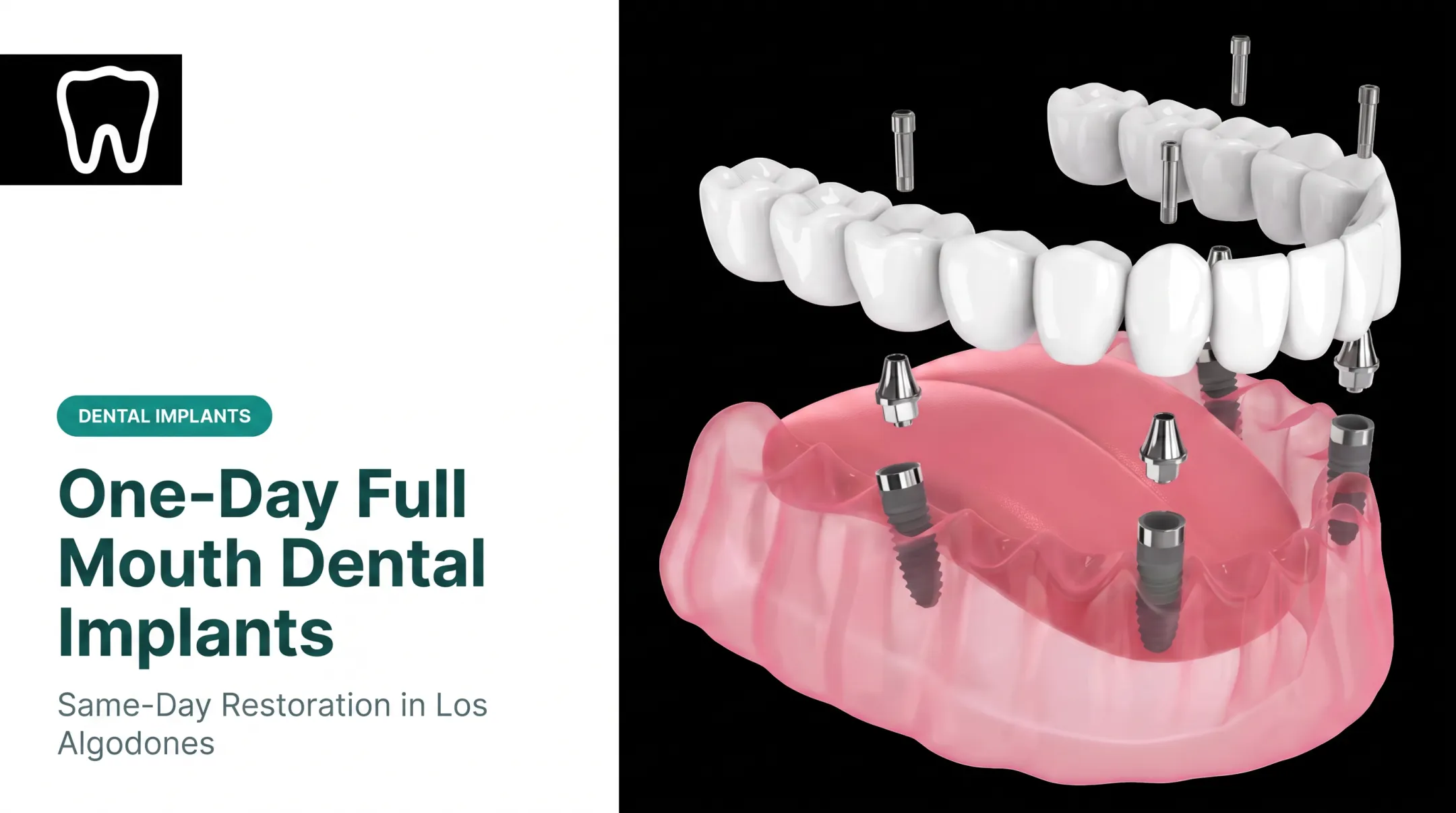
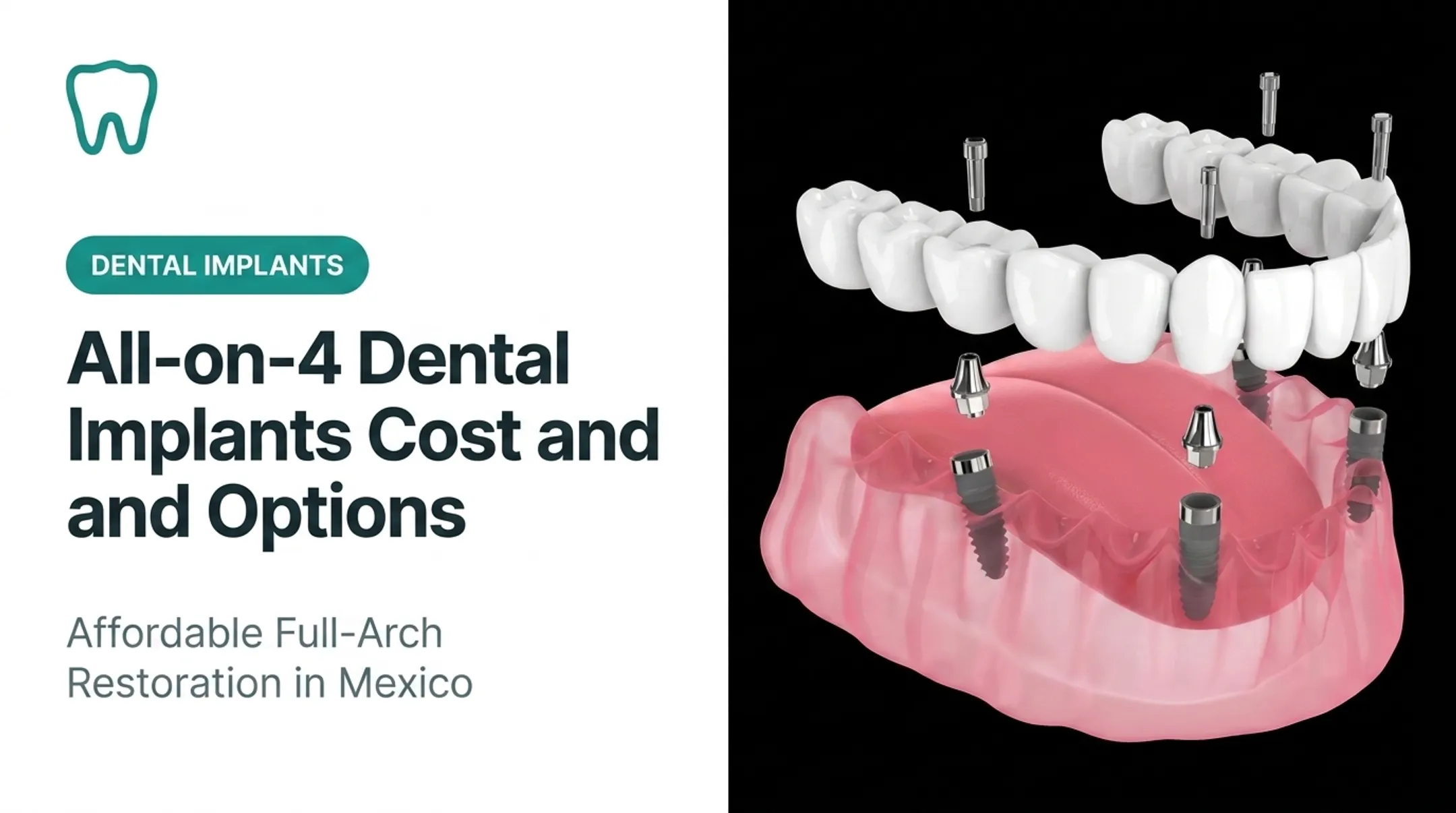
Teeth-in-a-Day is a full-arch implant protocol. Four to six strategically placed implants anchor a full row of fixed teeth, and those teeth are loaded on the same day as surgery.
That immediate loading is the main break from traditional implants, which usually wait 3–4 months in the lower jaw and 6–8 months in the upper jaw before any teeth are attached.
Placement makes same-day loading possible: two implants go in vertically at the front, and the posterior implants are angled up to 45 degrees. The angle uses denser available bone and often removes the need for grafting.
The 3-ON-8™ Alternative
Dr. José Moguel, a board-certified periodontist with 38+ years of experience and 17,000+ implants placed, developed a patented alternative called 3-ON-8™. Instead of four implants supporting one continuous bridge, this protocol places eight implants per arch supporting three independent, custom-milled zirconia bridges.
The advantage: chewing forces spread across more support points, and damage to one segment doesn't compromise the entire restoration. Integration typically runs 4-6 months, slightly longer than All-on-4's 3-4 month window.
Important distinction: the teeth you receive on surgery day are temporary. The final restoration, usually zirconia or porcelain, is placed months later once the implants have fully fused with the jawbone.
Teeth-in-a-Day vs. Traditional Implants vs. Dentures
Side by side, the practical differences look like this:
| Factor | Teeth-in-a-Day | Traditional Implants | Removable Dentures |
|---|---|---|---|
| Timeline to fixed teeth | Same day | 6–9 months | Weeks, but not fixed |
| Appointments | Fewer, consolidated | Multiple stages | Multiple fittings |
| Stability | Fixed, non-removable | Fixed, non-removable | Removable, can shift |
| Bone requirement | Moderate (angled placement) | Higher, grafting common | Minimal |

The Teeth-in-a-Day Procedure: Step-by-Step
Most Teeth-in-a-Day cases follow five stages, from imaging through final restoration:
- Consultation and diagnostics - A 3D Cone Beam CT scan maps bone density, width, and nerve pathways. Digital scanning and treatment planning follow, giving detail 2D X-rays cannot provide for safe implant placement.
- Extraction and implant placement - Your dentist removes failing teeth and places implants with computer-guided precision. Local anesthesia, oral conscious sedation, or IV sedation is available based on your comfort needs.
- Immediate temporary bridge - A custom fixed bridge, made with in-house CAD/CAM technology, is secured to the implants that same afternoon.
- Healing and osseointegration - This phase runs 3-6 months. You follow a soft-food diet, moving from cold liquids in the first 48 hours to soft solids like scrambled eggs and mashed potatoes by day four.
- Final restoration - Once integration is complete, your permanent bridge is fitted using FDA-approved systems such as Nobel Biocare, Straumann, or MegaGen.

The Dental Implants in Mexico clinic—a short walk from the Andrade, California border crossing—completes every stage under one roof, so you are not sent between facilities mid-treatment.
Benefits and Risks of Teeth-in-a-Day
Teeth-in-a-day delivers a fixed smile quickly, but immediate loading still involves tradeoffs you should review before surgery.
Benefits:
- Immediate function and aesthetics: a stable, non-removable smile from day one
- Jawbone preservation through implant stimulation, reducing facial sagging after long-term tooth loss
- Fewer appointments and a shorter total timeline than staged implant treatment
Those upsides come with candidacy limits and healing rules.
Risks:
- Immediate loading carries a slightly higher failure risk than delayed loading protocols
- A systematic review of All-on-4 outcomes reported survival rates of 95% to 99.8%, though prosthetic-part detachment exceeded 20% in one study
- Uncontrolled diabetes, heavy smoking, or severe bone loss without grafting can rule out candidates
- Smoking is linked to roughly 35% higher implant-failure risk in a PLOS One meta-analysis
- Temporary restorations need careful handling and a soft-food diet for about 3–4 months of healing

Who Is a Good Candidate?
Good candidates share these traits:
- Sufficient bone density to anchor four to six implants securely
- Good general and oral health, with no active gum disease
- Multiple failing or missing teeth in one arch
- Discomfort or dissatisfaction with removable dentures
Patients with lower bone volume aren't necessarily excluded. Angled implant placement often works around sinus cavities or nerve pathways without grafting. When grafting is needed, it typically adds 3–6 months of integration time.
The clinic offers a free, no-obligation consultation that includes 3D imaging, so you know whether you qualify before you book travel.
Cost and Why Patients Choose Mexico for Teeth-in-a-Day
US pricing for All-on-4 typically runs $12,000 to $28,000 per arch, according to a 2024 cost comparison from Bookimed. Costs climb based on implant brand, sedation type, grafting needs, and the complexity of the case.
In Mexico, comparable treatment costs far less. At Dental Implants in Mexico, All-on-4 starts from $6,000 per arch, with typical Teeth-in-a-Day pricing between $9,000 and $13,000. That works out to roughly 60-70% savings versus typical US prices, with treatment from a board-certified periodontist.

Cost is the main draw, but support around the visit is why many patients follow through:
- Bilingual coordinators who respond within 24 hours
- Hotel coordination in Yuma, Arizona (about 15 minutes from the clinic), including Hilton Garden Inn and Marriott TownePlace Suites
- Itemized insurance statements with CDT codes for US reimbursement claims
- Lifetime warranty on implant hardware, plus five years on crowns and bridges
Frequently Asked Questions
How much do one-day implants cost?
US pricing typically runs $12,000-$28,000 per arch. In Mexico, comparable Teeth-in-a-Day treatment runs $9,000-$13,000, roughly 60-70% less.
Can you really get implants in 24 hours?
Yes. Implants and a fixed temporary bridge are placed the same day as surgery. The final permanent restoration follows after 3-6 months of bone healing.
Who is not a good candidate for one-day implants?
You may need preparatory treatment first if you have:
- Uncontrolled diabetes or a heavy smoking habit
- Active gum disease
- Severe bone loss that requires grafting before implants
How painful are same-day implant teeth?
Surgery is performed under local anesthesia or sedation, so the procedure itself is painless. Mild post-operative discomfort is typical and managed with prescribed medication.
Do teeth in a day look natural?
Yes. Digital smile design and custom CAD/CAM fabrication create bridges shaped and shaded to match each patient's facial structure and natural tooth appearance.
Is Teeth in a Day worth it?
For qualified candidates, immediate function, jawbone preservation, and 60-70% cost savings versus typical US fees make it worthwhile. It is not right for every patient, so a free consultation is the best way to confirm candidacy.