
That's a mistake. The material sitting on top of your implant affects how natural your smile looks, how well it survives your bite force, and how much you'll spend over the restoration's lifetime. A 10-year study on lithium-disilicate implant crowns found a 93.8% survival rate — proof that material choice has staying power, literally.
This guide breaks down porcelain and zirconia side by side, so you can walk into your consultation already knowing what questions to ask.
TL;DR
- Porcelain leads on translucency for natural-looking front teeth
- Zirconia holds up better under heavy bite force in molars and full-arch cases
- Metal-free zirconia is highly biocompatible; porcelain is often layered over metal or zirconia
- Hybrid restorations (zirconia core + porcelain layer) balance strength with beauty
- Have a board-certified specialist match material to your bite force, gum thickness, and implant location
Porcelain vs. Zirconia: Quick Comparison
| Factor | Porcelain | Zirconia |
|---|---|---|
| Cost | Generally lower for single crowns | Typically higher due to CAD/CAM milling |
| Composition | Feldspathic, leucite, or lithium disilicate ceramics | Zirconium dioxide, a crystalline "ceramic steel" |
| Durability | More prone to chipping under heavy bite force | Highly fracture-resistant |
| Aesthetics | Superior translucency, mimics enamel | Strong, slightly more opaque |
| Best For | Front teeth, visible smile zones | Molars, bruxism, full-arch cases |
The strength gap is significant. Zirconia’s flexural strength exceeds 900 MPa, while feldspathic porcelain is about 154 MPa—nearly six times weaker under bite pressure.

What Is Porcelain?
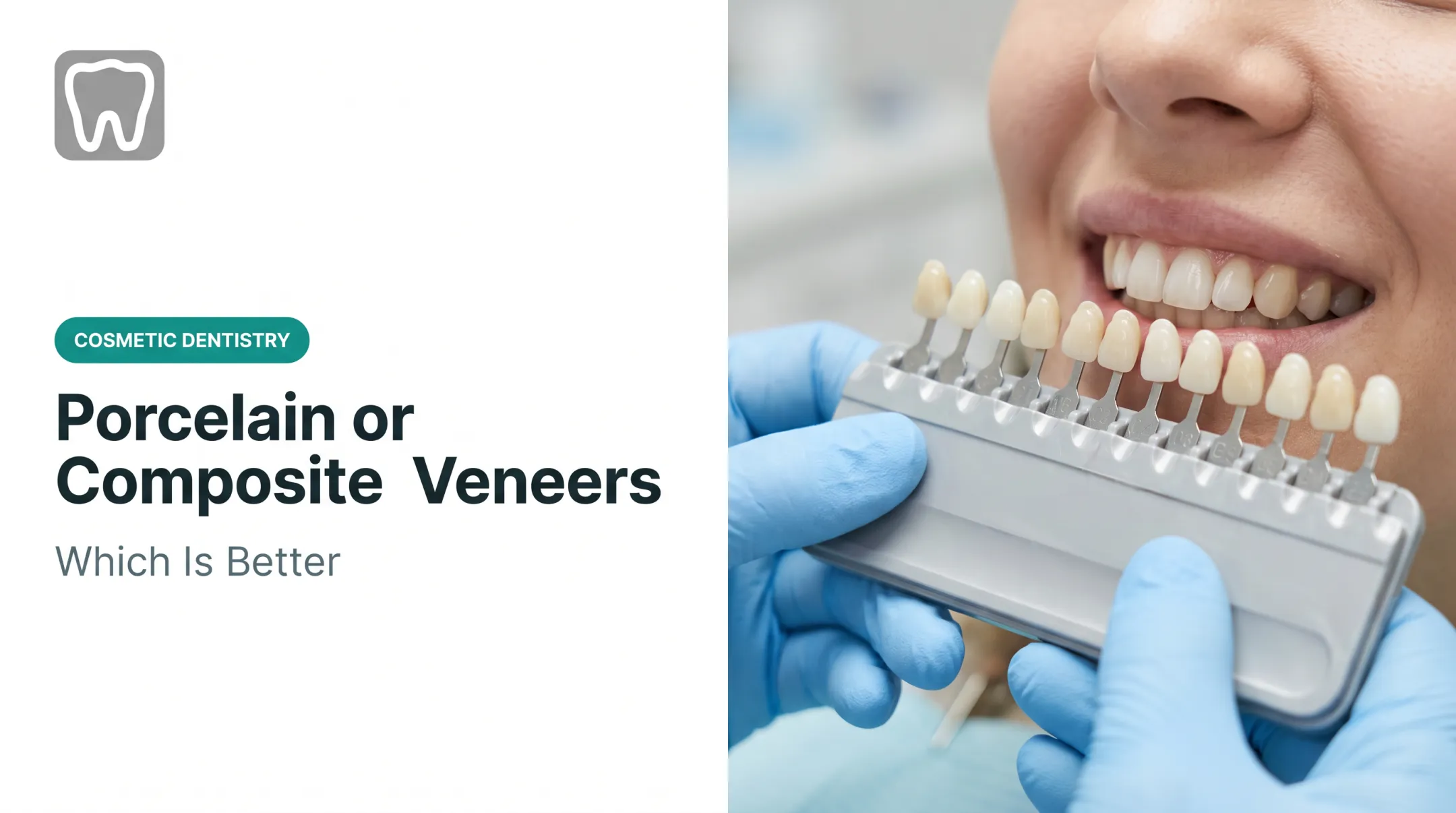
Porcelain has been a dental workhorse for decades, prized for one thing above all: it fools the eye. Light passes through it the way it passes through real enamel, which is why cosmetic dentists still reach for it on front-tooth cases.
Not all dental porcelain is created equal. Three main types exist:
- Feldspathic porcelain — the most translucent, but the weakest structurally
- Leucite-reinforced — slightly stronger, with improved fluorescence and opalescence
- Lithium disilicate (E.max) — the strongest porcelain option, reaching 360-530 MPa flexural strength depending on the product line
Your bite classification, whether you grind your teeth, and even the color of the abutment underneath (titanium versus zirconia) all shape how the final crown looks. A titanium abutment under thin gum tissue can cast a gray shadow that undermines an otherwise perfect porcelain crown.
Use Cases of Porcelain
Porcelain works best on single front-tooth implant crowns, where translucency matters more than raw strength. Dentists often pair it with a zirconia abutment when gum tissue is thin, which prevents that gray shadow under the crown.
A long-term study on implant-supported lithium-disilicate crowns reported a 94.1% chipping-free rate across more than 13 years of observation. Placed correctly, high-quality porcelain holds up well in the front of the mouth.

What Is Zirconia?
Zirconia (zirconium dioxide) is the newer player, and it's earned its reputation the hard way: through sheer strength. Dentists sometimes nickname it "ceramic steel" because it combines a tooth-like appearance with mechanical properties that rival metal.
Two main formats exist:
- Monolithic zirconia — solid zirconia throughout, maximizing strength
- Layered zirconia — a zirconia core with a porcelain overlay for enhanced aesthetics
Zirconia is completely metal-free, which matters for two reasons. It's highly biocompatible with low bacterial affinity, and its naturally white color eliminates the gray shadow problem titanium abutments can cause under thin gums.
Use Cases of Zirconia
Zirconia is the go-to when fracture resistance under repeated force matters more than perfect translucency:
- Molars and other high-load teeth
- Patients with bruxism (teeth grinding)
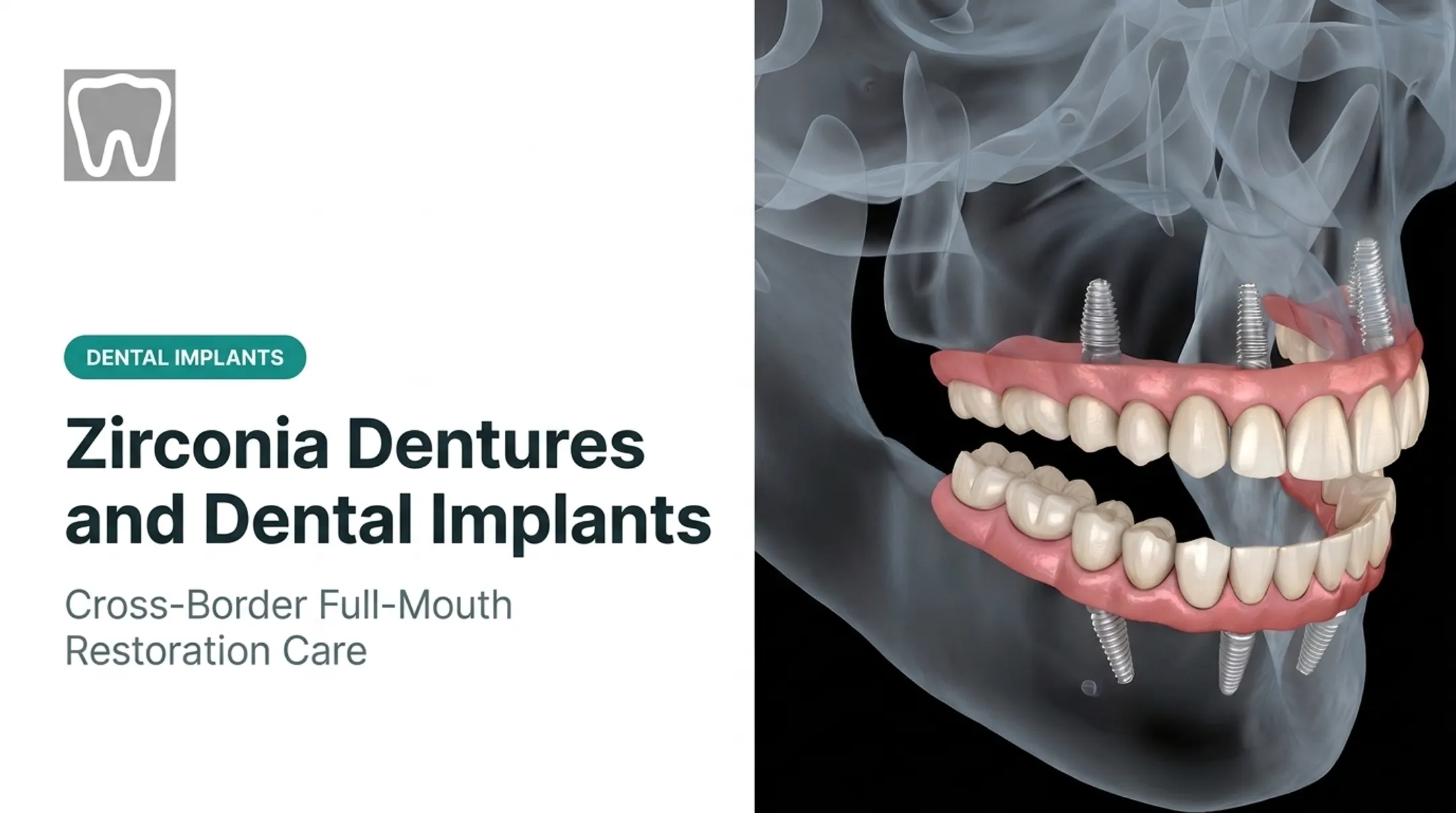
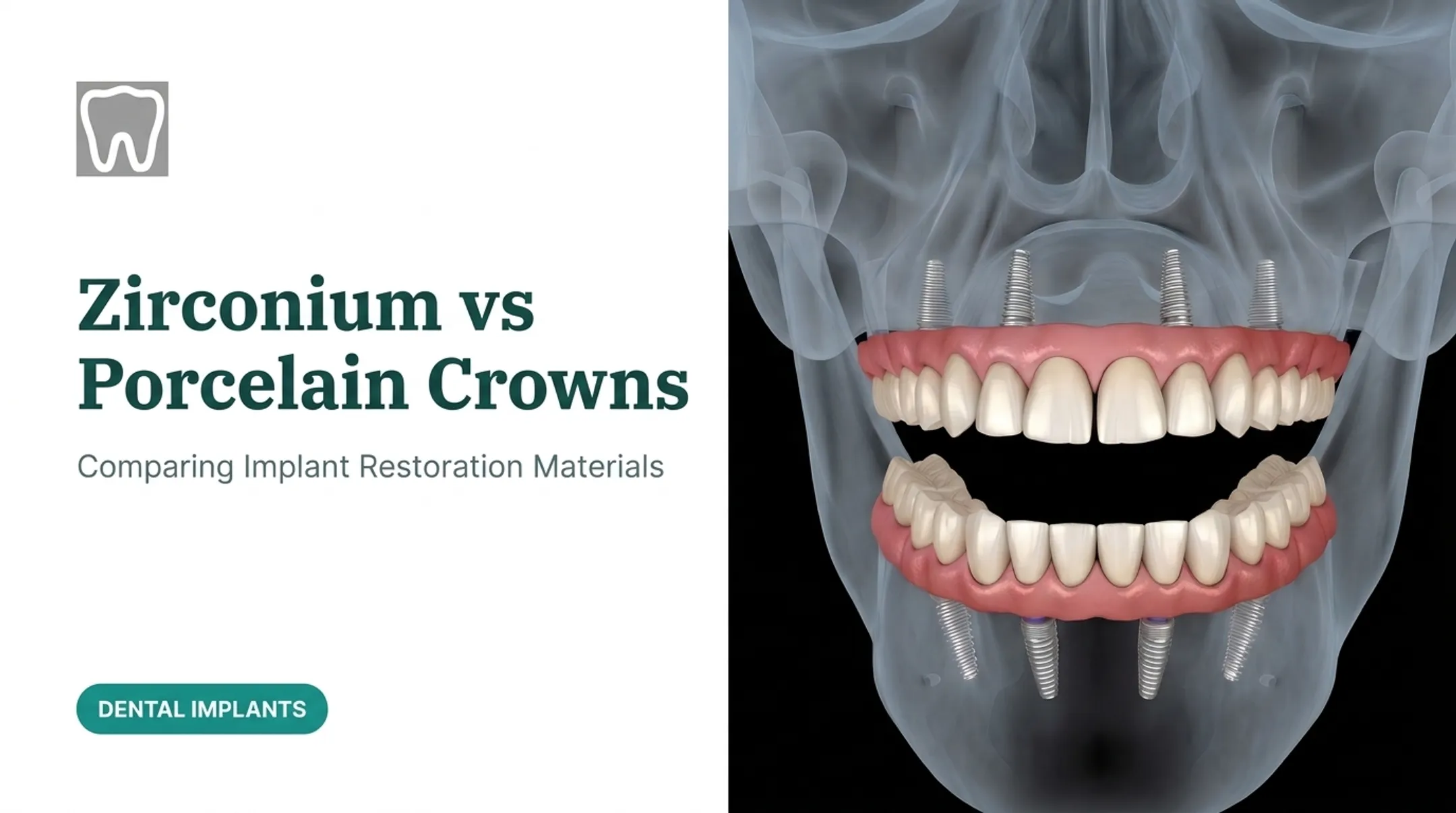
- Full-arch reconstruction
- Patients seeking a metal-free, holistic-friendly option
A 2023 narrative review of zirconia full-arch implant prostheses found survival rates ranging from 88% to 100% across follow-ups of one to seven years. One series of 50 arches reported 100% survival at two years.
Bruxism patients specifically benefit. Grinding raises implant-failure risk by 2.2 to 4.7 times, so zirconia's fracture resistance is a practical necessity.

At Dental Implants in Mexico, zirconia shows up across real cases. One patient received six upper-arch Straumann implants with a zirconia bridge after bilateral sinus lifts. Another received 16 titanium implants supporting fixed zirconia bridges, restoring chewing and speech with no reported complications.
Porcelain vs. Zirconia: Which Is Better?
There's no universal winner here. The right answer depends on:
- Bite force — heavy grinders need zirconia's fracture resistance
- Location in the mouth — front teeth favor porcelain's translucency; back teeth favor zirconia's strength
- Gum thickness — thin gums often call for zirconia abutments to avoid shadowing
- Cosmetic priorities — how much translucency matters to you personally
Many specialists split the difference with a hybrid: a zirconia substructure layered with porcelain. You get zirconia's core strength with porcelain's surface beauty. The tradeoff is that the porcelain layer can still chip, and chipping is the most commonly reported complication with layered zirconia crowns.
At Dental Implants in Mexico, Dr. José Moguel works with FDA-approved materials from Nobel Biocare, Straumann, and MegaGen. An in-house CAD/CAM lab custom-fabricates porcelain or zirconia restorations to match each case.
In one example, a patient received a NobelActive implant with a custom zirconia abutment and a translucent ceramic crown. The restored gumline was described as indistinguishable from natural teeth.
Case Consideration: Choosing Materials for Full-Mouth Restoration
Picture a patient needing full-mouth reconstruction. They're deciding between all-porcelain, all-zirconia, or a hybrid approach, and the stakes are higher than a single crown.
A periodontist typically weighs:
- Bone density and width, assessed via 3D CT or CBCT imaging
- Bite force and grinding habits, since bruxism dramatically raises failure risk
- Long-term maintenance expectations, including how easily a segment can be repaired later
Dr. Moguel's patented 3-ON-8™ protocol illustrates this thinking. Rather than one continuous prosthesis, it pairs eight titanium implants per arch with three separate, independently supported zirconia bridges. If one segment ever needs attention, the other two stay in place undisturbed.

Clinics also pair All-on-4 and All-on-6 with durable zirconia frameworks when long-term full-arch stability is the priority.
In one documented case, a 58-year-old patient received eight implants in each arch, secured with custom-crafted zirconia bridges. Another patient underwent 16 implants with CAD/CAM-fabricated zirconia bridges, screw-retained after a six-month, two-phase treatment that restored both chewing and speech with no complications.
Material choice for full-mouth cases isn't a template. It's an individualized evaluation.
Considering a full-mouth solution? Book a free, no-obligation consultation for a personalized treatment plan and transparent price quote.
Conclusion
Neither porcelain nor zirconia is universally "better." The right choice hinges on where the implant sits, how hard you bite, and whether you prioritize natural translucency or raw strength.
Work with a board-certified periodontist experienced in high-volume implant cases to match the material to your bite, smile goals, and long-term durability. A free consultation can confirm which option fits your restoration plan.
Frequently Asked Questions
Which is better, zirconia or porcelain implants?
Zirconia is stronger and better suited for back teeth or bruxism patients, while porcelain often looks more natural on visible front teeth. Many patients combine both to get strength and a natural look.
Can porcelain and zirconia be combined in one restoration?
Yes. Layered zirconia (a zirconia core with a porcelain overlay) is a common hybrid approach that balances strength with a natural appearance.
How long do porcelain and zirconia implant crowns last?
Both can last many years to decades with proper care. A 10-year study on lithium-disilicate crowns reported a 93.8% survival rate, and zirconia full-arch prostheses have shown similarly strong long-term outcomes.
Is zirconia a metal-free option?
Yes. Zirconia is a ceramic, not a metal alloy, so it suits patients with metal sensitivities.
Does insurance or financing cover porcelain or zirconia implants?
Coverage varies by plan, but eligible crowns are often reimbursed at roughly 40-50%, subject to an annual maximum. Clinics can assist with claim documentation and CDT procedure codes.
Which material is recommended for people who grind their teeth?
Zirconia is recommended for bruxism patients because of its higher fracture resistance under heavy bite forces. Grinding can raise implant-failure risk by 2.2 to 4.7 times, so material durability matters.