
This guide is for anyone comparing tooth replacement options, especially patients weighing treatment in Mexico against US pricing. Understanding what's actually involved helps you budget correctly and set realistic expectations. Many patients use "implant" and "crown" interchangeably, which causes real confusion about cost and timeline.
Here's what the procedure involves, step by step, what affects success, and how to know if it's right for you.
TL;DR
- A dental implant with crown replaces both the tooth root (titanium implant) and the visible tooth (custom crown)
- Treatment involves surgical placement, a multi-month healing period called osseointegration, then crown attachment
- Most cases take 3–6 months, because osseointegration cannot be rushed
- Success depends on bone density, implant material, and provider experience
- Dental Implants in Mexico provides this treatment at about 60–70% less than typical US prices
What Is a Dental Implant With Crown?
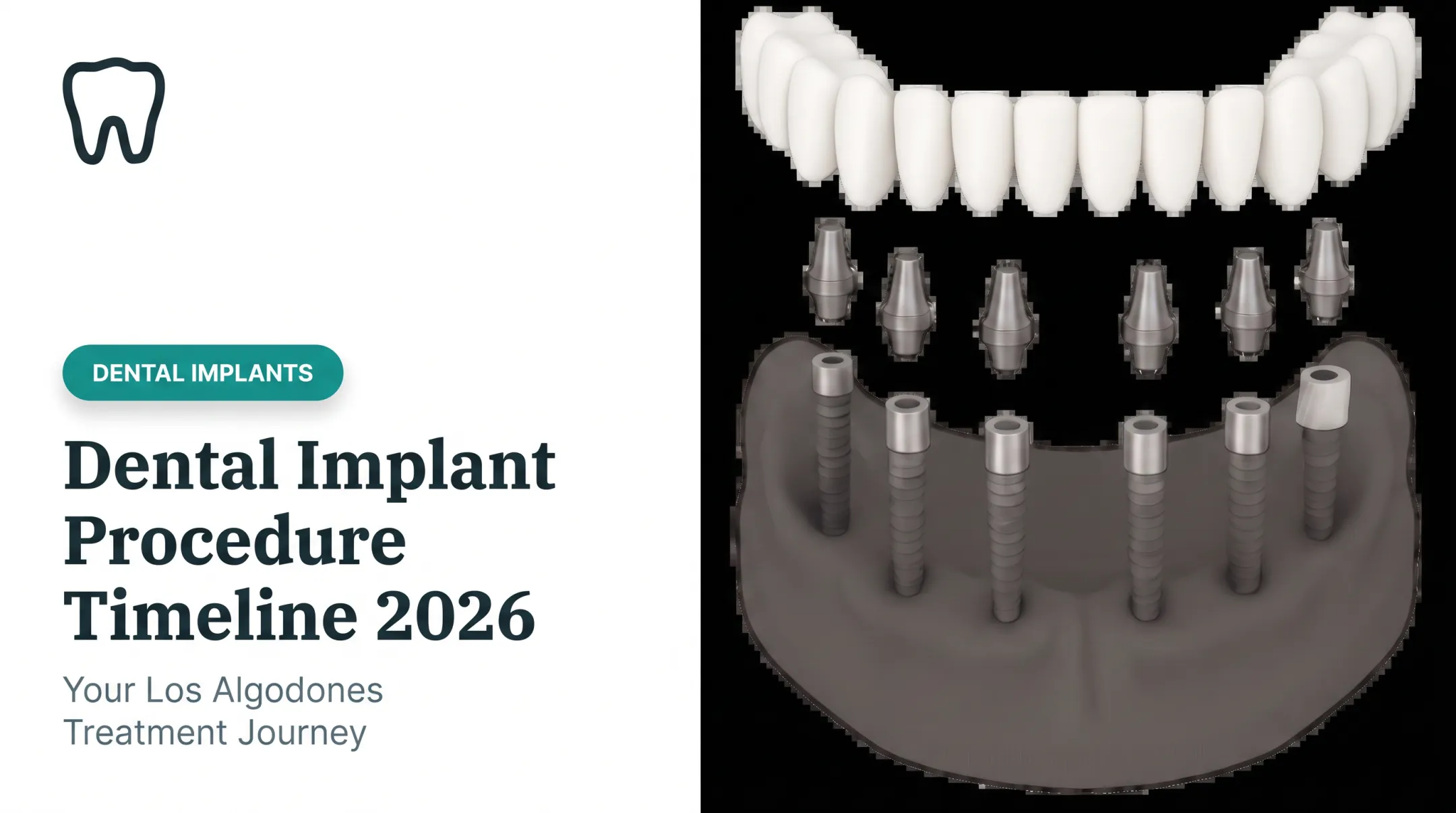
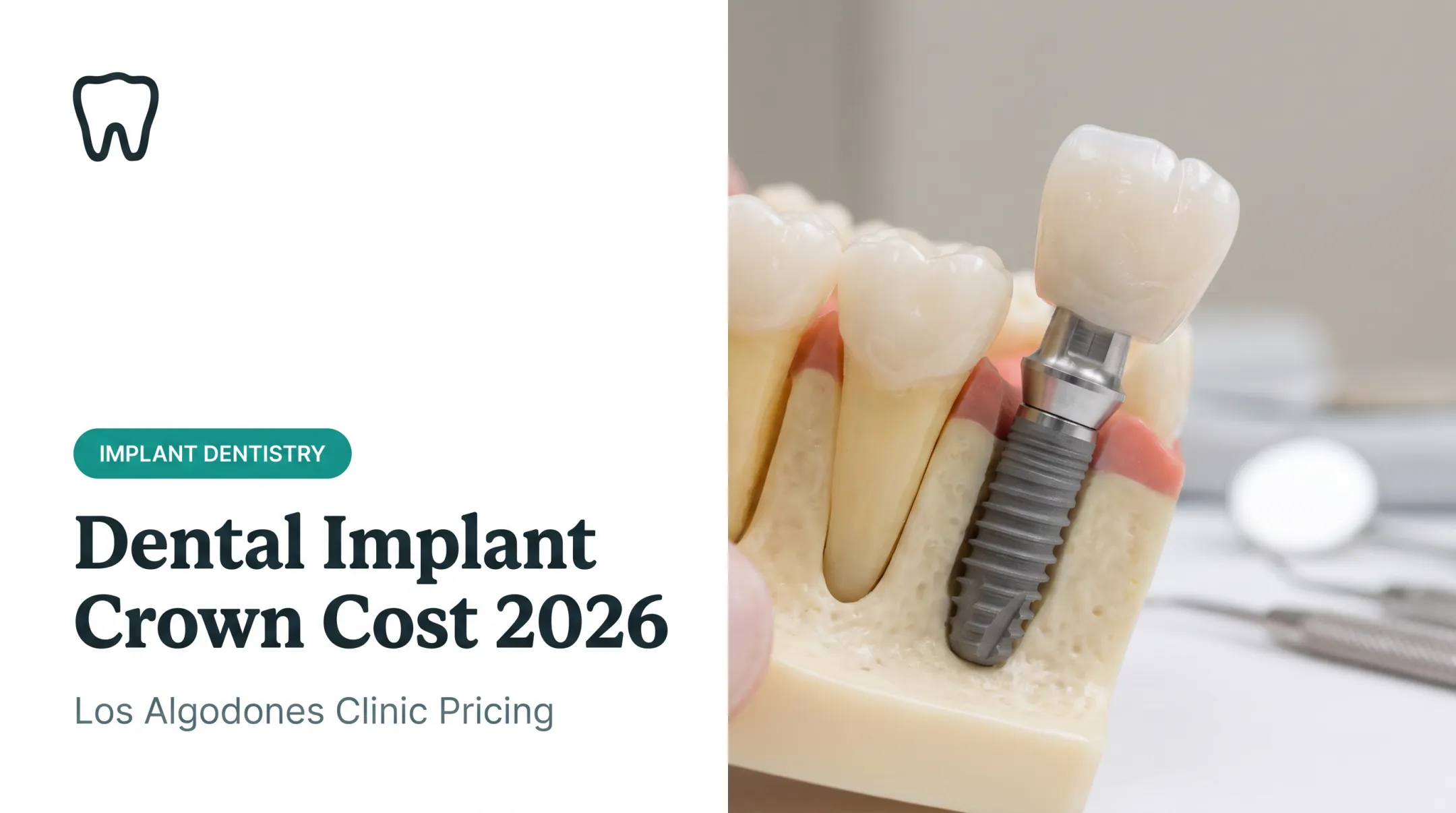
A dental implant with crown replaces both the root and the visible tooth. A titanium post is placed in the jawbone as an artificial root. A custom crown attaches on top through a connector called an abutment.
Together, the implant, abutment, and crown recreate a complete tooth (root and all). The American Association of Oral and Maxillofacial Surgeons (AAOMS) describes this as a long-term solution for missing teeth, with those three parts working as one unit.
How this differs from other options:
- Standalone dental crown: Caps a damaged but intact natural tooth. No root replacement needed because the root is still there.
- Bridge: Anchors to adjacent natural teeth, which get ground down to support it. No jawbone stimulation happens underneath the gap.
- Implant with crown: Stands independently, preserves the jawbone, and doesn't touch neighboring teeth at all.
The result is a permanent tooth that looks, feels, and functions like the one you lost.

Why the Implant-With-Crown Procedure Is Used
Implants become the go-to option when a tooth is missing entirely or too damaged to save with a simple crown. A crown needs an intact root to attach to. Without a root, a crown alone will not hold.
What patients actually need after tooth loss:
- Restored chewing function
- Preserved jawbone structure
- A result that looks and feels natural
- No reliance on cutting into healthy neighboring teeth
What happens if the gap goes untreated:
Research shows the consequences are significant. Alveolar bone width can shrink by up to 50% within the first year after extraction, with two-thirds of that loss happening in just the first three months.
Neighboring teeth also migrate toward the empty space. In one 2023 dataset, 119 out of 143 distal teeth shifted after a molar was lost. That is bone loss and tooth movement compounding over time.
An implant-with-crown restores the missing root and the visible tooth in one system, so chewing load stays local and healthy neighbors are left alone. At Dental Implants in Mexico, board-certified periodontist Dr. José Moguel (over 38 years of experience and more than 17,000 implants placed) uses this approach for single-tooth replacement when a crown alone is no longer an option.
How the Dental Implant With Crown Procedure Works
The process moves through four distinct phases: evaluation, surgery, healing, and final crown placement. Each phase depends on the one before it. You can't skip ahead.
Step 1: Consultation, Imaging, and Treatment Planning
The dentist evaluates bone density and gum health, then uses 3D scans to build a customized treatment plan and price quote. CBCT imaging lets the dentist plan implant length, width, angle, and depth before ever touching a drill.
At Dental Implants in Mexico, this consultation is free. You can submit X-rays or a CBCT scan through a secure form, and a bilingual coordinator schedules a virtual review with Dr. Moguel, typically within 24 hours.
Step 2: Implant Placement Surgery
The dentist surgically inserts the titanium post into the jawbone. If bone volume is insufficient, this step may include grafting or a sinus lift first — a common addition, since grafting is often required in over half of implant sites, and rates as high as 77% in the anterior maxilla have been reported.
Anesthesia options typically include:
- Deep local anesthesia (numbs the area, patient stays fully awake)
- Oral conscious sedation (a pill for a calm, drowsy state)
- IV conscious sedation (deeper, sleep-like state, administered by an anesthesiologist)
Step 3: Osseointegration (Healing Period)
This is the waiting phase, and it's the one patients most often underestimate. The implant needs time to physically fuse with the jawbone. Research shows this typically takes 3-4 months in the lower jaw and 6-8 months in the upper jaw, since upper jawbone tends to be softer.
A temporary crown or healing cap usually protects the gum shape during this window, so you're not walking around with a visible gap.
Step 4: Abutment and Crown Placement
Once imaging confirms the implant has fused successfully, the dentist attaches the abutment — the connector piece — and takes a digital scan to design the final crown. The crown, typically zirconia or porcelain, is custom-shaded and shaped to match surrounding teeth, then permanently secured.
Same-day options exist for eligible patients through protocols like Teeth in a Day, All-on-4, or 3-ON-8™, where a temporary fixed bridge is placed immediately after surgery while the implants integrate underneath. The permanent restoration follows after healing completes.

Key Factors That Affect the Procedure's Success
Not every case proceeds identically. Clinical conditions, provider skill, and a few practical choices all influence whether an implant integrates successfully and lasts:
- Bone density and volume — A 2024 meta-analysis of nearly 30,000 implants found types I–III had significantly higher survival rates than softer type IV bone. Low volume may mean grafting or a sinus lift first.
- Implant material quality — Systems from manufacturers like Nobel Biocare, Straumann, and MegaGen use FDA-cleared, medical-grade titanium designed for long-term stability.
- Provider experience — Technique directly affects osseointegration success. Dr. Moguel's clinic reports a 98% overall implant success rate across placements.
- Smoking and uncontrolled health conditions — A 2013 meta-analysis found smoking nearly doubled implant failure risk (RR 1.92). Controlled diabetes has not shown the same penalty, but keeping systemic disease in check still matters.
- Travel logistics for cross-border care — Finishing surgical and crown visits on schedule supports long-term success. Dental Implants in Mexico packages implant, abutment, and crown for about $750–$1,500, versus roughly $3,100–$5,800 in the US (ADA Health Policy Institute).

Common Issues, Misconceptions, and When the Procedure May Not Be Right
Misconception #1: "Crown" and "implant" mean the same thing. They don't. The crown is only the visible cap on top. The full restoration includes the implant post, the abutment, and the crown together.
Misconception #2: The whole process takes a few weeks. In reality, osseointegration alone runs 3-6 months before a final crown goes on, far longer than a few weeks.
When implants might not be the right first step:
- Severe, uncontrolled bone loss without prior grafting
- Certain untreated systemic conditions or medications (for example, long-term IV bisphosphonates)
- Unwillingness to commit to the multi-month healing timeline
In these cases, a bridge or denture might serve as a better interim solution. A free consultation with a specialist — not a generic online estimate — is the best way to determine actual candidacy.
Frequently Asked Questions
Is it better to replace a crown or get an implant?
It depends on whether the natural tooth root is still intact. If the root is healthy, a standalone crown can repair the visible tooth. If the tooth is missing or the root can't be saved, an implant with crown is the appropriate replacement.
How long does an implant crown typically last?
Studies show implant-supported crowns have survival rates around 94-96% at 5 years, and roughly 93-96% at 15 years with proper care. The implant itself can last decades, though it isn't guaranteed for life.
Do dental implants include the crown?
A complete implant restoration always includes the implant post, abutment, and crown. Some providers quote these separately, while others, like Dental Implants in Mexico, bundle all three into one package price.
How long after a dental implant can a crown be placed?
Most patients wait 3-6 months for osseointegration (bone bonding to the implant) before the final crown is attached, depending on jaw location and bone quality. Same-day protocols exist for eligible patients, but those involve a temporary crown, not the final restoration.
How long does it take to get used to a crown on an implant?
Most patients adjust to biting and speaking comfortably within a few weeks. Full comfort builds as the mouth adapts to the new tooth.