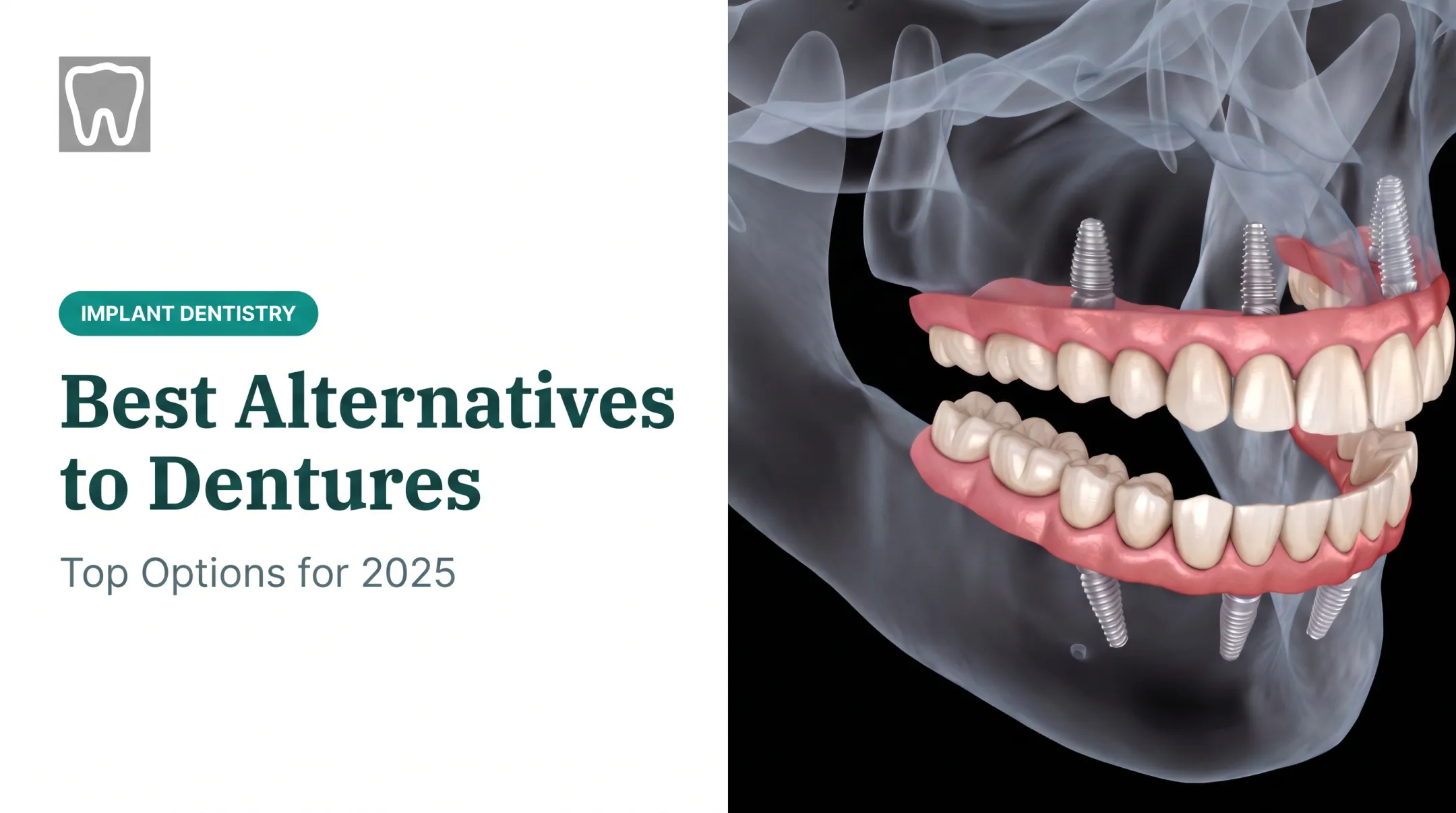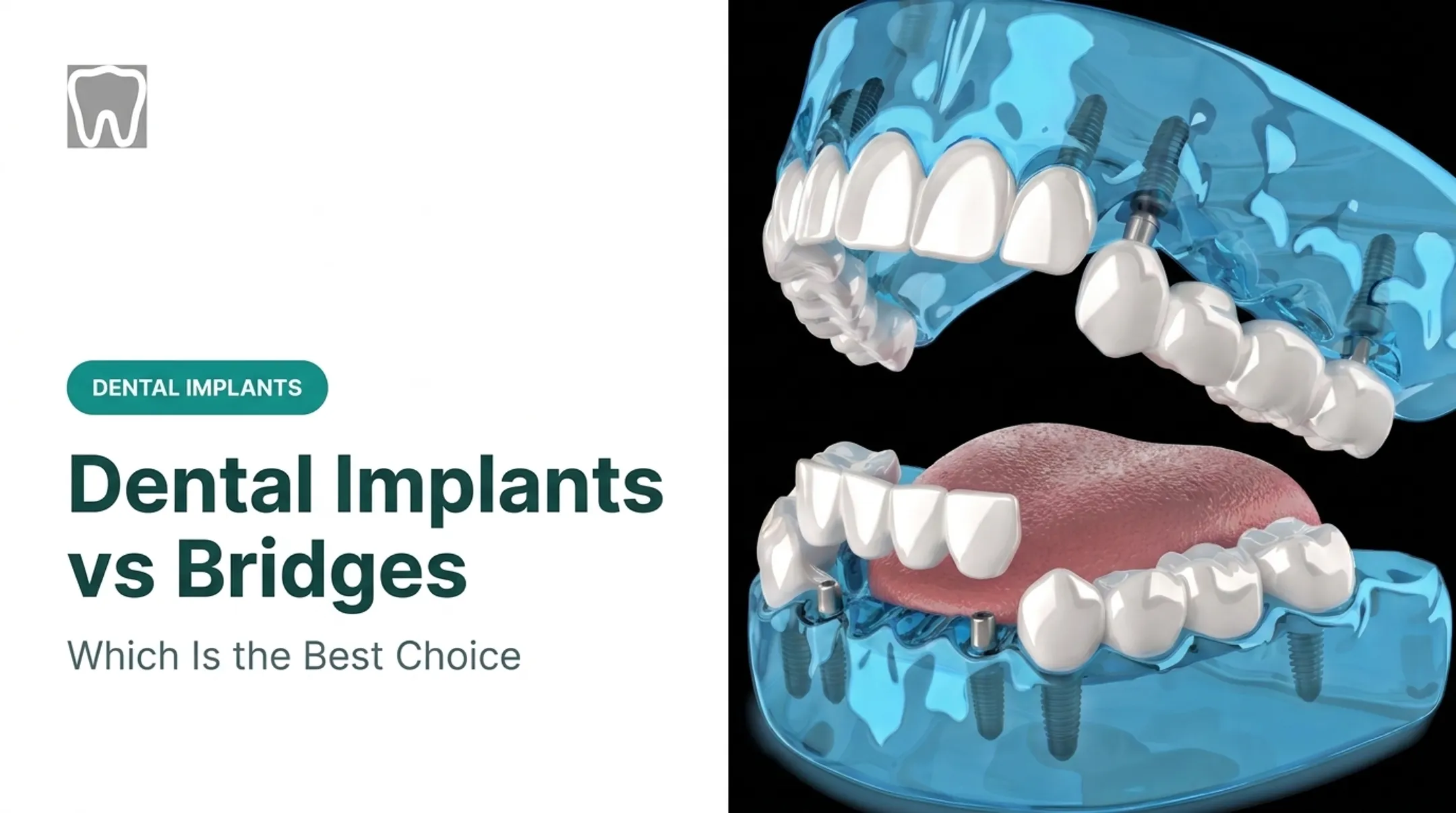

That's pushed more patients to ask what else is out there. Today's alternatives range from single implants to fixed full-arch solutions that don't move, click, or require adhesive.
This guide breaks down the top denture alternatives, what they cost, and how to figure out which one actually fits your situation.
Key Takeaways
- Traditional dentures often slip, cause gum sores, and accelerate jawbone loss over time
- Implants, overdentures, All-on-4 and All-on-6, and the 3-ON-8™ protocol restore secure chewing and help preserve jawbone
- Costs range from a few thousand dollars to $20,000+, driven mainly by whether you choose removable or fixed treatment
- Match your option to bone density, budget, and whether you need a removable or fixed restoration
Overview of Denture Alternatives in Modern Dentistry
"Denture alternatives" generally means fixed or implant-supported prosthetics that replace the need for a removable plate entirely — or at least stabilize it.
Implant dentistry has made these more accessible. Between 1999 and 2016, implant use among U.S. adults with missing teeth jumped from 0.7% to 5.7%, a roughly 14% annual increase.
Part of that growth comes from cross-border care. Clinics in Mexico, particularly in Los Algodones, have made full-arch implant treatment financially reachable for patients from the U.S. and Canada who'd otherwise be priced out.
Below, we rank the top alternatives by stability, comfort, longevity, and cost-effectiveness.
Top Alternatives to Dentures
Dental Implants in Mexico (All-on-4, All-on-6, 3-ON-8™)
Dr. José Moguel's clinic in Los Algodones, Baja California, has placed over 17,000 implants across 38+ years of practice. As a board-certified periodontist, he offers full-arch implant solutions as permanent, fixed replacements for removable dentures.
His patented 3-ON-8™ protocol uses eight implants and three independent zirconia bridges per arch.
What sets this apart:
- Lifetime warranty on implant screws
- FDA-approved materials from Nobel Biocare, Straumann, and MegaGen
- 3D Cone Beam CT imaging and an in-house CAD/CAM lab
- Savings of roughly 60-70% versus comparable U.S. treatment
| Best For | Patients wanting a permanent, fixed full-arch solution instead of removable dentures |
| Technology | 3D Cone Beam CT imaging, digital scanning, in-house CAD/CAM lab |
| Cost Advantage | 60-70% lower than U.S. pricing, with free consultations and travel support |

One patient, a retired veteran who'd worn slipping acrylic dentures for over a decade, made the switch to All-on-4 and finally stopped dealing with chronic gum sores from shifting plates.
Traditional Dental Implants (Single Tooth)
A single implant is a titanium post that fuses with your jawbone, replacing the root of one missing tooth. It functions independently, with no impact on neighboring teeth (unlike a bridge).
Long-term data backs this up: one review found 97.2% survival at 5 years and 95.2% at 10 years for implants supporting single crowns (Jung et al., 2012).
| Key Features | Preserves bone, functions like a natural tooth |
| Considerations | Full treatment often takes several months; requires adequate bone density, sometimes with grafting first |
| Best For | Single missing tooth replacement |
Implant-Supported Overdentures (Snap-In Dentures)
These anchor a removable denture to 2-4 implants and improve retention over a conventional plate. Patients can still pop them out nightly for cleaning, but chewing capacity can increase by up to 300% compared to traditional dentures.
| Key Features | Removable yet stable, helps preserve jawbone density |
| Considerations | Requires nightly removal; attachment components need periodic replacement |
| Best For | Patients wanting more stability without the cost of a fixed full-arch |
In Mexico, this treatment runs $3,500-$5,500, compared to $10,000-$14,000 in the U.S.
All-on-4 / All-on-6 Fixed Full-Arch Implants
A fixed prosthesis anchored by four or six implants per arch. All-on-4 works well for patients with lower bone density, while All-on-6 offers extra anchoring for those who want it — though it may require more available bone.
A 2011 study on All-on-4 reported 98.1% implant success at 5 years and 94.8% up to 10 years, with prosthesis survival at 99.2% over the same period (Malo et al., 2011).
| Key Features | Fixed, non-removable; same-day temporary teeth often possible |
| Considerations | Recovery runs 3-5 months; All-on-6 may need bone grafting or a sinus lift |
| Best For | Patients with significant tooth loss seeking a permanent fixed solution |

Maggie K., a patient from Calgary, got a fixed upper All-on-6 zirconia bridge and described it as natural-looking and completely secure — saving over 65% versus Canadian quotes.
Flexible Partial Dentures / Resin-Bonded (Maryland) Bridges
For patients missing just a few teeth, flexible nylon partials or wing-bonded Maryland bridges skip surgery altogether. They're cheaper upfront but not built for heavy chewing zones.
A meta-analysis of over 2,300 resin-bonded bridges found survival dropped from 91.4% at 5 years to 82.9% at 10 years, with debonding in 15% of cases within the first five (Thoma et al., 2017).
| Key Features | Comfortable, natural-looking; no metal clasps (flexible) or minimal tooth alteration (Maryland) |
| Considerations | Less durable long-term than implants; not ideal for molars or heavy chewing |
| Best For | Patients wanting a non-surgical, lower-cost interim or cosmetic fix |

How We Chose the Best Denture Alternatives
We evaluated each option on stability, longevity, cost transparency, and clinical track record rather than marketing claims. That means looking at actual survival data over 5 to 10 years or more, beyond what a brochure promises.
Common mistakes patients make:
- Choosing based on price alone, without factoring in bone health
- Skipping verification of provider certification and credentials
- Underestimating long-term maintenance needs (attachment replacement, relining, follow-ups)
- Assuming all "implants" are equal, regardless of materials or technique
A proper evaluation, including bone density imaging, should come before any treatment decision.
Cost Comparison: Denture Alternatives at a Glance
| Option | Mexico Price Range | U.S. Price Range |
|---|---|---|
| Single-tooth implant | $750-$1,500 | $3,000-$4,500 |
| Implant-supported overdenture | $3,500-$5,500 | $10,000-$14,000 |
| All-on-4 (per arch) | $8,000-$12,000 | $24,000-$30,000 |
| All-on-6 (per arch) | $12,000-$16,000 | $28,000-$36,000 |
| 3-ON-8™ Protocol | $16,000-$20,000 | Not commonly offered in U.S. |

Alternatives cost more upfront than a basic denture. But over 15-20 years, factoring in relines, replacements, and adjustments that a conventional denture typically needs, fixed implant options often prove more cost-effective long term.
Conclusion
There's no single "best" denture alternative. The right choice depends on your bone health, budget, and whether a fixed or removable solution fits your lifestyle.
A patient with strong jawbone density and a larger budget may be a strong candidate for the 3-ON-8™ protocol. Someone with more bone loss may do better starting with an overdenture.
Get a professional evaluation, including a 3D scan and bone density assessment, before committing to any treatment plan. Dr. Moguel's clinic in Los Algodones offers a free, no-obligation consultation to walk through implant-based alternatives suited to your case.
Frequently Asked Questions
What is the least expensive way to get dentures?
Flexible or acrylic partials and dental school clinics tend to offer the lowest upfront cost. Keep in mind they trade durability and stability for that lower price point.
How can I afford dental implants?
Financing plans, help with insurance appeals for partial reimbursement, and cross-border treatment in Mexico can cut out-of-pocket costs by 60-70% compared with U.S. pricing.
What are the best alternatives to dentures?
Top options include single-tooth implants, implant-supported overdentures, All-on-4/6 full-arch implants, and resin-bonded bridges. Each suits a different combination of missing teeth, bone health, and budget.
What are fake teeth called that aren't dentures?
Terms include implants (permanent tooth-root replacements), bridges (fixed replacements anchored to nearby teeth), flippers (temporary removable partials), and veneers (cosmetic shells, not tooth replacements).
What is the newest type of dentures?
Digital and 3D-printed dentures, designed using CAD/CAM technology, have shown better retention, comfort, and fewer appointments than conventional dentures in recent studies.
Are there silicone dentures available for people with no teeth?
Not exactly. Flexible nylon or soft-liner materials are used for comfort, not silicone specifically. For patients wanting more permanent stability, implant-supported options remain the sturdier choice.