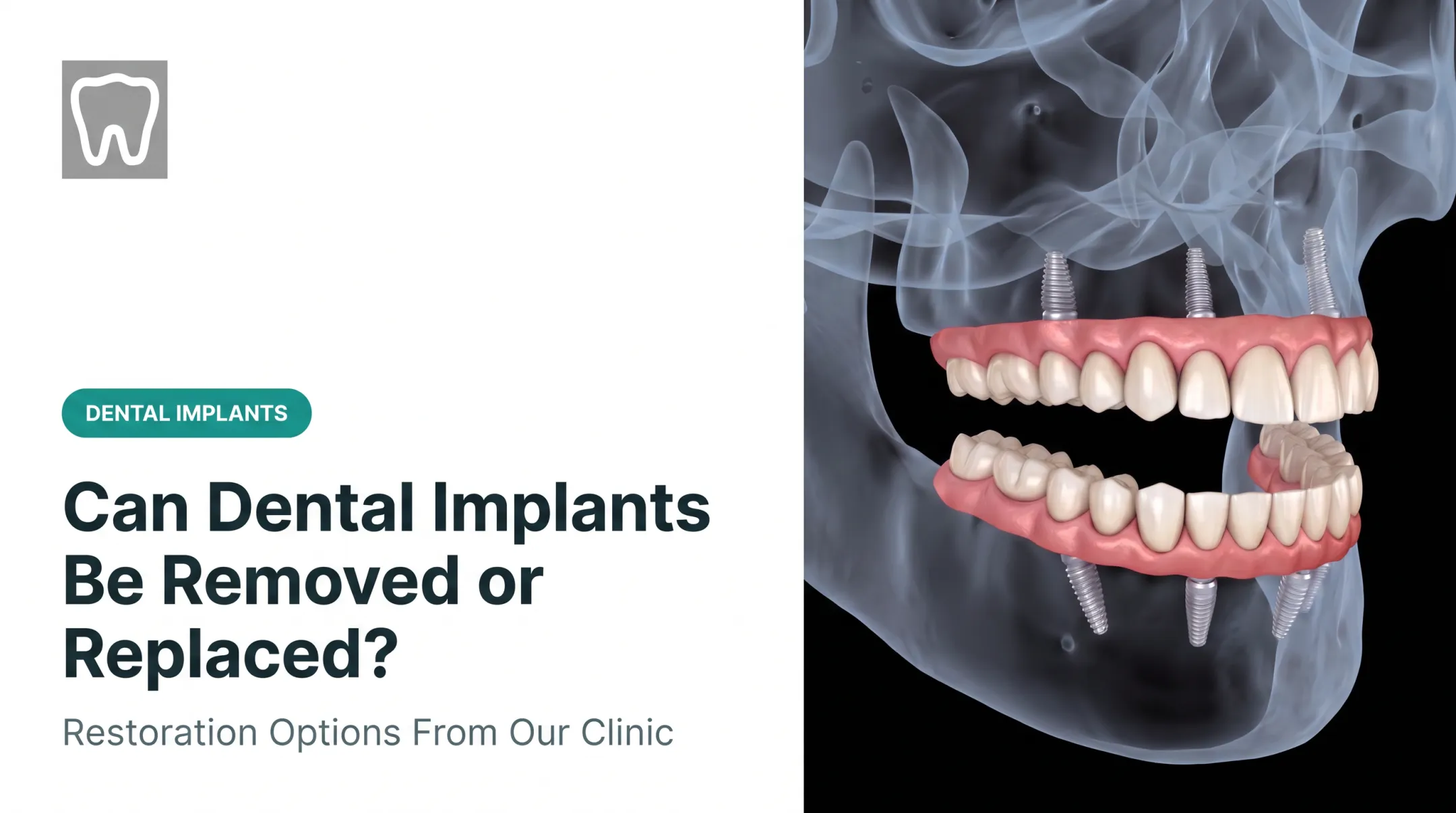

Here's the good news: implants can last decades, often a lifetime, when placed correctly and cared for well. The catch is that "the implant" and "the crown on top of it" are two different things with two different timelines. Materials matter too, and so does who's holding the drill.
Dr. José Moguel, a board-certified periodontist who has placed more than 17,000 implants over 38 years, sees this distinction play out daily at his Los Algodones practice. His perspective on what separates a 30-year implant from a failed one grounds everything below.
Key Takeaways
- Titanium implant posts can last 20+ years or a lifetime; crowns usually need replacement every 10–15 years
- Clinical studies show 96.4% implant survival at the 10-year mark when placed properly
- Smoking nearly doubles implant failure risk; bruxism raises it too
- Daily hygiene and twice-yearly checkups do the most to protect implant lifespan
- A board-certified, high-volume specialist significantly lowers your failure risk
How Long Do Dental Implants Last? The Real Timeline
An implant has two parts, and they age differently.
The titanium post fuses to your jawbone through a process called osseointegration. Once that bond forms, it's designed to last decades—often a lifetime. A 2019 systematic review found 96.4% implant-level survival at 10 years. A 2021 cohort tracking nearly 11,000 implants for up to 22 years reported 96.8% survival at 10 years and 94.0% at 15 years.
The crown is a different story. It's the part doing the chewing, so it wears down. A 2008 review found implant-supported crowns had 94.5% five-year survival, compared to 96.8% for the implants underneath them. Your post might outlast three or four crowns.
Full-Arch Solutions Play by Different Rules
Full-mouth restorations distribute forces differently than a single tooth:
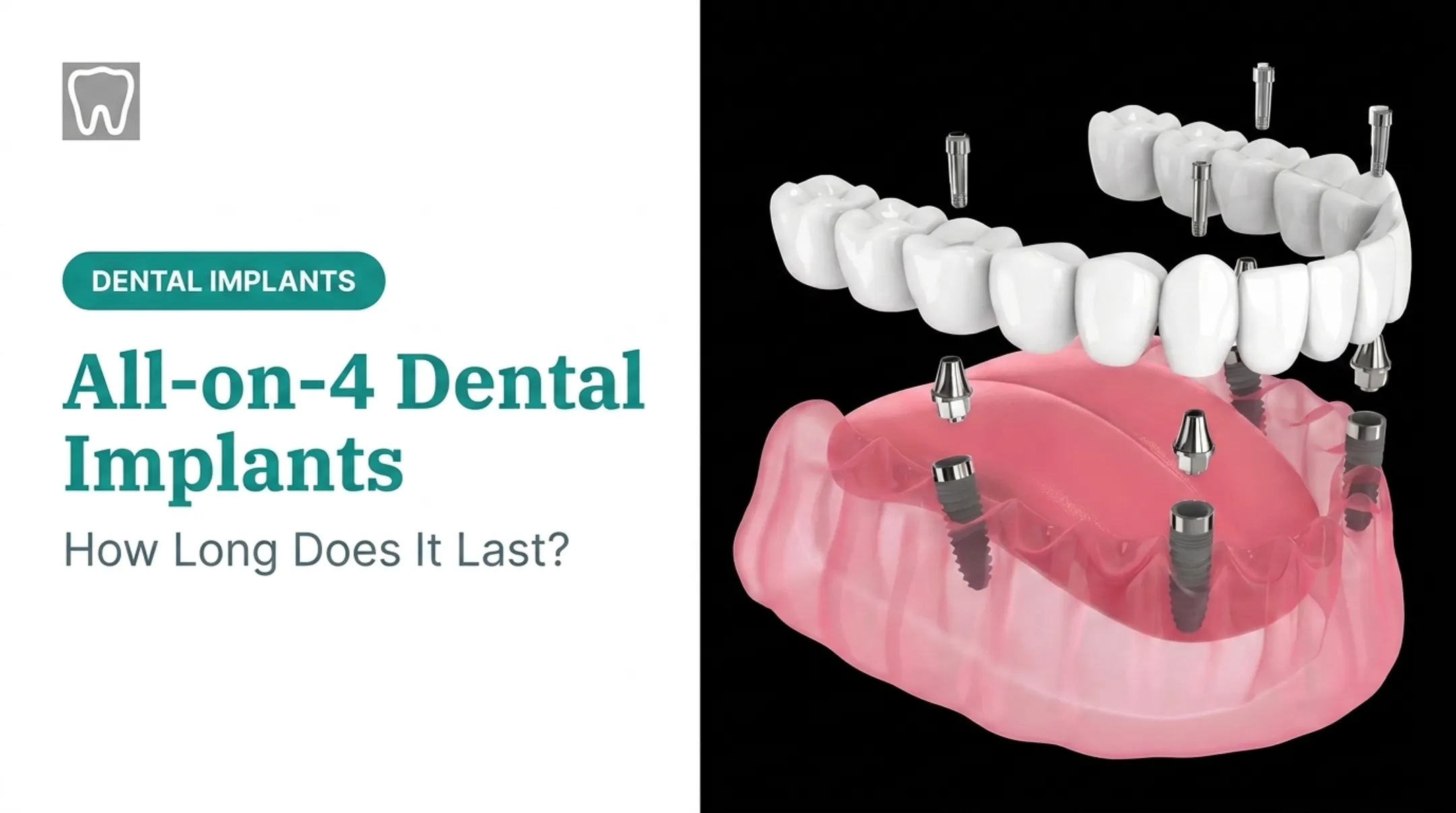
- All-on-4 uses four implants per jaw to support a fixed arch
- All-on-6 uses six implants for added stability, often in cases with more bone loss
- 3-ON-8™, Dr. Moguel's patented protocol, uses eight implants supporting three independent bridges instead of one continuous arch
That segmented 3-ON-8™ design matters for longevity: if one section develops an issue, only that bridge needs attention. The other two stay in place and keep working normally.
Materials matter too. Premium FDA-approved systems such as Nobel Biocare, Straumann, and MegaGen use grade-5 titanium and zirconia backed by decades of clinical research. Dr. Moguel's clinic uses these systems and reports a 98%+ clinical success rate across his case volume, above the commonly cited international average of 95–97%.

What Determines Whether Your Implant Lasts Decades or Fails Early
Bone Health and Osseointegration
Your jawbone needs enough density and volume to form a stable bond with the implant. Thin or resorbed bone often means grafting or a sinus lift is needed first. When grafting is skipped or an implant goes into inadequate bone, early failure becomes far more likely.
Lifestyle and Health Factors
These are the risk factors within your control:
- Smoking — a 2021 meta-analysis found smokers face 2.4 times higher implant-failure risk and 0.58 mm more bone loss around the implant
- Bruxism (teeth grinding) — people who grind their teeth show over double the failure odds of non-grinders
- Uncontrolled diabetes — not an automatic disqualifier, but poor glucose control correlates with more bone loss around implants
- Poor oral hygiene — biofilm buildup is the leading cause of peri-implantitis, the infection that eats away at supporting bone
Surgeon Experience and Technology
Placement precision matters as much as biology. Studies tracking outcomes by clinician experience level found survival rates climbing from 88.6% for first-year residents to 94.2% by year three, and that gap widens further with decades of practice.
Dr. Moguel's approach relies on 3D Cone Beam CT imaging for every case, mapping bone density, nerve pathways, and sinus location before a single incision is made. That planning discipline underpins his results across more than 17,000 placements.

Age and Medical Conditions
Can you get implants at 70? Age alone isn't the barrier people assume. A 2025 review found patients over 75 had 96.8% five-year survival, comparable to or better than younger cohorts. What actually matters:
- Overall healing capacity
- Bone quality (not just quantity)
- Conditions like osteoporosis or immune disorders, which require careful case-by-case evaluation rather than blanket exclusion
How to Maximize the Lifespan of Your Dental Implants
Simple habits do most of the heavy lifting here:
- Brush twice daily with a soft-bristled brush, cleaning carefully around the implant collar
- Floss or use interdental brushes daily; food trapped near the gumline raises peri-implantitis risk
- Schedule professional cleanings every 3–6 months, based on your risk profile
- Avoid using teeth as tools, and skip very hard or sticky foods that stress the crown
- Wear a night guard if you grind; it reduces overload damage to the implant and crown
- Book annual implant checkups so bone loss or early infection is caught before it threatens the fixture

Skipping that last step is where most preventable failures happen. Peri-implantitis stays quiet early on. Pain usually means the problem has already moved past the easiest stage to treat.
Implants vs. Other Tooth Replacement Options: A Longevity Comparison
| Option | Typical Lifespan | Key Trade-off |
|---|---|---|
| Complete dentures | ~10 years on average | Requires relining/replacement as jawbone shifts |
| Tooth-supported bridges | Roughly 79-82% survival at 10 years | Relies on healthy adjacent teeth for support |
| Dental implants (fixture) | 96%+ at 10-15 years | Higher upfront cost, longer treatment timeline |
Beyond raw lifespan, implants stimulate the jawbone every time you chew, similar to a natural tooth root. Dentures don't do this, so jawbone resorption tends to accelerate under a denture over time. Long-term studies show implant-supported restorations lose less bone each year than conventional dentures.

Can a Failed or Old Implant Be Replaced?
Yes, in most cases. A 2024 literature review found replacement implants achieved 86.3% survival at 1-5 years after a failed one was removed. Those are solid odds, though survival drops with each subsequent replacement attempt.
How many times can an implant be replaced? As long as sufficient healthy bone remains, multiple replacements are possible. Each round may require grafting first, since bone often needs 3-6 months to rebuild before a new implant can be placed securely.
Can all your teeth be replaced with implants? Full-arch options like All-on-4, All-on-6, and 3-ON-8™ replace an entire arch using a handful of strategically placed implants rather than one per missing tooth.
Whether you need a single replacement or a full-arch plan, bone quality and warranty terms decide how secure that next step is—especially if you are traveling across the border for care.
Dr. Moguel's clinic includes a lifetime warranty on implant hardware: if a placed implant fails, it is replaced at no cost. 3D CBCT scans confirm bone adequacy before any new fixture goes in, so replacement decisions rest on clear imaging rather than guesswork.
Frequently Asked Questions
How many times can a dental implant be replaced?
Multiple times, provided enough healthy bone remains at the site. Repeated failures typically require grafting and a closer look at the underlying cause before trying again.
Can all my teeth be replaced with dental implants?
Yes. Full-arch solutions like All-on-4, All-on-6, or 3-ON-8™ use a small number of strategically placed implants to support an entire arch of replacement teeth.
Can I get dental implants at age 70?
Age alone doesn't disqualify anyone. What matters is bone quality, healing capacity, and overall health — many patients in their 70s and beyond receive implants successfully.
What's the difference between the implant and the crown in terms of lifespan?
The titanium post is designed to last decades or a lifetime once integrated with bone. The crown on top typically needs replacement after 10-15 years due to normal wear.
How do I know if my dental implant is failing?
Watch for pain when chewing, looseness or mobility, swelling, bleeding, or pus around the gumline. Any of these warrants a prompt professional evaluation, not a wait-and-see approach.
Does where I get my implant placed affect how long it lasts?
Significantly. Provider experience, use of advanced imaging like 3D CBCT, and the quality of implant materials all directly influence how long the result lasts.