
Choosing the wrong type can mean a crown that never quite looks natural, gum tissue that recedes, or a screw that keeps loosening. Understanding your options helps you have a smarter conversation with your treatment team.
This article covers what an abutment does, why the type matters, the main categories available, and how specialists decide which one fits your case.
TL;DR
- An abutment connects the implant fixture in your jawbone to the final crown, bridge, or denture
- Types vary by material (titanium, zirconia), fabrication (stock vs. custom), and angulation (straight vs. angled)
- The right choice depends on tooth location, gum thickness, aesthetics, and bite force
- Board-certified specialists use imaging and digital scanning to match the abutment to your anatomy
What Is a Dental Implant Abutment?
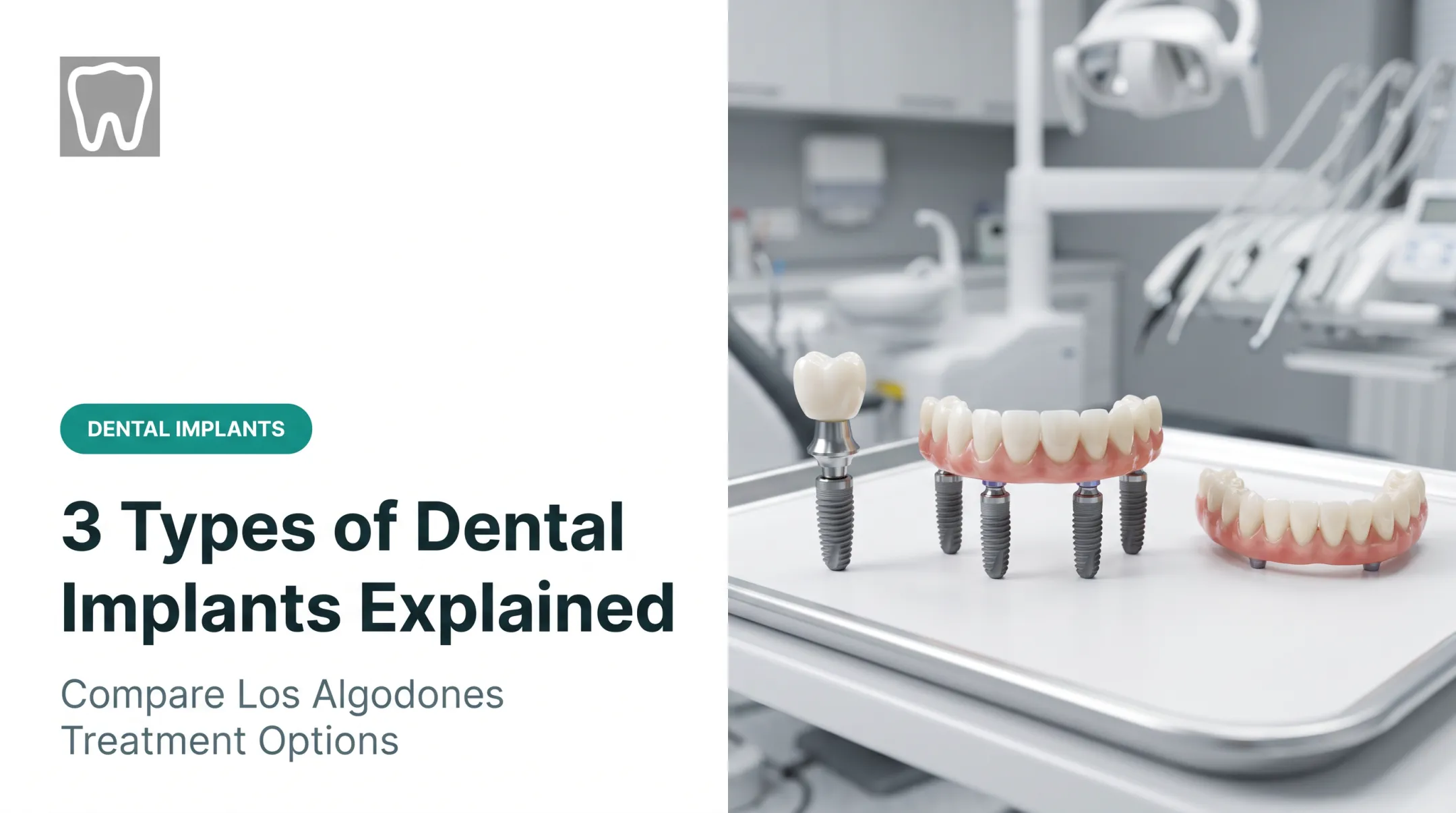
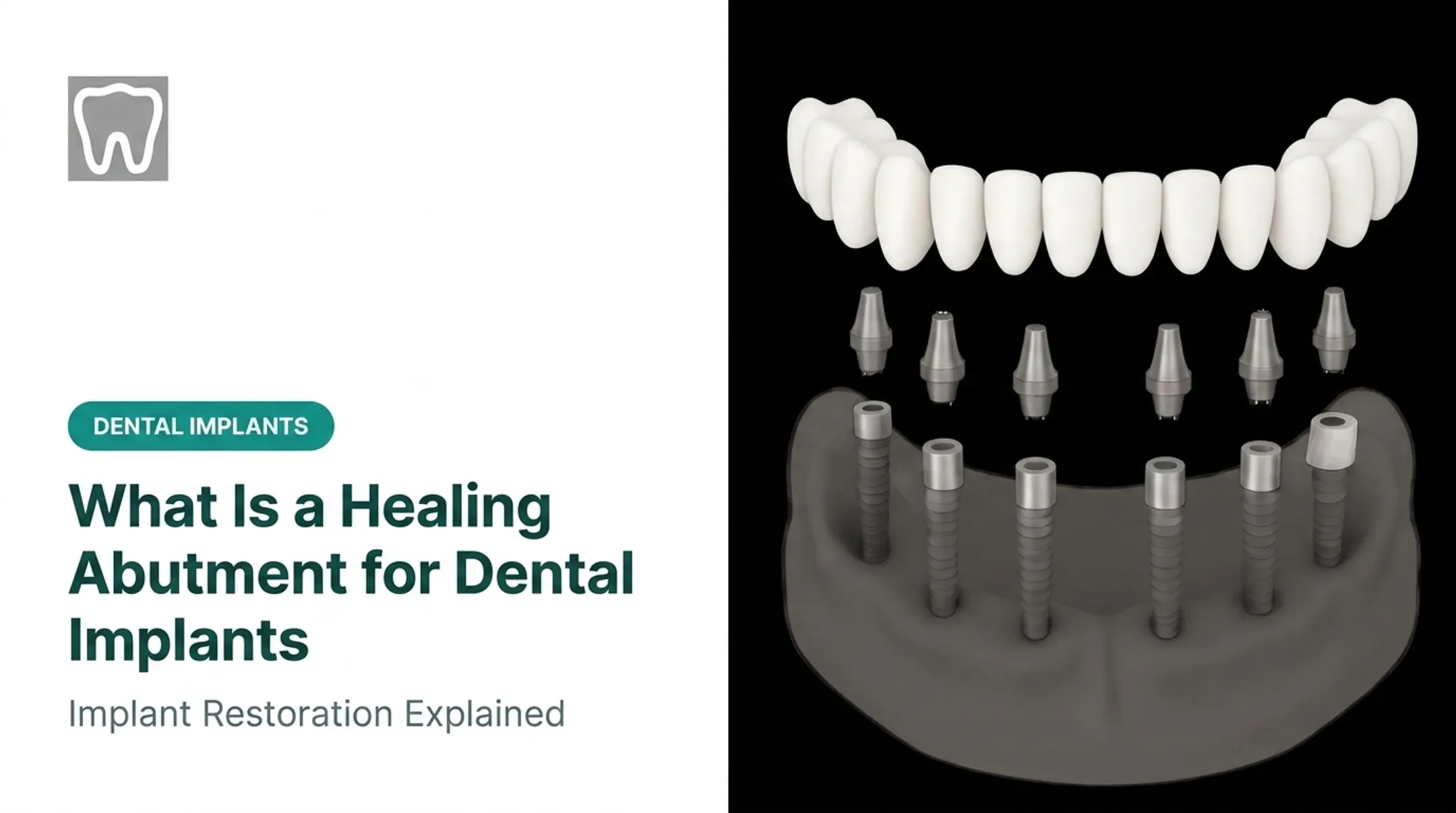
An abutment is the connector piece attached to the top of your implant post once healing is underway. It supports the crown, bridge, or denture that sits above the gumline. The American Academy of Implant Dentistry describes it as the attachment placed on a healed implant to provide the base for the replacement tooth. It may be added at a later surgical step or during the original surgery, typically under local anesthesia. Think of it as the bridge between two phases of treatment: the surgical placement of the implant, and the restorative work that gives you a functioning, natural-looking tooth. It sits at or just above the gumline. Abutments appear across nearly every kind of implant case:
- Single-tooth replacements
- Multi-unit bridges
- Full-arch restorations, such as All-on-4, All-on-6, or the 3-ON-8™ protocol Its design directly shapes how your final restoration fits and looks.

Why Is the Right Abutment Important in Implant Dentistry?
Abutment selection isn't a minor detail. It affects fit, how the gum tissue shapes around the restoration, bite alignment, and how natural the final tooth looks.
Get it wrong, and problems can follow:
- Bone impingement from improper sizing or angulation
- Gum recession, especially with metal abutments in thin tissue
- Screw loosening under repeated bite forces
- Unnatural emergence profile, where the tooth doesn't blend with the gumline
A 2022 systematic review found that emergence angles above 30 degrees were associated with higher rates of peri-implantitis — 31.3% versus 15.1% at shallower angles. The evidence is still considered weak and observational, but it reinforces that contour and angulation deserve careful planning, not guesswork.

This is why treatment planning by an experienced, board-certified specialist matters. At Dental Implants in Mexico, every patient receives a 3D CBCT scan before surgery. Dr. José Moguel uses that three-dimensional view of bone density and nerve pathways to plan implant position and abutment angulation accurately.
Once the implant integrates, a digital scan of the mouth guides design of the abutment and the crown that sits on it.
Types of Dental Implant Abutments
Abutments aren't one-size-fits-all. They're categorized by material, how they're made, when they're placed, and their angle. The right type depends on where the tooth sits, how visible it is, how thick the gum tissue is, and how much bite force it needs to handle.
Stock (Prefabricated) Abutments
Stock abutments are mass-produced connectors available in standard shapes and sizes for common implant systems. There's no custom design involved. They rely on pre-set dimensions rather than an individual scan of your mouth.
A 2024 prospective cohort study following 64 patients for one year found no significant clinical difference between stock and custom titanium abutments, with both groups reporting 100% survival and success rates.
Best suited for: posterior teeth and standard cases where extensive customization isn't critical.
- Lower cost
- Immediate availability
- Proven track record
Limitation: may not achieve the ideal fit or emergence profile needed in aesthetic zones, like front teeth.
Custom Abutments
Custom abutments are individually designed and milled based on digital scans of your implant position and gum contour. Rather than a generic shape, CAD/CAM technology builds a patient-specific fit.
At Dental Implants in Mexico, one anterior implant case used digital scans taken around month four of healing. The team then fabricated a custom solid zirconia abutment paired with a translucent ceramic crown for a natural front-tooth result.
Best suited for: front teeth and cases demanding a natural emergence profile.
- Superior aesthetics
- Optimal angulation for your specific anatomy
- Better long-term tissue health
Limitation: higher cost and added lab/design time compared to stock options.
Titanium Abutments
Titanium abutments are metal connectors valued for strength and biocompatibility. They prioritize mechanical durability over aesthetics.
A review of multiple systematic reviews found no significant overall survival difference between titanium and zirconia abutments, but titanium held up better mechanically in posterior, higher-force situations.
Best suited for: back teeth and patients with strong bite forces or grinding habits.
- Proven durability
- High biocompatibility
- Cost-effective
Limitation: possible gray show-through in thin gum tissue near the front of the mouth.
Zirconia Abutments
Zirconia abutments are tooth-colored ceramic connectors built for natural aesthetics. They prioritize translucency and color-matching over raw mechanical strength.
Best suited for: front teeth, thin gum tissue, and patients with metal sensitivities.
- Natural appearance with no metal show-through
- Good biocompatibility
- Better optical results where soft tissue is visible
Limitation: can be more brittle under heavy bite forces than titanium in select cases, and lab studies show more wear at the connection interface under repeated loading.

Angled Abutments
Angled abutments come with built-in angle correction to compensate for implants placed off-axis due to bone anatomy. Rather than sitting straight on the implant, they correct alignment issues created by limited bone availability.
A 2011 review in the Journal of the American Dental Association found no significant reduction in prosthesis longevity or increased screw loosening tied to angled abutments, though higher angulation does increase mechanical stress.
In All-on-4 cases, this shows up directly: the two posterior implants are commonly tilted roughly 45 degrees to bypass the sinus cavity or mental nerve. This approach can reduce or eliminate the need for bone grafting in patients with moderate bone loss.
Best suited for: full-arch restorations and cases where bone limitations required angled implant placement.
Limitation: added planning complexity and slightly higher cost than straight abutments.
Healing (Temporary) Abutments
Healing abutments are short-term caps placed right after implant surgery to shape gum tissue during healing. They're not a final restorative piece. They're used only during osseointegration.
Timelines vary by case type:
- Single-tooth implants: osseointegration typically takes 3–4 months before the permanent abutment is placed
- Full-arch (All-on-4): temporary bridge often fitted the same day; permanent restoration in 3–6 months
- Full-arch (3-ON-8™): permanent restorations typically follow in 4–6 months

Key strength: guides proper gum contour and protects the implant during healing.
Limitation: must be replaced with a permanent abutment before the final crown goes on.
How to Choose the Right Type of Abutment
The right abutment depends on your specific case, not popularity or lowest cost. Specialists weigh several factors together:
- Tooth location and visibility — front teeth generally call for custom or zirconia options; back teeth tolerate stock or titanium
- Gum tissue thickness and health — thin tissue favors zirconia to avoid gray show-through
- Bite force and grinding habits — heavier forces favor titanium's mechanical strength
- Budget and insurance coverage — stock abutments cost less upfront; custom options can improve long-term fit
- Case complexity — single tooth, multiple units, or full-arch reconstruction (All-on-4, All-on-6, 3-ON-8™) each carry different requirements
Once those factors are clear, board-certified specialists use imaging to lock in the choice. Dr. José Moguel, with over 38 years of clinical experience and more than 17,000 implants placed, uses 3D CBCT scanning to evaluate bone density and plan implant position before selecting an abutment.
Digital scans after implant integration then guide final abutment and crown design.
What to Check Before Finalizing an Abutment Type
Before signing off on a treatment plan, a few checks protect both your wallet and your long-term results:
- Don't default to the most expensive option. A simpler stock abutment often performs just as well for posterior teeth.
- Ask about maintenance. Different materials affect how easily you can clean around the restoration and maintain gum health.
- Check your clinician's credentials. Abutment fit directly impacts how long your implant lasts, so experience matters.
- Confirm pricing structure. Ask whether the abutment is bundled or billed separately. At Dental Implants in Mexico, single-tooth packages of $750–$1,500 USD typically include the implant, abutment, and crown.
One documented case totaled $1,350 for a custom zirconia abutment and ceramic crown, versus a $4,800 U.S. quote. Still verify exact materials and scope with a personalized cost assessment—not general ranges alone.
Conclusion
The abutment might be small, but it determines how your implant looks, feels, and functions for years to come. Stock or custom, titanium or zirconia, straight or angled — each type solves a different clinical problem.
Getting this decision right starts with a specialist who evaluates your bone, gum tissue, and bite before recommending a path forward. At Dental Implants in Mexico, board-certified periodontist Dr. José Moguel uses that full clinical picture to match abutment type to your anatomy and build a personalized plan that holds up long term.
Frequently Asked Questions
How long after implant do you get abutment?
Abutment placement typically happens 3 to 6 months after implant surgery, once imaging confirms osseointegration. Some full-arch cases allow a temporary abutment or bridge on the same day as surgery.
Do all dental implants need abutments?
Nearly all crown, bridge, and denture restorations require an abutment. The rare exception is a one-piece implant, which combines the post and abutment into a single unit.
How painful is the abutment on an implant?
Abutment placement is done under local anesthesia and is generally less invasive than the implant surgery itself. Expect mild soreness for a few days afterward.
Can you eat with implant abutment?
Stick to soft foods for the first few days after placement. Most patients return to a normal diet within about a week as the gum tissue heals.
What's the difference between titanium and zirconia abutments?
Titanium offers superior mechanical strength and is cost-effective for back teeth. Zirconia provides natural, tooth-colored aesthetics better suited to front teeth and thin gum tissue.
Can an abutment be replaced if needed?
Yes. A specialist can remove and replace an abutment if it becomes loose, damaged, or if a different type is needed for aesthetic reasons.