
The final price depends on how many implants you need, what materials go into your new teeth, and whether extractions or bone grafting come first. Someone with strong jawbone density needing four implants pays far less than someone who needs sinus lifts, grafting, and eight implants per arch.
This guide breaks down full-mouth implant pricing by treatment type, the factors that move your quote up or down, and how patients are cutting costs by 60-70% through board-certified care in Los Algodones, Mexico.
Key Takeaways
- Full-mouth implant costs differ by option: implant-supported dentures, All-on-4/6, or the 3-ON-8™ protocol
- Materials, implant count, and add-ons like bone grafting can shift your final price substantially
- Mexico care with a board-certified periodontist can cut costs by roughly 60-70% versus US pricing
- Financing, insurance documentation support, and free consultations lower the barrier to starting treatment
How Much Does a Full Set of Teeth Implants Cost? (Pricing Overview)
There's no single "full set of implants" price. Your cost depends entirely on which solution fits your clinical needs and treatment goals.
Common misunderstandings that throw off budgets:
- Assuming a per-implant price multiplied by eight equals the total cost (materials and labor don't scale linearly)
- Assuming extractions and sedation are included when they're often extra
- Underestimating what the final restoration material costs on top of the implants themselves
Typical Cost Ranges
Here's how full-arch treatments typically price out in the US:
| Treatment | US Range (per arch/treatment) |
|---|---|
| Implant-supported dentures | $10,000–$14,000 |
| All-on-4 fixed bridge | $24,000–$30,000 |
| All-on-6 fixed bridge | $25,000–$40,000 |
| Full mouth reconstruction | $45,000–$65,000 |

These figures generally cover implants, abutments, and the prosthesis itself. They typically exclude extractions, sedation, and diagnostic imaging, which get added separately once your treatment plan is finalized.
Cost of Treatment at Dental Implants in Mexico
Those US ranges are why many patients compare care across the border. Dr. José Moguel's clinic in Los Algodones offers All-on-4, All-on-6, and his patented 3-ON-8™ protocol at roughly 60–70% less than comparable US pricing.
Quotes are transparent and itemized—not vague package estimates. Mexico pricing for the same treatments typically runs:
| Treatment | Mexico Range (per arch/treatment) |
|---|---|
| All-on-4 | $8,000–$12,000 |
| All-on-6 | $12,000–$16,000 |
| 3-ON-8™ | $16,000–$20,000 |

A free, no-obligation consultation—including review of X-rays or a 3D CT scan—gives you a personalized quote before you commit.
Key Factors That Affect the Cost of Full Mouth Implants
Surgical complexity, material choice, and provider expertise all stack together to determine your final number.
Type of Treatment Chosen
Your restoration style drives a large share of the total:
- Removable implant-supported dentures cost less upfront but require more implants over time for stability
- Fixed bridges (All-on-4, All-on-6) cost more initially but function like natural teeth
- Individual implants placed tooth by tooth across a full arch add up fastest, since each tooth is priced and restored separately
Number of Implants and Bone Density
Your jawbone strength largely determines how many implants you need:
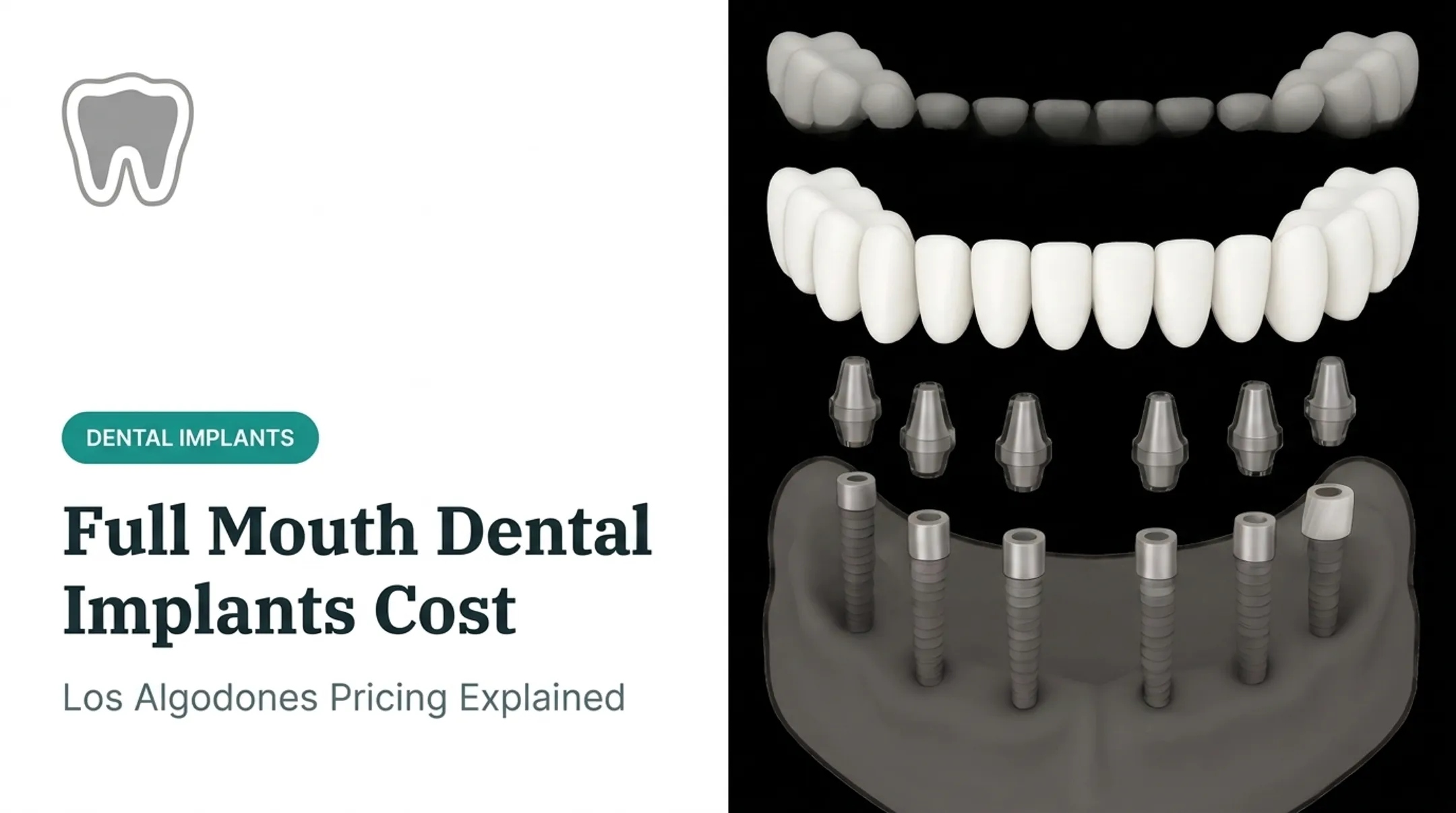
- All-on-4 uses four implants per arch
- All-on-6 uses six implants per arch, for stronger load distribution
- 3-ON-8™ uses eight implants per arch, split across three independent zirconia bridges
More implants generally means more stability, but also a higher price. Bone density often dictates which option is realistic for you.

Materials Used
Zirconia implants and restorations cost more than titanium posts or acrylic teeth, but they hold up better against chipping, cracking, and wear. Zirconia is sometimes described as "ceramic steel." You pay more now for a restoration that may last considerably longer.
Pre-Treatment Procedures
Years of missing teeth often mean bone loss, so extra procedures may be needed before implants can be placed:
- Bone grafting rebuilds width and depth in the jaw
- Sinus lifts add bone thickness for upper back implants where sinuses have expanded
These add-ons are common for patients who have lived with missing teeth for a while—not rare exceptions.
Provider Expertise and Location
A board-certified specialist using 3D Cone Beam CT imaging can plan implant placement with more precision, which matters for permanent surgery. Clinics near the US-Mexico border, including Los Algodones, offer this same American-standard technology at a fraction of US overhead costs.
Cost Breakdown: What Goes Into Your Total Investment
Your total investment covers more than the number on a billboard. Here's what typically factors in, and when.
Initial consultation and diagnostic imaging (one-time) Every patient at Dr. Moguel's clinic receives a high-resolution 3D CBCT scan rather than a basic 2D X-ray. This maps bone density in three dimensions and determines implant length, width, and position before surgery ever begins.
Extractions and preparatory procedures (one-time) When extractions, bone grafting, or sinus lifts are needed, they're priced separately from the implants themselves:
- Extractions: charged per tooth based on complexity
- Bone grafting: $500–$800 in Mexico versus $2,000–$3,500 in the US
- Sinus lifts: $600–$900 in Mexico versus $2,500–$4,000 in the US
Implant placement surgery (one-time) This is the core surgical cost : placing the titanium (or zirconia) posts into the jawbone. Sedation options factor in here too, with sedation dentistry running $300–$600 in Mexico versus $1,200–$2,000 in the US.

Temporary and final prosthetics (one-time) Many All-on-4 patients receive a temporary bridge the same day as surgery, followed by a custom permanent restoration after 3–4 months of healing and osseointegration. Material choice (zirconia versus acrylic-hybrid) drives much of the price difference at this stage.
Follow-up care and maintenance (recurring) Check-ups, adjustments, and long-term maintenance continue after the main procedure wraps up. A lifetime warranty on the implants helps offset unexpected later costs.
US Pricing vs. Getting Implants in Mexico — What's the Difference?
Overall Cost
Full mouth reconstruction in the US can reach $45,000–$65,000, and complex single-arch cases alone can climb toward $50,000. The same treatment through Dr. Moguel's clinic in Los Algodones runs $16,000–$24,000, in line with the clinic's claimed 60–70% savings versus US prices.
Quality and Materials
Reputable Mexico clinics use the same FDA-approved implant brands found in US practices, including Nobel Biocare, Straumann, and MegaGen. The technology overlap is real too: 3D Cone Beam CT imaging, digital scanning, and in-house CAD/CAM labs aren't exclusive to US clinics.
Travel and Logistics
Dr. Moguel's clinic sits roughly a three-minute walk from the Andrade, California border crossing. You'll need a valid US or Canadian passport, passport card, or enhanced driver's license to cross. For Yuma residents, appointments can often work as day trips, no hotel required. For patients traveling farther, the clinic coordinates hotel stays and shuttle assistance.
Long-Term Follow-Up
A low price means little if follow-up care disappears once you've left the country. Look for a clinic with a lifetime implant warranty and a track record spanning years, not months. Dr. Moguel's 38+ years of experience and 17,000+ implants placed reflect the kind of continuity that matters when complications or adjustments come up later.
How to Budget for Your Full Set of Teeth Implants
Budget around total treatment value, not the lowest number posted online. What you pay depends on what is included, how long the restoration lasts, and how you fund care.
- Get an itemized, personalized quote after a full exam and imaging, not a generic “starting at” figure
- Confirm what is included, such as extractions, sedation, temporary and final prosthetics, and follow-up visits
- Review financing and insurance options, including partial dental or medical coverage, clinic payment plans, and third-party financing for patients traveling for care
- Weigh long-term value: one implant investment versus replacing dentures or bridges every several years
A free consultation, sometimes done remotely with existing X-rays, is usually the fastest way to replace guesswork with real numbers.
Frequently Asked Questions
How much does a full mouth of dental implants typically cost?
It depends heavily on the treatment type. In the US, implant-supported dentures run $10,000–$14,000, while All-on-4 or All-on-6 fixed bridges run $24,000–$40,000. Mexico clinics often price the same protocols about 60–70% lower, though materials, bone needs, and provider credentials still change the final quote.
Can I get all my teeth pulled and get implants?
Yes, full-arch extraction with immediate implant placement is a common approach. Many patients receive a temporary bridge the same day as surgery, followed by a permanent restoration once healing is complete.
How many implants are needed for a full set of teeth?
Most protocols use between four and eight implants per arch. All-on-4 uses four, All-on-6 uses six, and the 3-ON-8™ protocol uses eight, depending on bone density and stability needs.
Are full dental implants worth the cost?
For many patients, yes. The higher upfront cost typically pays off through durability, natural function, and prevention of further bone loss, compared to dentures that need replacing every few years.
How do people afford full dental implants?
Common options include payment plans, third-party medical financing, partial insurance coverage, HSA/FSA funds, and treatment in Mexico at a lower cost without sacrificing quality materials or provider credentials.
Will dental implants ever be covered by insurance?
Coverage is typically partial at best, and many standard dental plans exclude implants entirely. Medical insurance may apply in specific cases involving trauma or documented medical necessity, so check your plan directly.