
Implants are constantly called the "gold standard" of tooth replacement, but that label doesn't answer the question patients actually ask: do the real-world benefits justify the cost and effort?
This article breaks down what implants actually deliver — durability, bone health, function, and lifetime value — plus how cross-border care in Los Algodones, Mexico is changing the affordability equation.
TL;DR
- Implants replace the tooth and root, offering stability and bone preservation that bridges and dentures can't match
- With proper care, implants show 94% survival at 15 years and often cost less long-term than repeated bridges or dentures
- Patients traveling to Los Algodones, Mexico get board-certified implant care at 60-70% lower cost than the US
- Bone health, gum condition, and overall health determine candidacy — implants aren't automatic for everyone
- A consultation with imaging is the only real way to know your personal cost-benefit outlook
What Are Dental Implants?
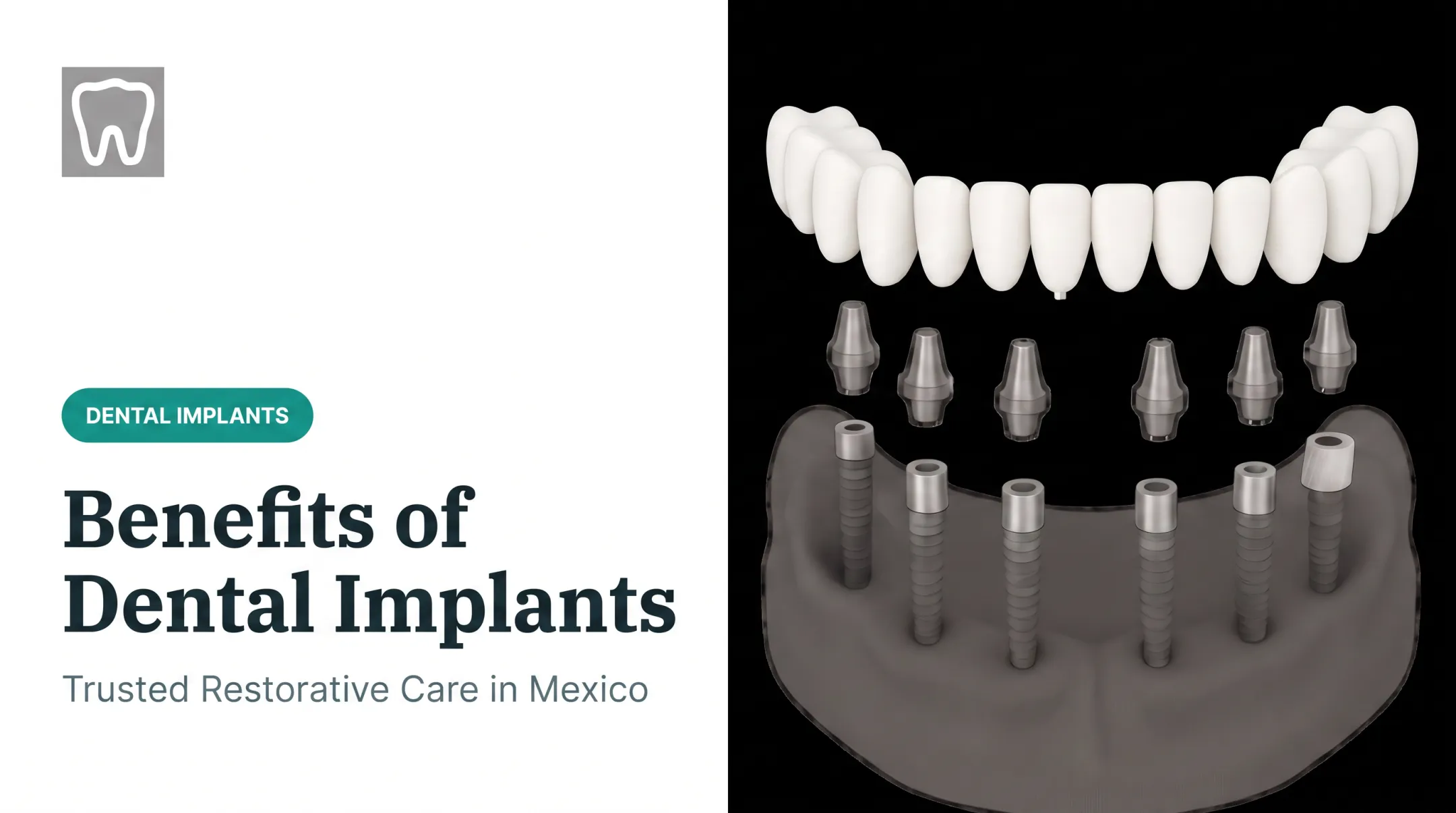
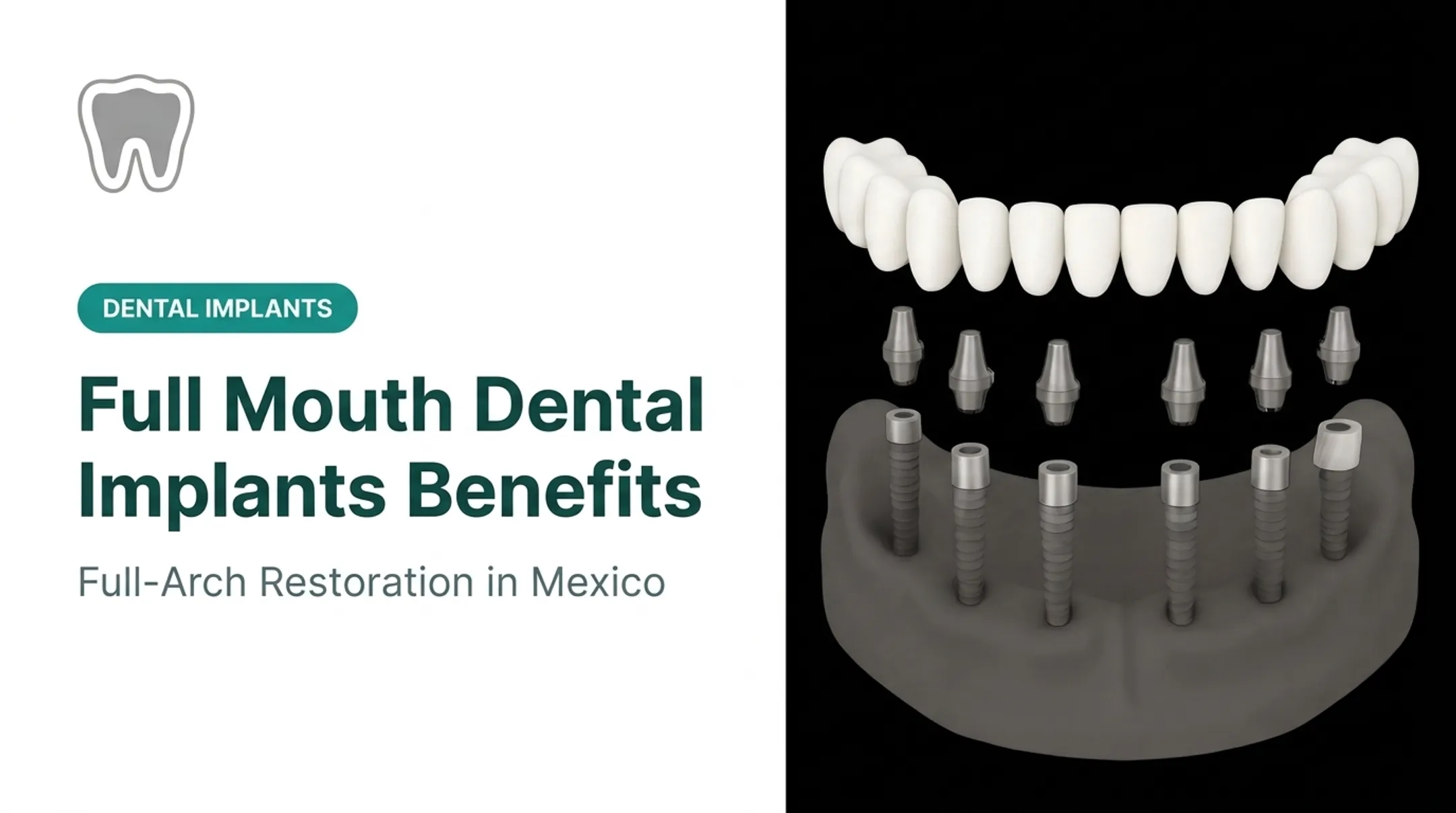
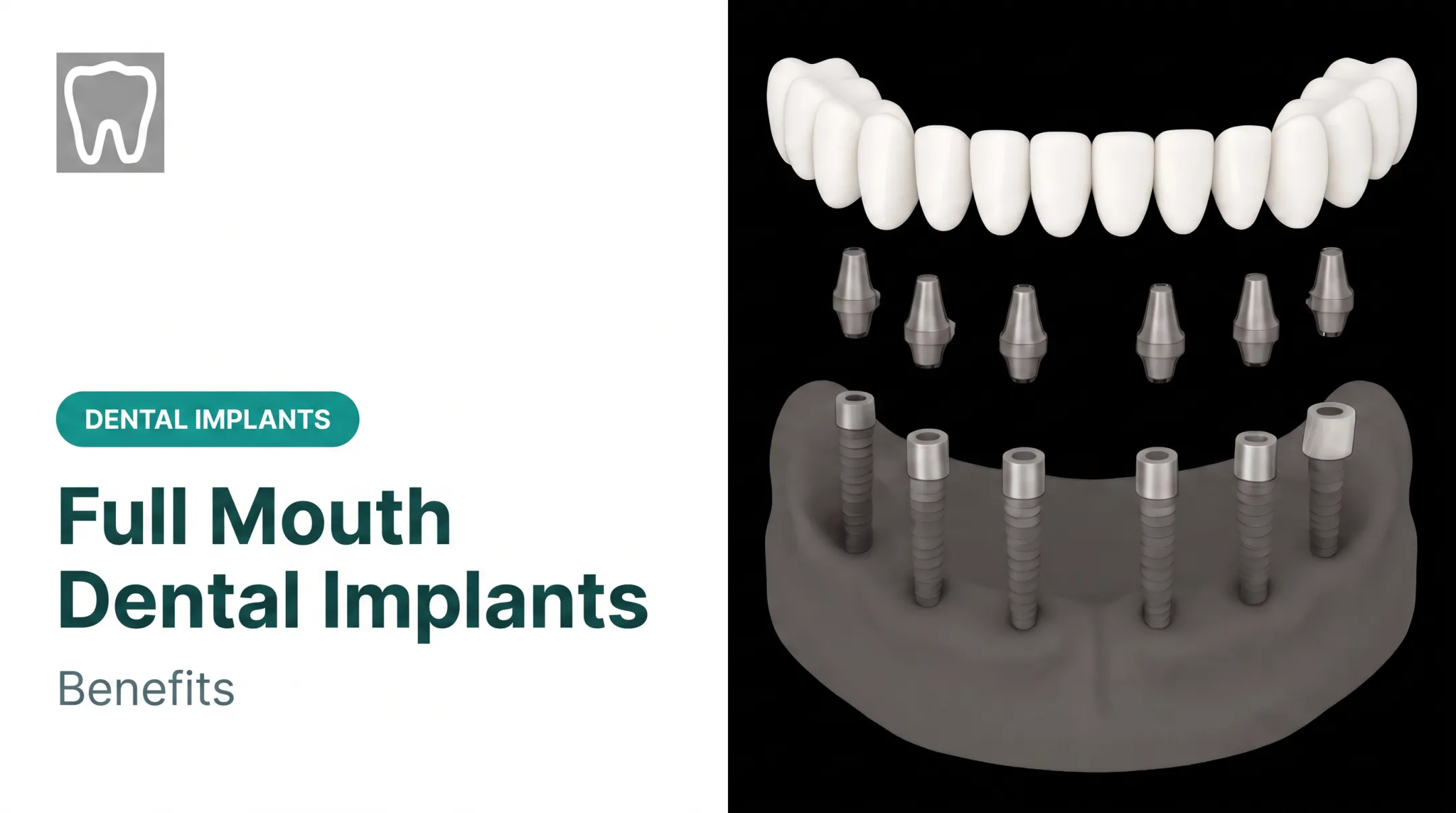
An implant is a titanium or zirconia post placed directly into the jawbone, acting as an artificial tooth root. Once it integrates with the bone, a custom crown is attached on top. Implants can address:
- Single missing teeth, using one implant and crown
- Multiple missing teeth, using implant-supported bridges
- Full-arch reconstruction, through protocols like All-on-4, All-on-6, or the patented 3-ON-8™ system Material choice matters, too. Titanium remains the most used option, but zirconia is a metal-free alternative for patients with metal sensitivities or who want to avoid gray shading near the gumline. At Dental Implants in Mexico, Dr. José Moguel uses grade-5 titanium and zirconia systems from Nobel Biocare, Straumann, and MegaGen. Material selection follows a 3D CBCT scan of bone density, plus each patient’s aesthetic goals and budget. Implants do more than fill a gap in your smile. They restore chewing function, protect oral health, and help prevent the bone loss and tooth shifting that follow an empty socket.
Key Benefits of Dental Implants
The benefits below focus on measurable outcomes — function, health, longevity, and cost over time — not just appearance.
Long-Term Durability and Cost Value
Implants are built to last. A large cohort study following 10,871 implants found survival rates of 96.8% at 10 years and 94.0% at 15 years (French et al., 2021).

Compare that to conventional bridges, which show 89.2% survival at just 10 years, or complete dentures, with a pooled average lifespan around 10 years before needing replacement or relining.
That gap compounds. Every denture reline or bridge replacement means another appointment, another lab fee, another disruption. Implants, by contrast, are placed once and typically maintained rather than replaced.
- Bridges/dentures: repeat procedures every 5-15 years
- Implants: decades of stability with routine cleanings
Younger patients and anyone who wants a permanent fix gain the most from exiting that replacement cycle. Dental Implants in Mexico backs its implant hardware with a lifetime warranty: if the implant itself fails, it is replaced at no cost when patients keep up regular professional cleanings.
Jawbone Preservation and Facial Structure
Your jawbone needs stimulation from a tooth root to maintain its density. Remove the tooth, and the bone starts resorbing almost immediately.
Research shows extraction sites can lose 32% of ridge width within 3 months and up to 63% by 6-7 months (Tan et al., 2012). That remodeling is rapid, and it starts working against you right away.

Left unaddressed, this bone loss can:
- Alter facial contours, giving a sunken appearance
- Shift bite alignment
- Complicate or eliminate future implant candidacy if bone volume drops too far
Implants replicate the root's job, delivering stimulation that helps prevent this cascade. For full-mouth restoration candidates, delay is costly: the longer you wait, the more bone grafting you may need before implants are possible again.
Restored Function and Quality of Life
Chewing efficiency and speech clarity take a real hit with removable dentures. Implant-supported prosthetics restore fixed chewing force and day-to-day stability. A systematic review comparing implant overdentures to conventional dentures found significantly higher satisfaction scores post-treatment (PMC meta-analysis). Patients also reported clearer speech, more comfort, and better chewing stability.
Real patient outcomes back this up. One All-on-4 case at Dental Implants in Mexico involved a retired veteran who had worn traditional dentures for over a decade, dealing with slipping, gum sores, and constant adhesive use.
After four angled implants per arch, his chewing force was restored by 90%, and the adhesive dependency disappeared entirely. He called it the best financial investment of his retirement.
Day-to-day, implants mean:
- Eating whatever you want, without dietary restrictions
- No adhesives, no slipping, no embarrassment
- Brushing and flossing like natural teeth
If you have full-arch tooth loss or already fight ill-fitting dentures, function is usually the benefit you feel first.
Protecting Adjacent Healthy Teeth
Traditional bridges need support. That support comes from grinding down the healthy teeth on either side of the gap, permanently altering them to hold the bridge in place.
Implants skip that step entirely. The implant post stands on its own in the jawbone, meaning neighboring teeth stay untouched.
This matters because bridge abutment teeth carry ongoing risk. Documented complication rates for three-unit bridges include 2.6% for dental caries and 2.1% for abutment fracture over the studied period (Cristea et al., 2023). Every prepared tooth is a tooth now vulnerable to decay or structural failure it wouldn't otherwise face.

For single-tooth replacement cases where neighboring teeth are still healthy, this is often the deciding factor in choosing implants over a bridge.
Making Implants More Accessible: The Cost Factor
Cost remains the biggest barrier. In the US, a single implant with crown and abutment typically runs $3,100-$5,800, while full-arch treatment can reach $14,000-$36,000 per arch. This is where cross-border care resets the cost equation. Los Algodones, Mexico has become a hub for patients seeking the same technology (3D CT imaging, digital scanning, and FDA-approved materials from Nobel Biocare, Straumann, and MegaGen) at 60-70% lower cost. At Dental Implants in Mexico, current starting prices include:
| Treatment | Starting Price |
|---|---|
| Single Tooth Implant | $1,500 |
| All-on-4 | $6,000 |
| All-on-6 | $8,000 |
| 3-ON-8™ Protocol | $15,000 |
| Real case examples show the gap clearly. One patient's single anterior implant with a zirconia abutment and ceramic crown cost $1,350, versus a $4,800 US quote for comparable work. Another patient's Straumann All-on-6 case cost $14,200, compared to a $42,000 US estimate. | |
| Treatment is provided by Dr. José Moguel, a board-certified periodontist with 38+ years of experience and over 17,000 implants placed. | |
| Clinic support is built around cross-border patients: |
- Free consultations and remote CBCT review
- Bilingual coordinators for travel logistics and border-crossing guidance
- Hotel recommendations in Yuma The clinic sits roughly a three-minute walk from the Andrade pedestrian border crossing.
What Happens When Treatment Is Delayed or Skipped
Putting off implant treatment doesn't pause the problem. It usually makes it worse:
- Accelerated bone loss — remaining jawbone keeps resorbing and can block later implant placement without grafting
- Teeth shifting — neighboring teeth often drift into the gap within months
- Reduced chewing ability — softer diets and limited food choices, which can hurt nutrition over time
- Reliance on temporary solutions — removable devices that need repeated adjustment
- Higher cumulative costs — bridges and dentures that need replacing again and again
- Harder treatment later — longer timelines, more appointments, and a steeper total bill once the case becomes complex

Not every patient is on a hard deadline. A timely evaluation still preserves more treatment options—and usually costs less—than waiting until the case is complex.
Getting the Most Value from Dental Implants
Implants deliver the best return when a few things line up:
- Proper candidacy assessment: a 3D CBCT scan and thorough consultation before any treatment decision
- Consistent oral hygiene: daily brushing, flossing, and professional cleanings that protect the implant and lifetime warranty coverage
- Experienced, credentialed treatment: planning by a board-certified specialist using proven protocols and quality materials—not shortcuts
Those same factors shape treatment planning at Dental Implants in Mexico. Candidacy still comes down to bone density and gum health:
- Active periodontal disease is addressed first, because untreated infection raises the risk of peri-implantitis and failure
- Insufficient bone volume can be rebuilt with grafting, which typically integrates over 3–6 months before placement
Getting those steps right protects both the clinical result and the long-term value of the investment.
Conclusion
Dental implants pay off through long-term function, bone preservation, and quality of life that compound over years. That stands in stark contrast to the recurring costs and maintenance cycles of bridges and dentures.
With affordable, credentialed care at Dental Implants in Mexico’s Los Algodones clinic, implants are within reach for patients who once considered them unaffordable.
Frequently Asked Questions
Is there anything better than dental implants?
Dental implants are the closest option to a natural tooth root available today. Whether they are right for you still depends on your bone density and overall health.
Are dental implants worth it for one missing tooth?
Yes, for most candidates. Implants avoid altering neighboring healthy teeth, making them a strong option if your bone and gum health support the procedure.
Do dental implants last a lifetime?
The implant fixture itself can last decades, with studies showing 94% survival at 15 years. The visible crown may need replacement after roughly 10-15 years depending on wear.
Why are dental implants more expensive than dentures or bridges?
Costs reflect surgical planning, imaging, premium materials, and case complexity. Bone grafting or sinus lifts, when needed, add to that total.
Can I get dental implants if I have bone loss?
Often, yes. Bone grafting or a staged treatment approach can rebuild the jaw before implant placement, determined through a CBCT imaging assessment.
How can I make dental implants more affordable?
Payment plans help, but traveling for treatment often yields larger savings. In Los Algodones, Mexico, implant care can cost 60-70% less than comparable U.S. treatment.