
Both replace a missing tooth. Both can look natural. But they work in completely different ways, cost different amounts, and hold up over very different timelines. Understanding those differences before you commit to either matters, because reversing course later is expensive and time-consuming.
One factor increasingly shaping this decision: where you get treatment. Accredited clinics near the US border, including several in Los Algodones, Mexico, have made implant care accessible at a fraction of typical US pricing. We'll break that down later.
Key Takeaways
- 96.4% implant survival at 10 years in research; bridges rely on neighboring teeth and usually last less
- Bridges cost less upfront but often need earlier replacement from decay or wear on supporting teeth
- Healthy neighboring teeth stay intact with implants; traditional bridges require reshaping them
- Los Algodones, Mexico care can cut implant costs by 60-70% versus typical US pricing
- Best choice hinges on bone health, budget, timeline, and condition of adjacent teeth
Dental Implant vs Bridge: Quick Comparison
| Factor | Dental Implant | Dental Bridge |
|---|---|---|
| Cost | Higher upfront; implant fixture averages $2,143 in the US ($1,646–$4,175), before crown and fees | Lower upfront; 3-unit bridge averages $2,500–$4,000 in the US |
| Procedure | Surgical placement in the jawbone, then healing while bone fuses to the implant (osseointegration) | Non-surgical; requires filing down adjacent teeth to hold crowns |
| Longevity | About 96.4% survival at 10 years | About 79–89% survival at 10 years (study-dependent) |
| Bone health | Root-form design that anchors directly into bone | Doesn't replace the root; underlying bone can still shrink over time |
| Neighboring teeth | No alteration to adjacent healthy teeth | Requires enamel removal on the teeth bordering the gap |

These figures come from consumer pricing guides and peer-reviewed research—use them as benchmarks, not a quote. Your clinic’s itemized estimate is what counts.
What is a Dental Implant?
A dental implant is a titanium (or zirconia) post surgically placed into the jawbone, where it fuses to bone through a process called osseointegration. Once healed, it acts as an artificial root, anchoring a crown, bridge, or full-arch prosthetic on top.
Core benefits include:
- Standalone support with no reliance on neighboring teeth
- Root-form design that functions similarly to a natural tooth
- Natural look and feel, especially with zirconia or premium ceramic crowns
- Strong long-term outcomes, backed by a 96.4% 10-year survival estimate from a 2019 systematic review
Implants aren't one-size-fits-all. Variations include single-tooth implants and implant-supported bridges spanning multiple teeth. Full-arch options include All-on-4, All-on-6, or the patented 3-ON-8™ protocol, which uses eight implants per arch to support three separate zirconia bridges.

Use Cases of Dental Implants
Implants work best for patients with adequate jawbone density and healthy gums who want a permanent, standalone fix. They're commonly used for:
- A single missing tooth
- Multiple gaps across the mouth
- Full-mouth reconstruction when most or all teeth need replacement
Those outcomes still depend heavily on who places the implant. Dr. José Moguel, a board-certified periodontist at Dental Implants in Mexico, has placed more than 17,000 implants over 38 years, with a reported success rate above 98%, compared with the international average of roughly 95-97%.
What is a Dental Bridge?
A dental bridge is a fixed prosthetic that "bridges" a gap in your smile. Crowns are placed on the healthy teeth adjacent to the gap (called abutment teeth), and a false tooth, or pontic, sits between them.
Core benefits include:
- Faster treatment timeline, often completed in two visits
- No surgery required
- Lower initial cost than implants in most published pricing guides
Bridge types vary too:
- Traditional bridge: crowns on both sides of the gap
- Cantilever bridge: anchors to only one adjacent tooth
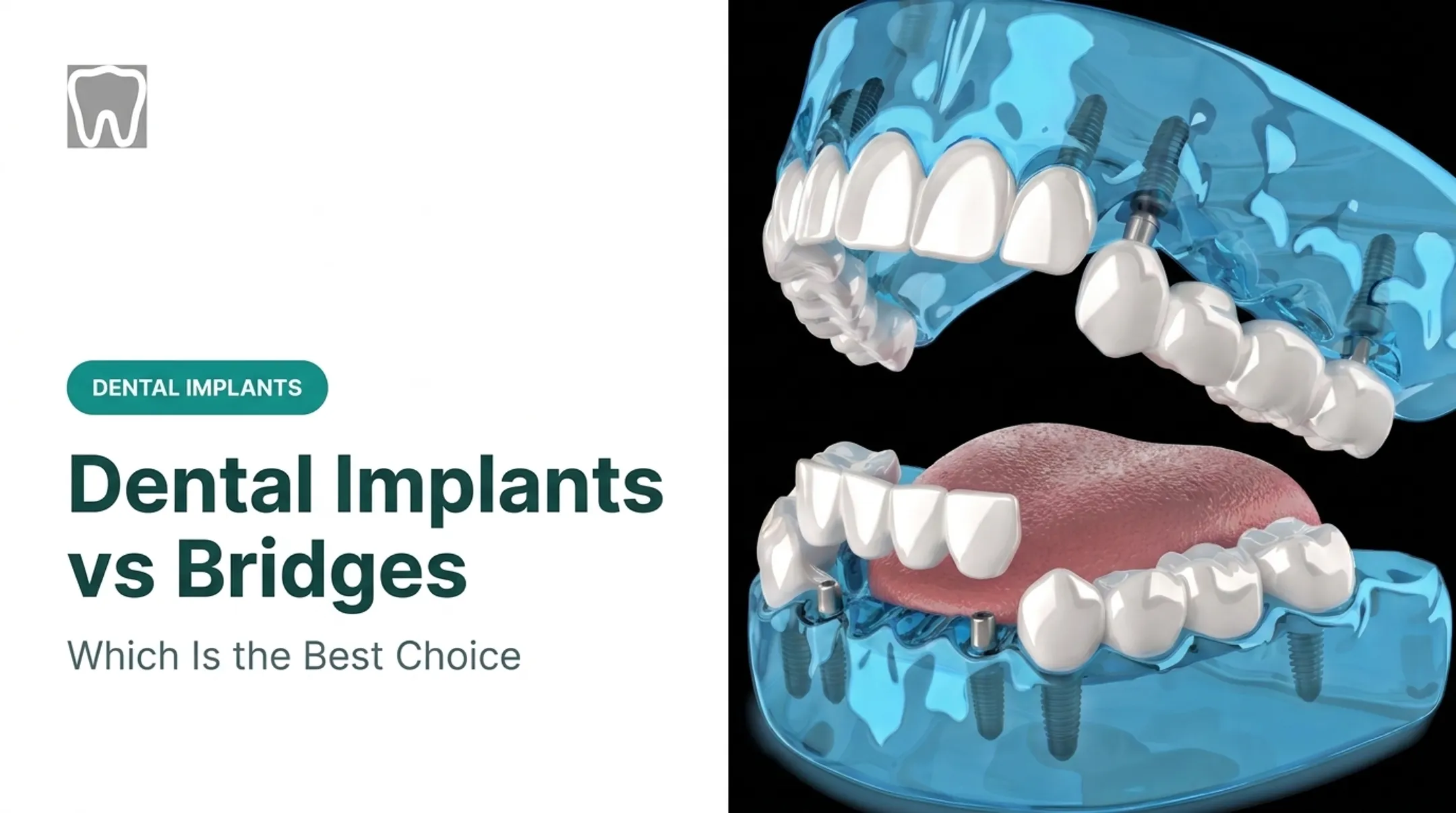
- Implant-supported bridge: replaces multiple teeth using implants instead of natural teeth as anchors
An implant-supported bridge is a different mechanism entirely and should not be priced or compared the same way as a tooth-supported bridge.
Use Cases of Dental Bridges
Bridges suit patients whose neighboring teeth already need crowns anyway, or who want to avoid surgery altogether. They're most commonly used to replace one to three consecutive missing teeth.
That said, longevity is conditional. A 2023 NCBI evidence review found 10-year bridge survival estimates ranging from roughly 79% to 82%, with secondary decay on abutment teeth, chipping, and loss of retention listed as common reasons for early replacement.

Dental Implant vs Bridge: What is Better?
There's no universal winner. The right call depends on a handful of factors:
- Bone density — insufficient bone may rule out implants without grafting
- Budget — bridges often cost less upfront; implants cost more but may avoid future replacement
- Timeline — bridges are faster; implants require a healing period
- Neighboring teeth — if they already need crowns, a bridge can build on that work
- Long-term maintenance — implants generally require less intervention over decades
Choose an implant if you want a permanent, root-replacing solution and don't mind a longer treatment process. Choose a bridge if you need a fast, non-surgical fix, or your adjacent teeth already require crowns anyway.
Many patients start with a bridge, then move to an implant later once budget or bone grafting makes that possible.
Cost Breakdown: US Prices vs Savings in Mexico
US pricing varies by region, provider, and what's included. Published benchmarks show:
- Single implant (fixture only): $1,646–$4,175 (about $2,143 average per CareCredit's 2025 guide)
- Traditional 3-unit bridge: $2,500–$4,000
- Implant-supported bridge (multiple teeth): $5,000–$15,000
Those implant figures usually exclude the crown, abutment, and any extraction, so full US case totals run higher.
Clinics in Mexico cut those totals sharply. According to the Academy of General Dentistry, US patients often save about 40–65% on care in Mexico, and Los Algodones pricing averages roughly one-third of US equivalents.
Starting prices at Dental Implants in Mexico track that gap:
- Single tooth implant: from $1,500
- All-on-4 full arch: from $6,000
- All-on-6 full arch: from $8,000
- 3-ON-8™ protocol: from $15,000
These are advertised starting prices, not guaranteed totals, since final cost depends on bone grafting needs, imaging, and materials selected.

At Dental Implants in Mexico, quoted plans typically include:
- Free consults with X-ray or 3D CT review; Dr. Moguel assesses bone density before quoting
- Transparent fees for surgical placement, standard abutments, and restorations
- Care from a board-certified periodontist (38+ years; 17,000+ implants placed)
- Itemized receipts with ADA/CDT codes for out-of-network insurance claims
The clinic is about a three-minute walk from the Andrade, California border crossing. Bilingual coordinators help with hotels in Yuma, Arizona, or Los Algodones, and with local shuttle options.
The CDC notes that oversight of dental providers varies by country, so vetting credentials, warranty terms, and follow-up care plans before booking matters just as much as comparing price tags.
Frequently Asked Questions
How much does a 1 tooth dental bridge cost?
A single-gap bridge in the US typically runs $2,000-$5,000, averaging around $2,500 according to GoodRx. Final cost depends on materials, geographic location, and whether insurance covers part of the procedure.
How much does it cost to get a bridge with 4 teeth and dental implants?
An implant-supported bridge spanning three to four teeth, using two implants for support, typically costs $5,000-$15,000 in the US. The wider range reflects multiple implants, lab work, and materials involved.
What is the cheapest way to replace all your teeth?
Traditional full dentures are generally the lowest upfront cost, averaging around $1,968-$3,648 in the US. Full-arch implants such as All-on-4 cost more but last longer, with Mexico pricing often starting around $6,000.
Is it better to get a dental implant or a bridge?
Implants generally last longer and preserve the jawbone, while bridges are faster, non-surgical, and cost less upfront. The better choice depends on your bone health, budget, and how long you want the restoration to last.
Why might a dentist recommend a bridge instead of an implant?
A dentist may suggest a bridge if you lack sufficient jawbone density for an implant, have a medical condition that complicates surgery, or if your neighboring teeth already need crowns. In those cases, a bridge can be the more practical, faster option.
Can a tooth rot under a dental bridge?
Yes. Decay can develop on the abutment teeth supporting the bridge or underneath the pontic if oral hygiene isn't thorough. Regular flossing with a threader and routine checkups help prevent this common cause of early bridge failure.