
That assumption is usually wrong. Age isn't the deciding factor for dental implants — overall health and bone quality are. Unlike slipping dentures that need adhesive and constant adjustment, implants offer a fixed, permanent solution that functions like natural teeth.
This article covers who's actually a good candidate, what implants cost, cheaper alternatives worth considering, and how seniors are increasingly finding affordable, quality care across the border in Mexico.
Key Takeaways
- Age alone doesn't disqualify seniors from implants; health and bone density matter far more
- Implant survival exceeds 95% at 10 years, even in patients aged 65-89
- Full-arch treatment in Mexico can cost 60-70% less than comparable US pricing
- Cheaper removable dentures exist but wear out faster and don't stop bone loss
- Medicare rarely covers implants, making cost comparison essential before choosing a path
Are Dental Implants a Good Option for Seniors?
Yes. For most seniors in reasonably good health, implants outperform traditional dentures in nearly every measurable way. They don't slip while eating or talking, they restore near-normal chewing force, and they preserve jawbone density by mimicking a natural tooth root.
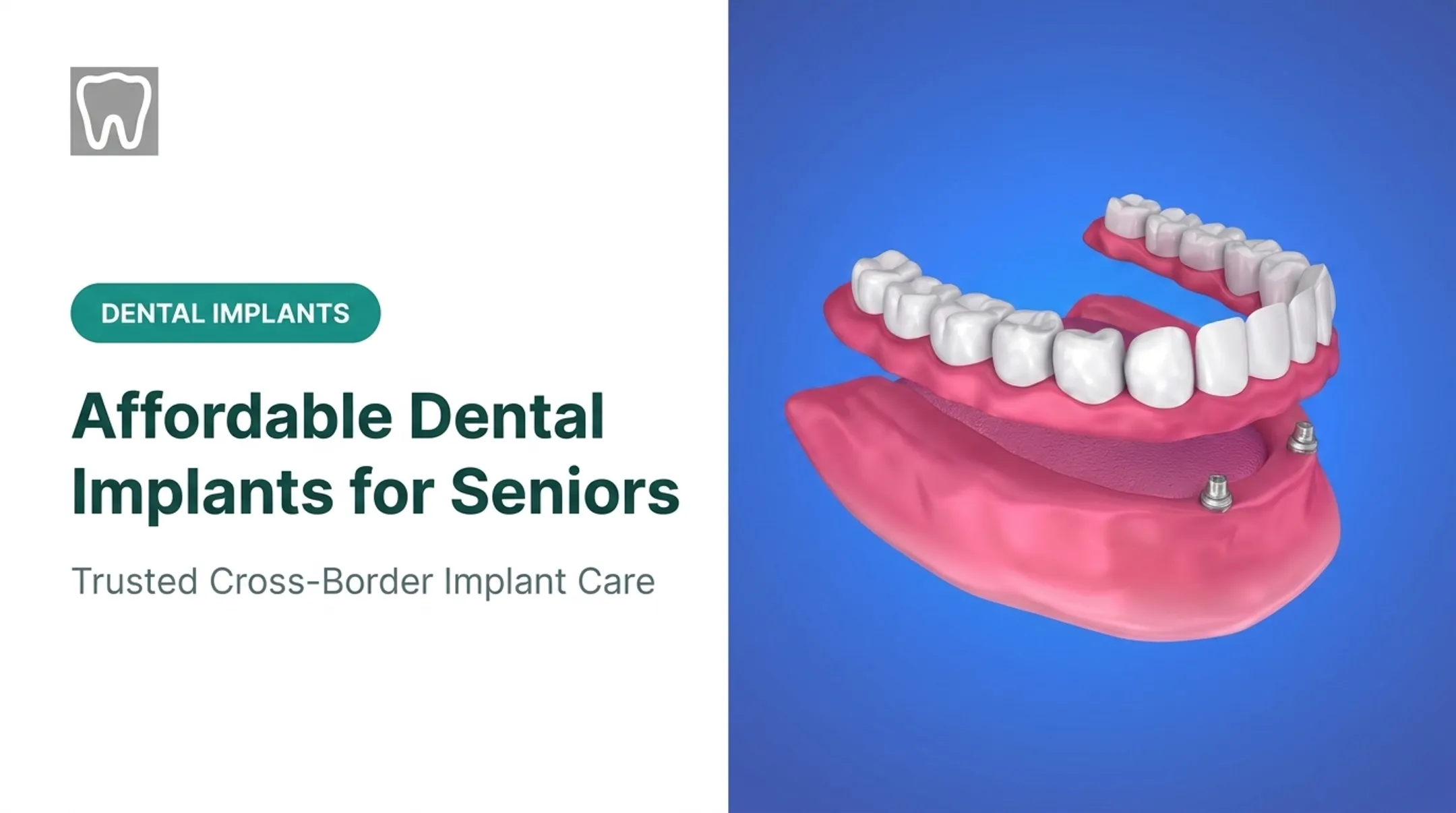
Dentures, on the other hand, sit on top of the gum and provide no stimulation to the jawbone underneath. Over years of wear, this causes bone resorption: the jaw literally shrinks, which is why long-term denture wearers often develop a sunken facial appearance.
What the Research Shows
A retrospective study of patients aged 65 to 89 found 95.39% implant survival across 902 implants placed over 2 to 17 years. The researchers noted something important: age alone didn't appear to affect outcomes. What mattered was overall health, bone quality, and maintenance.
Beyond survival numbers, implants change daily life:
- Patients chew tougher foods again (meat, raw vegetables, nuts), which improves nutrition
- Speech stays clear because implants don't shift like loose dentures
- Social confidence rises without fear of slipping or clicking
Dr. José Moguel, a board-certified periodontist who has placed more than 17,000 implants over 38 years, has treated patients well into their 80s after thorough evaluation. Age on its own has never been the disqualifier. Bone volume and general health determine the plan.

Tooth loss does become more common later in life. U.S. CDC data shows edentulism rising from 8.9% at ages 65–69 to 17.8% at 75-plus. Even so, age alone does not rule out implants when overall health and bone volume are adequate.
Who Is Not a Good Candidate for Dental Implants
Certain conditions complicate, but don't automatically rule out, implant treatment:
- Uncontrolled diabetes (particularly HbA1c above 8.0%) can delay healing and integration
- Active gum disease needs treatment first; untreated periodontitis raises implant failure risk significantly
- Osteoporosis medications (especially antiresorptive drugs) require individual assessment with your prescriber
- Heavy smoking roughly doubles implant failure risk in some studies
- Insufficient bone density, often from years of denture wear or long-term tooth loss
None of these are permanent "no" answers on their own. A proper evaluation (full medical history plus 3D imaging) determines candidacy, not a birthdate.
At Dr. Moguel's clinic, every patient receives a high-resolution 3D Cone Beam CT scan to assess bone density and width in three dimensions before any treatment plan is finalized. This lets him identify whether a patient needs bone grafting or a sinus lift before implants, rather than turning them away outright.
That's exactly what happened with Evelyn S., whom US dentists told she wasn't a candidate without extensive reconstruction. After bilateral sinus lifts and six Straumann implants, CBCT scans showed over 1.5 cm of bone regenerated in her posterior sinus area. She received a full fixed zirconia bridge at roughly a third of her US quote.

Cost of Dental Implants and Cheaper Alternatives
Implant pricing varies widely depending on scope. In the US, the American Academy of Implant Dentistry puts a single implant (fixture, abutment, and crown) at $3,100 to $5,800 American Academy of Implant Dentistry.
Common implant treatment types:
| Treatment | What it involves |
|---|---|
| Single-tooth implant | One fixture, abutment, and crown |
| Implant-supported bridge | Multiple teeth on shared implants |
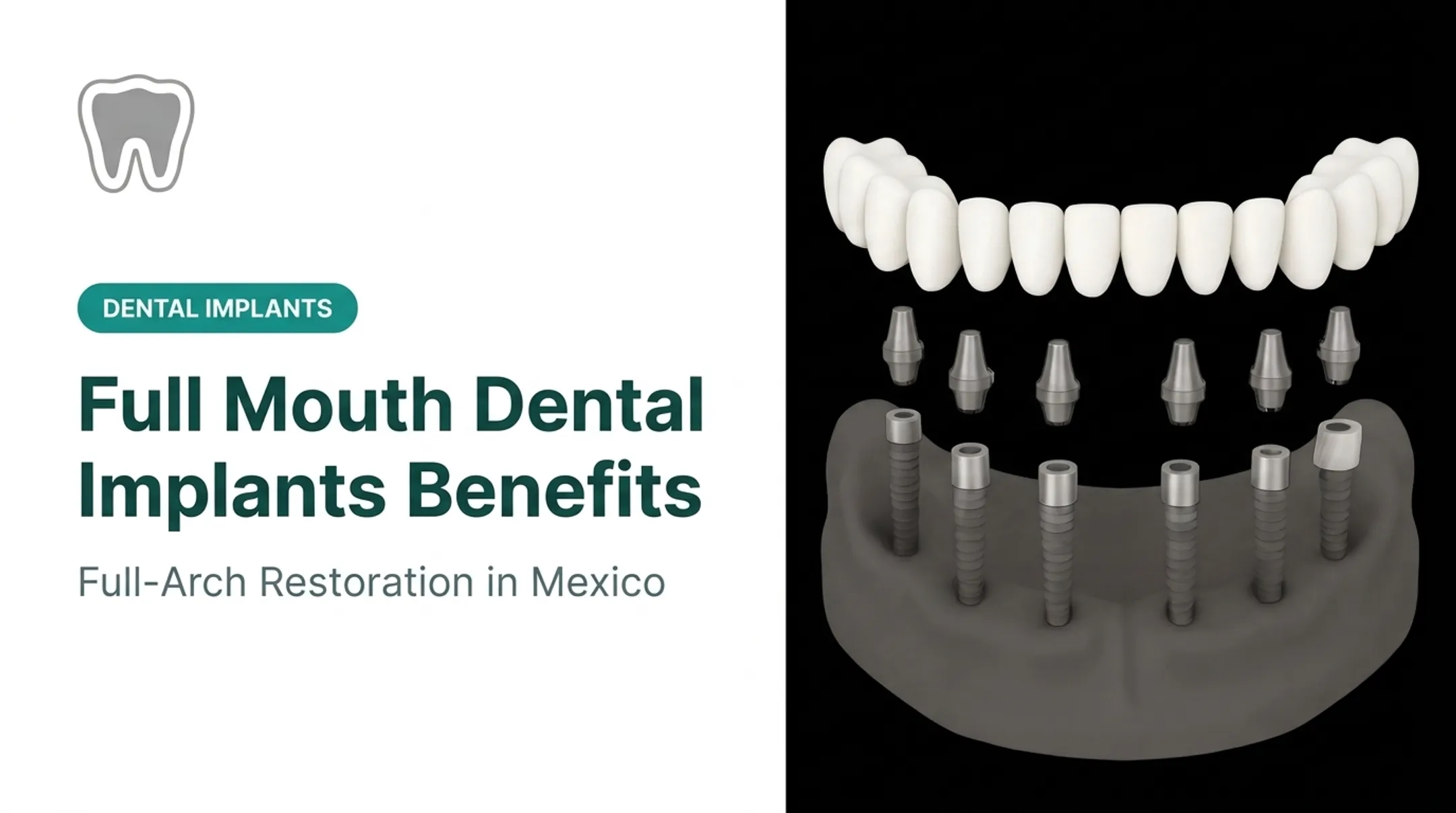
| All-on-4 / All-on-6 | Full-arch replacement on 4 or 6 implants |
| 3-ON-8™ protocol | Full-mouth restoration on 8 implants per arch |
Implants vs. Removable Dentures
Flexible or removable dentures cost less upfront but come with real trade-offs:
- Dentures typically need replacement every 6-10 years, while implants can last decades with proper care
- Dentures don't stop bone resorption; implants do
- Dentures require adhesive and adjustment; implants function like natural teeth
Several factors affect your final implant quote:
- Number of implants needed
- Materials (titanium vs. zirconia)
- Where in the jaw they’re placed
- Whether bone grafting is required first
Why Seniors Are Looking to Mexico
Many US and Canadian seniors are turning to board-certified clinics near the border to close the cost gap. At Dr. Moguel's Los Algodones clinic, savings run 60-70% versus comparable US treatment, depending on the procedure:
- Single-tooth implants from $1,500
- All-on-4 from $6,000 (up to 70% savings)
- All-on-6 from $8,000 (up to 65% savings)
- The patented 3-ON-8™ full-mouth protocol from $15,000 (up to 60% savings)
For context, the same 3-ON-8™ treatment often runs $30,000-$45,000 in the US, versus $16,000-$20,000 per arch in Mexico. Those savings reflect lower operating costs in Mexico, not lesser materials. The clinic uses Nobel Biocare, Straumann, and MegaGen implant systems, the same brands common in US practices.

Tooth Loss Trends and the Newest Implant Technology for Seniors
Complete tooth loss climbs steadily with age: from roughly 9% at 65-69 to nearly 18% by 75-plus, according to U.S. CDC figures. That trend has pushed implant dentistry toward tools built for older patients who need precision without long, invasive surgery.
Modern innovations that cut risk and recovery time include:
- 3D Cone Beam CT imaging: maps bone density, width, and nerve pathways before surgery begins
- Computer-guided implant placement: improves positional accuracy compared with freehand technique
- Same-day/immediate-load protocols: shorten time spent without a functional temporary tooth
- Digital scanning and in-house CAD/CAM labs: produce custom-fitted crowns and bridges without weeks of outside-lab delays

Arthur V., 68, shows how this works in a real case. A digital 3D CT scan guided placement of 16 Nobel Biocare titanium implants, then digitally designed, in-house-milled zirconia bridges for both arches. For older patients, that planning means less exploratory surgery and faster healing.
Affording Implants: Medicare, Insurance, and Cross-Border Options
Here's the blunt truth: Original Medicare generally does not cover dental implants Medicare.gov. Some Medicare Advantage plans include limited dental benefits, but annual caps often sit around $1,300 — nowhere near enough for full-arch treatment. Steps to check what you actually have:
- Call your plan and ask specifically about implant coverage, not just "dental benefits"
- Request the annual maximum, waiting periods, and exclusions in writing
- Gather itemized treatment documentation if you plan to appeal a denial Financing routes worth exploring:
- Medical credit financing through third-party lenders
- Dental discount plans
- Direct pay by credit card, cashier’s check, or cash If you plan to seek US insurance reimbursement after treatment abroad, Dr. Moguel’s clinic can supply English-language itemized statements with standard ADA CDT codes (such as D6010 for implant placement), plus digital X-rays and CBCT records to support medical-necessity claims or appeals. Cross-border care has become a practical middle path. The clinic sits a three-minute walk from the Andrade, California border crossing and offers free consultations, transparent “from” pricing, and a lifetime warranty on implant hardware (with a separate five-year warranty on crowns and bridges, contingent on regular cleanings). For seniors on fixed incomes, that mix of clear pricing and warranty protection often decides whether treatment stays on hold or gets done.
Frequently Asked Questions
How can seniors afford dental implants, and will Medicare cover them?
Medicare generally doesn't cover implants, though some Medicare Advantage plans offer limited dental benefits with low annual caps. Financing plans, dental schools, and lower-cost treatment in Mexico are common alternatives seniors use to close the gap.
Are dental implants a good option for seniors?
Yes, when overall health and bone density are adequate. Studies show over 95% implant survival in patients aged 65-89, with age itself not being a significant factor in outcomes.
Who is not a good candidate for dental implants?
Uncontrolled diabetes, active gum disease, heavy smoking, and severe bone loss without grafting can complicate treatment. A thorough evaluation with imaging determines candidacy on a case-by-case basis, not age alone.
What are cheaper alternatives to dental implants, and how do their costs compare?
Removable or flexible dentures cost less upfront but need replacement every 6-10 years and don't stop jawbone loss. Implants cost more initially but often last decades with proper care.
Can seniors keep their natural teeth, and how common is tooth loss among people in their 70s and 80s?
Complete tooth loss affects roughly 9% of people in their late 60s, rising to nearly 18% by age 75-plus. Preventive dental care can help many people retain natural teeth well into their senior years.
What is the newest procedure or technology for dental implants?
Computer-guided placement, 3D Cone Beam CT imaging, and same-day loading protocols now allow more precise, less invasive surgery. These advances particularly benefit older patients by reducing recovery time and surgical risk.