
This choice matters even more if you're weighing treatment in Los Algodones, Mexico, where cost savings can be significant but the technical decision still has to be right for your anatomy. Below, we break down how each system works, who qualifies, and how Dr. Moguel's clinic — including its patented 3-ON-8™ protocol — determines the best fit for each patient.
Key Takeaways
- 3-on-6: six implants support segmented bridges that follow natural gum contour and clean more easily.
- All-on-4: four implants (two angled) often skip bone grafts when bone loss is more advanced.
- 3-on-6 usually costs more because of the extra implants and custom bridgework.
- Both are fixed, permanent solutions with similar 3–6 month healing timelines.
- Only a 3D CT scan can confirm which option matches your bone density.
3-on-6 vs All-on-4: Quick Comparison
| Factor | 3-on-6 | All-on-4 |
|---|---|---|
| Cost | Slightly higher — more implants, custom segmented bridges | More cost-effective — fewer implants and components |
| Bone requirements | Needs adequate volume at six sites | Angled posterior implants often avoid grafting |
| Appearance | Segmented bridges mimic natural teeth, no artificial gum | Single prosthesis includes pink acrylic gum material |
| Maintenance | Brush and floss like natural teeth | Bulkier design, harder to clean underneath |
| If an implant fails | Only the affected segment needs attention | Entire one-piece prosthesis may need attention |

According to a 2016 PubMed randomized trial, a five-year comparison of four versus six implants in the upper jaw found no statistically significant difference in implant failure or marginal bone loss. Six implants aren't automatically safer. The right choice depends on your anatomy, not a blanket rule.
What Is 3-on-6?
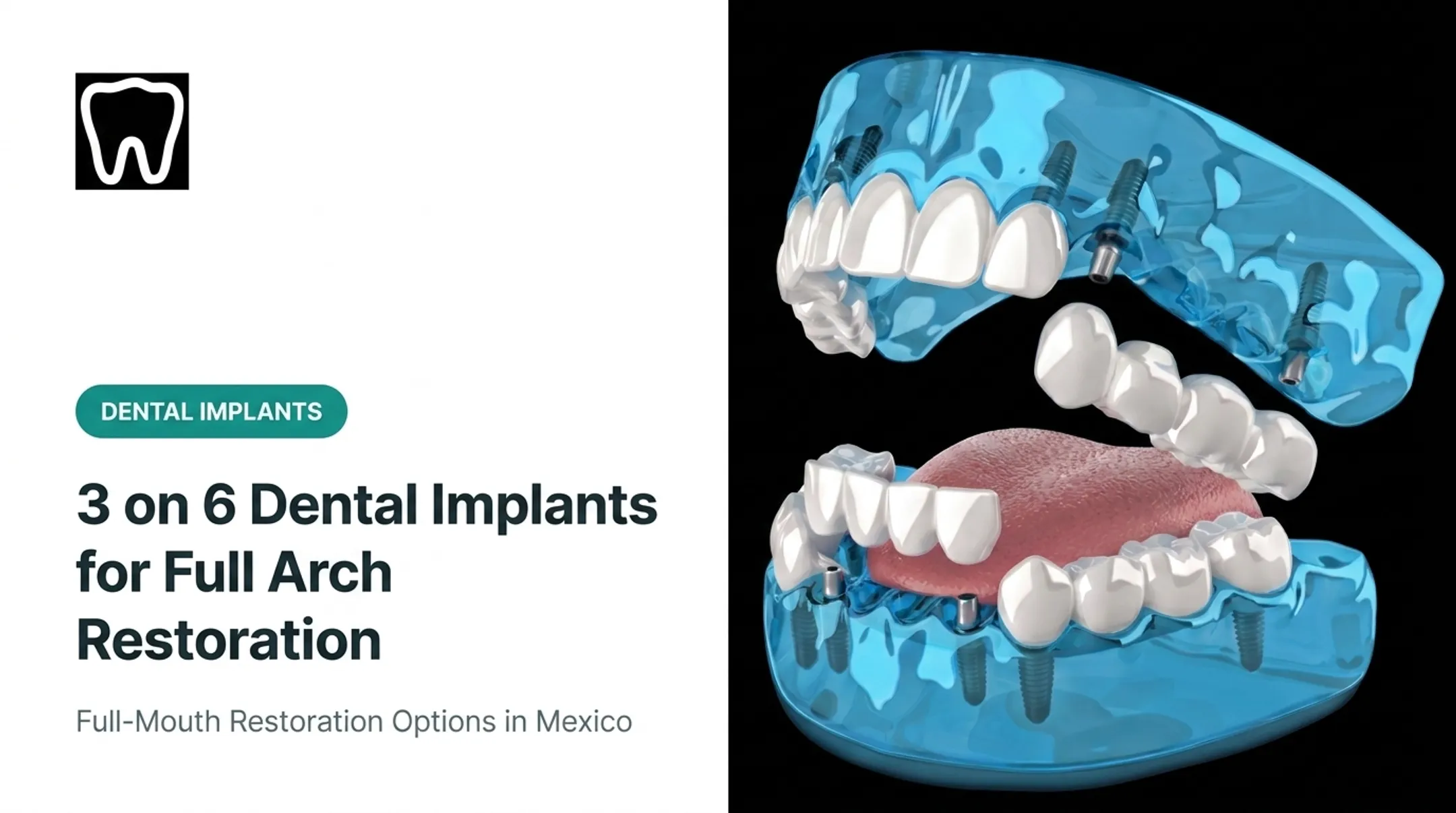
3-on-6 places six implants per arch, three per side, supporting three separate four-crown bridges instead of one continuous piece. The design divides the arch into manageable sections instead of relying on one continuous prosthesis.
Core benefits:
- Better force distribution across more implant sites
- Built-in redundancy — if one implant needs attention, the rest of the arch stays functional
- Segmented bridges that support long-term jaw health without artificial gum material
Dr. Moguel has taken this segmented-bridge concept further with his patented 3-ON-8™ protocol, which uses eight implants per arch supporting three independent zirconia bridges. It's an advanced evolution of the same segmentation logic, angled and shaped to mimic a natural dental arch.

Candidacy for 3-on-6
This approach works best for patients with:
- Adequate jawbone volume and minimal-to-moderate bone loss
- No history of severe ridge resorption from long-term denture wear
- Enough remaining bone to place six implants without extensive grafting first
Long-term denture wear often shrinks the jawbone, so many denture wearers need grafting before they qualify. A free consultation with 3D Cone Beam CT at the Los Algodones clinic confirms eligibility before any commitment.
What Is All-on-4?
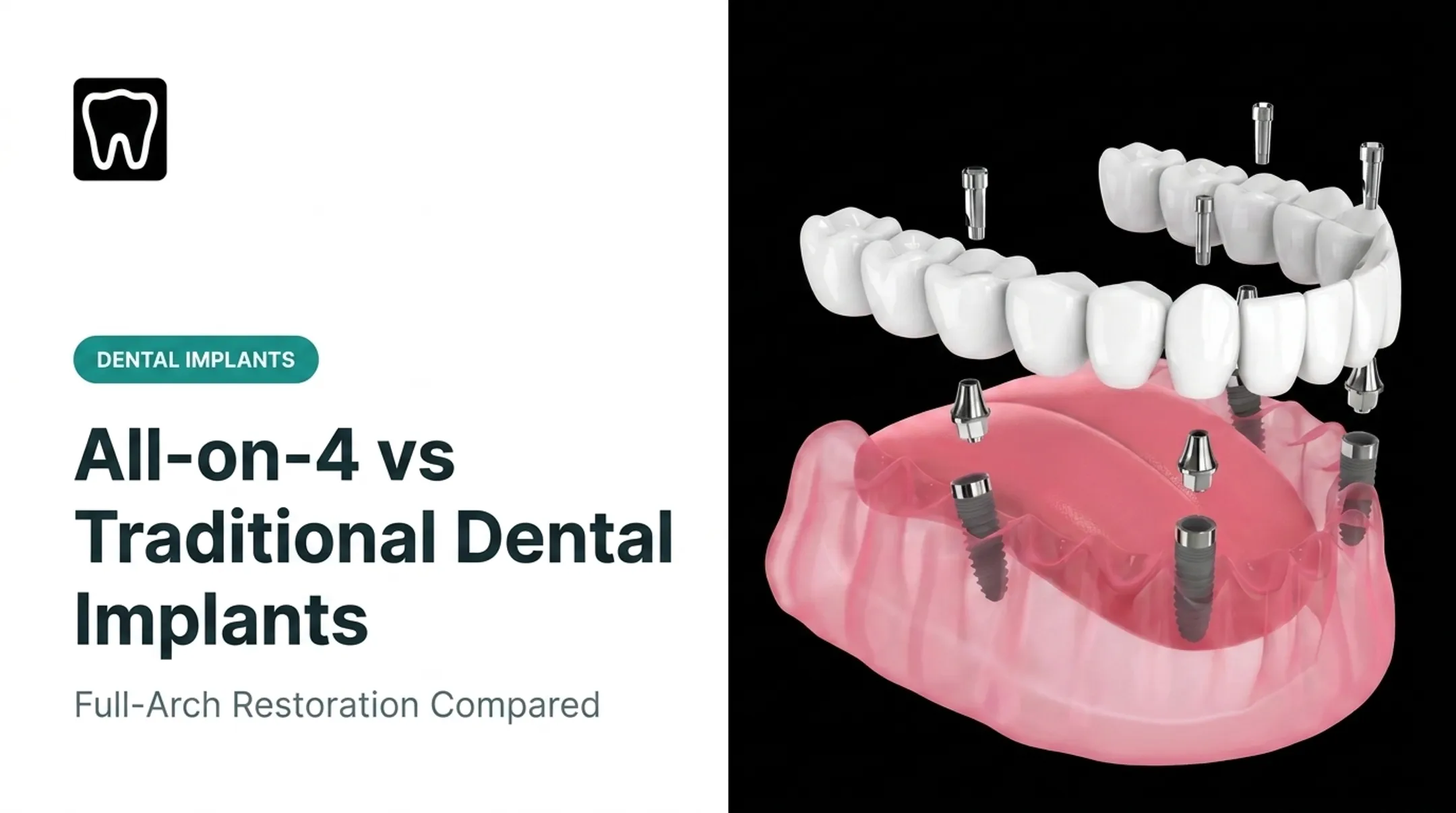
All-on-4 uses four implants per arch to support one full-arch prosthesis that includes artificial gum tissue. Two anterior implants sit straight; two posterior implants tilt up to 45 degrees.
Nobel Biocare's treatment documentation describes this tilt as a way to bypass the sinus cavities in the upper jaw and the mental nerve in the lower jaw. That design lets many patients skip bone grafting altogether.

Core benefits:
- Avoids extensive bone grafting for many patients with compromised bone
- Delivers same-day fixed teeth in many cases
- Offers a proven, cost-effective full-arch option
A variation called All-on-6 adds two implants for extra stability without moving to full 3-on-6 segmentation. It is a middle-ground upgrade for patients who want more support but not full bridge separation.
Candidacy for All-on-4
Best suited for patients who:
- Have moderate-to-significant bone loss and want to avoid grafting
- Want immediate, budget-conscious full-arch restoration
- Prefer one full-arch prosthesis rather than segmented bridges
A 2011 longitudinal study of 245 patients and 980 implants reported 94.8% patient-related success and 98.1% implant-related success at five years, with prosthesis survival at 99.2% up to 10 years.
A follow-up tracking patients 10 to 18 years out found 93% implant survival and 98.8% prosthetic survival (JADA, 2011).
3-on-6 vs All-on-4: What's Better for You?
The decision comes down to four factors: bone density, budget, aesthetic priorities, and long-term home maintenance.
- Choose 3-on-6 if you have healthy bone volume and want a natural, tooth-like feel with easier at-home cleaning.
- Choose All-on-4 if bone loss is significant and cost-efficiency with a strong evidence base matters most.
Neither option is universally "better." 3-on-6 segmented bridges offer redundancy and a more natural look, but they need more bone. All-on-4's angled implants work around bone loss, but the one-piece design means more complex cleaning and a larger repair if a section fails.
That's why personal preference alone shouldn't drive this decision. A 3D CT evaluation with a board-certified specialist maps your bone density and structure first. Dr. Moguel, who has placed more than 17,000 implants over 38 years, uses that scan to recommend the stronger path for your case.
Why Patients Travel to Los Algodones, Mexico for Full-Arch Implants
Full-arch implant treatment in the US often runs $20,000-$35,000 per arch. In Los Algodones, comparable All-on-4 and All-on-6 treatment typically runs $6,000-$12,000 per arch, a savings of roughly 60-70%.
That price gap exists without cutting corners on technology:
- 3D Cone Beam CT imaging for precise bone-density mapping
- Digital scanning and an in-house CAD/CAM lab for custom prosthetics
- Premium FDA-approved implant brands, including Nobel Biocare, Straumann, and MegaGen

The clinic sits roughly a three-minute walk from the Andrade, California border crossing. The team helps coordinate hotel stays in Yuma, Arizona, plus local shuttle service, so planning a cross-border trip stays simple.
Frequently Asked Questions
What is the healthiest dental implant?
Titanium and zirconia implants from reputable manufacturers like Nobel Biocare and Straumann are considered highly biocompatible. Success depends more on placement technique and bone integration than on material alone.
Which dental implants last the longest?
Premium, well-placed implants can last 15–20+ years in long-term studies when paired with good oral hygiene and regular checkups. Bone health and ongoing upkeep still shape individual results.
Can I switch from 3-on-6 to All-on-4 if my bone health changes?
Treatment plans can sometimes be adjusted based on updated CT scans. Whether a switch makes sense depends entirely on your current bone condition, so this should be discussed directly with a specialist.
Is 3-on-6 more expensive than All-on-4?
Yes, typically. The extra implants and custom segmented bridges add cost upfront, though 3-on-6 may carry lower long-term maintenance costs since only one segment needs attention if an issue arises.
How do I know which option is right for me?
A free consultation with 3D CT imaging measures your bone density and structure, which guides the recommendation. This isn't a decision to make from photos or general preference alone.
Do both options require the same recovery time?
Both generally follow a 3-6 month healing timeline for osseointegration, with temporary fixed teeth provided immediately after surgery in most cases.