
Implant costs vary wildly depending on what you actually need. A single tooth replacement is nothing like an All-on-4 full arch or a full-mouth 3-ON-8™ reconstruction. Materials matter too, and so does geography.
This guide breaks down real 2026 pricing ranges, the factors that drive cost up or down, and how to find a legitimately cheap option, including traveling to Mexico, without ending up with implants that fail in five years.
Key Takeaways
- Single implants: $2,143–$4,800+ in the US (crown often extra) vs $750–$1,500 at established Mexico clinics
- All-on-4 full-arch: $11,640–$27,500 per arch in the US; from $6,000 with board-certified Mexico specialists
- Lowest price is not best value: credentials, materials, and warranty shape long-term cost
- Accredited Los Algodones clinics can cut implant costs by roughly 60–70% near the US border
How Much Do Dental Implants Cost in 2026? (Pricing Overview)
Implant pricing is never one fixed number. It depends on which tooth needs replacing, how many implants you need, the materials chosen, and where you get treatment.
Three common budgeting mistakes:
- Forgetting the crown and abutment are often priced separately from the implant post
- Accepting the lowest quote without confirming what's actually included
- Ignoring long-term maintenance and follow-up visit costs
Entry-Level: Single Titanium Implant
A single implant in the US averages $2,143 for the implant post alone, per CareCredit's 2025 national study. The quoted range is $1,646-$4,157 excluding the crown.
Add a crown and total cost typically lands at $3,000-$7,000, according to GoodRx.
In Mexico, a complete single-tooth package (implant, abutment, and crown) typically runs $750-$1,500.
Mid-Range: Implant-Supported Crown or Bridge
A typical package includes the post, abutment, and crown. What it usually excludes: bone grafts, sedation, and follow-up imaging. CareCredit's US implant-supported bridge average is $5,195, while GoodRx puts full bridge pricing between $4,000 and $16,000. Mexico clinics often quote the same package far lower—always compare full inclusions, not the headline number alone.
High-End: Full-Arch Solutions
US All-on-4 pricing averages $15,176 per arch, with a range of $11,640-$27,500. Full-mouth protocols for both arches can reach $25,000-$35,000 or higher, per Forbes Advisor's ADA-sourced estimate.
Mexico-based specialist clinics quote full-arch treatment much lower: All-on-4 from $6,000, All-on-6 from $8,000, and the patented 3-ON-8™ protocol from $15,000.

"Cheapest" quotes often leave out imaging, anesthesia, or follow-up visits. Confirm those line items before you compare numbers.
Key Factors That Affect Dental Implant Cost
Type of Implant Procedure
- Single-tooth implant: One post, one crown, lowest complexity
- All-on-4: Four implants support a full arch, using angled posterior placement
- All-on-6: Six implants per arch for added stability
- 3-ON-8™: A patented full-mouth restoration protocol requiring more extensive planning
Materials and Implant Brand
Titanium remains the standard, while zirconia costs a few hundred dollars more, according to GoodRx. Premium brands like Nobel Biocare, Straumann, and MegaGen focus on long-term reliability and scientific backing rather than budget pricing. Ask exactly which system and brand your quote uses. This affects both durability and warranty support if you ever need service.
Need for Bone Grafting or Sinus Lift
Grafting adds real cost: CareCredit reports a US national range of $549-$5,148 depending on graft type. Some clinics avoid this entirely using angled implant placement: anterior implants placed vertically, posterior implants tilted around 45 degrees to bypass the sinus cavity or mental nerve. This technique is standard in many All-on-4 protocols and can eliminate the need for grafting altogether.
Dentist Credentials and Clinic Location
Board-certified periodontists and ADA/ADM-accredited clinics typically charge more per procedure, but they also reduce complication risk. Clinic location shifts base pricing too. A US metro carries higher labor and overhead costs than a border town like Los Algodones, where the same certifications apply at a fraction of the price.
Technology Used
3D Cone Beam CT imaging, digital scanning, and in-house CAD/CAM labs improve precision and reduce guesswork during placement. Basic 2D imaging setups are cheaper to run, but they offer less detail on bone density and nerve pathways, which matters for anyone considering angled implant placement.

Cost Breakdown: What's Included in the Price
The total cost of an implant includes far more than the metal post itself.
| Item | Frequency | Notes |
|---|---|---|
| Consultation & diagnostic imaging (X-ray, CBCT) | One-time | Often free with existing scans |
| Implant placement surgery | One-time | Includes the titanium or zirconia post |
| Abutment & crown fabrication | One-time | Lab-customized to fit |
| Anesthesia/sedation | One-time or per-visit | Complexity-dependent |
| Follow-up visits | Recurring | Monitors osseointegration (bone bonding) over months |
A quote missing any of these line items isn't necessarily cheaper. It may just be incomplete. Ask for a written, itemized treatment plan before you compare prices across clinics.

Cheapest Domestic Options vs. Traveling Abroad — What's the Real Difference?
US clinics, dental school programs, and financing plans all offer routes to lower-cost implants domestically. But traveling to Mexico remains the biggest lever for savings.
Cost Comparison
| Treatment | Typical US Cost | Los Algodones |
|---|---|---|
| Single implant | $3,000–$7,000 | $750–$1,500 |
| Full-arch (per arch) | $15,176+ | From $6,000 |
| Even accounting for 40%–65% dental tourism savings cited by AGD, the gap is significant. |
Quality and Standards
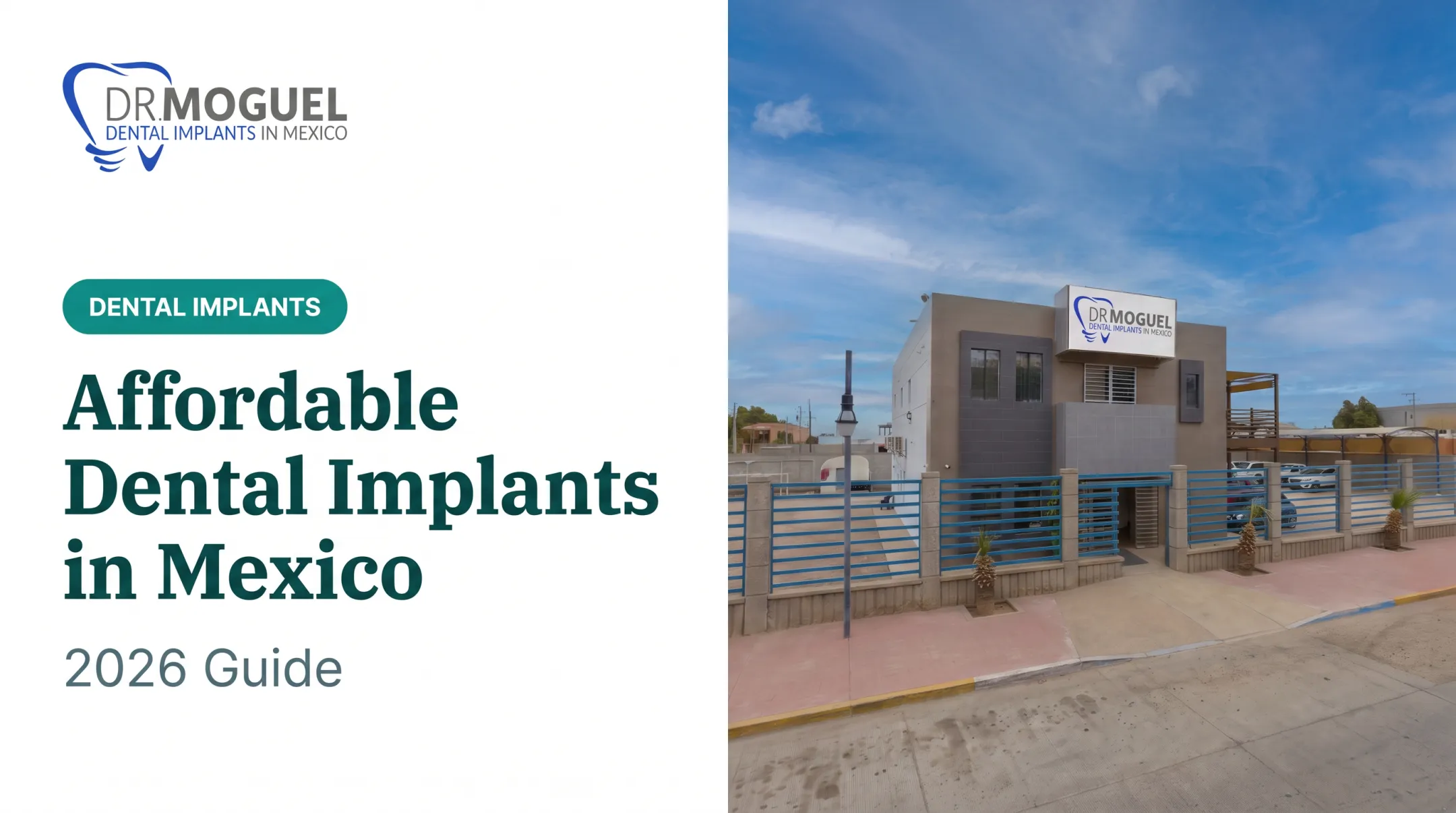
Accredited Mexico clinics near the border use the same FDA-approved implant brands (Nobel Biocare, Straumann, MegaGen) and follow ADA/ADM-equivalent protocols. Dr. José Moguel, for instance, holds board certification through both the ADA and Asociación Dental Mexicana, plus membership in the Consejo Mexicano de Periodoncia.
Convenience
Dental Implants in Mexico sits roughly a three-minute walk from the Andrade, California pedestrian crossing. The clinic offers:
- Bilingual patient coordinators
- Border-crossing guidance, including parking details (typically $5-$10 per day)
- Hotel recommendations in Yuma, Arizona
Warranty and Long-Term Value
Many US clinics offer little more than a standard manufacturer warranty on the implant hardware itself. Dr. Moguel's practice provides a lifetime warranty on implant hardware and a five-year warranty on prosthetic crowns, bridges, and zirconia arches, contingent on maintaining basic professional cleanings.

How to Find the Cheapest Legitimate Dental Implants Without Cutting Corners
- Get multiple written quotes. Confirm exactly what's included (imaging, anesthesia, follow-ups) before comparing totals side by side.
- Check dentist credentials. Board certification in periodontics or oral implantology, plus a verified case volume, matters more than sticker price. Dr. Moguel, for example, has placed more than 17,000 implants over 38+ years.
- Ask about financing. Options like healthcare credit lines, cashier's checks, or major credit cards can spread out the upfront cost. A free, no-obligation consultation can clarify total treatment cost before you commit.
- Factor in travel savings. Even with flights, parking, and a hotel stay, Mexico-based full-arch treatment typically still costs far less than equivalent US treatment.
- Confirm insurance documentation support. Ask whether the clinic provides itemized English receipts with ADA CDT codes (such as D6010 for surgical implant placement) and X-rays needed for reimbursement or appeals.
Frequently Asked Questions
What is the cheapest price for a dental implant?
The lowest documented single-implant prices run $1,646-$4,157 in the US (crown excluded) versus $750-$1,500 at established Mexico border clinics, including the implant, abutment, and crown.
What is the cheapest type of dental implant?
A single-tooth endosteal implant is generally the cheapest option, since it requires just one post and one crown rather than the multiple implants needed for All-on-4 or All-on-6 systems.
How much is a full set of All-on-4 implants?
US pricing averages $15,176 per arch, ranging from $11,640-$27,500. Mexico-based specialist clinics quote All-on-4 starting from $6,000 per arch for comparable treatment.
How can I get dental implants if I can't afford them?
Financing plans, dental school clinics, insurance documentation support, and treatment in Mexico are the main cost-reduction routes. Many clinics also offer free consultations so you can map total cost before committing.
What is the cheapest option to replace a tooth?
Dentures and bridges cost less upfront than implants. Full dentures range from $340-$11,018. Implants usually last decades with proper care, so they often deliver stronger long-term value.
Conclusion
Dental implant costs in 2026 vary widely by procedure type, materials, and where you have treatment done. A single tooth might cost $1,500 or $7,000 depending on location, including clinics just across the US-Mexico border.
Lowest price alone does not mean best value. Credentials, implant brand, and warranty terms all shape what you pay over the life of the implant. If you want major savings without cutting corners on quality, a free consultation with a board-certified specialist in Los Algodones is worth exploring before you commit to a treatment plan.