
Picking the wrong path can mean unexpected bone grafting, a treatment timeline that stretches into a second year, or thousands in avoidable costs. That's especially true for patients weighing treatment abroad, where getting the right diagnosis upfront matters even more.
This guide breaks down cost, procedure, recovery, and suitability, with insight from Dr. José Moguel, a board-certified periodontist practicing in Los Algodones, Mexico.
TL;DR
- All-on-4 uses four angled implants per arch, often skipping bone grafting and allowing same-day temporary teeth
- Traditional implants use one post per tooth (or 6–8 per arch) for individual teeth, with more surgery and time
- All-on-4 is usually faster and more affordable; traditional fits strong bone and partial tooth loss
- Both last for decades when placed correctly and maintained properly
- The specialist placing your implants matters more than the implant count alone
All-on-4 vs Traditional Implants: Quick Comparison
| Factor | All-on-4 | Traditional Implants |
|---|---|---|
| Cost per arch | Lower (fewer implants, less grafting) | Higher, especially for 6-8 implant full-arch cases |
| Implants used | Four per arch | One per missing tooth, or 6-8 for full-arch |
| Bone grafting | Rarely needed (angled posterior placement) | Often required if bone loss is present |
| Timeline | Same-day temporary teeth; final prosthesis in 4-6 months | 6-12+ months, longer with grafting |
| Best suited for | Full-arch loss, moderate bone loss, denture wearers | 1-3 missing teeth, healthy adjacent teeth, strong bone |
At Dental Implants in Mexico, All-on-4 starts from $6,000 per arch, compared to $1,500 for a single traditional implant. Once you're replacing 6 or more teeth individually, traditional treatment often costs more than a full-arch All-on-4.

What Is All-on-4?
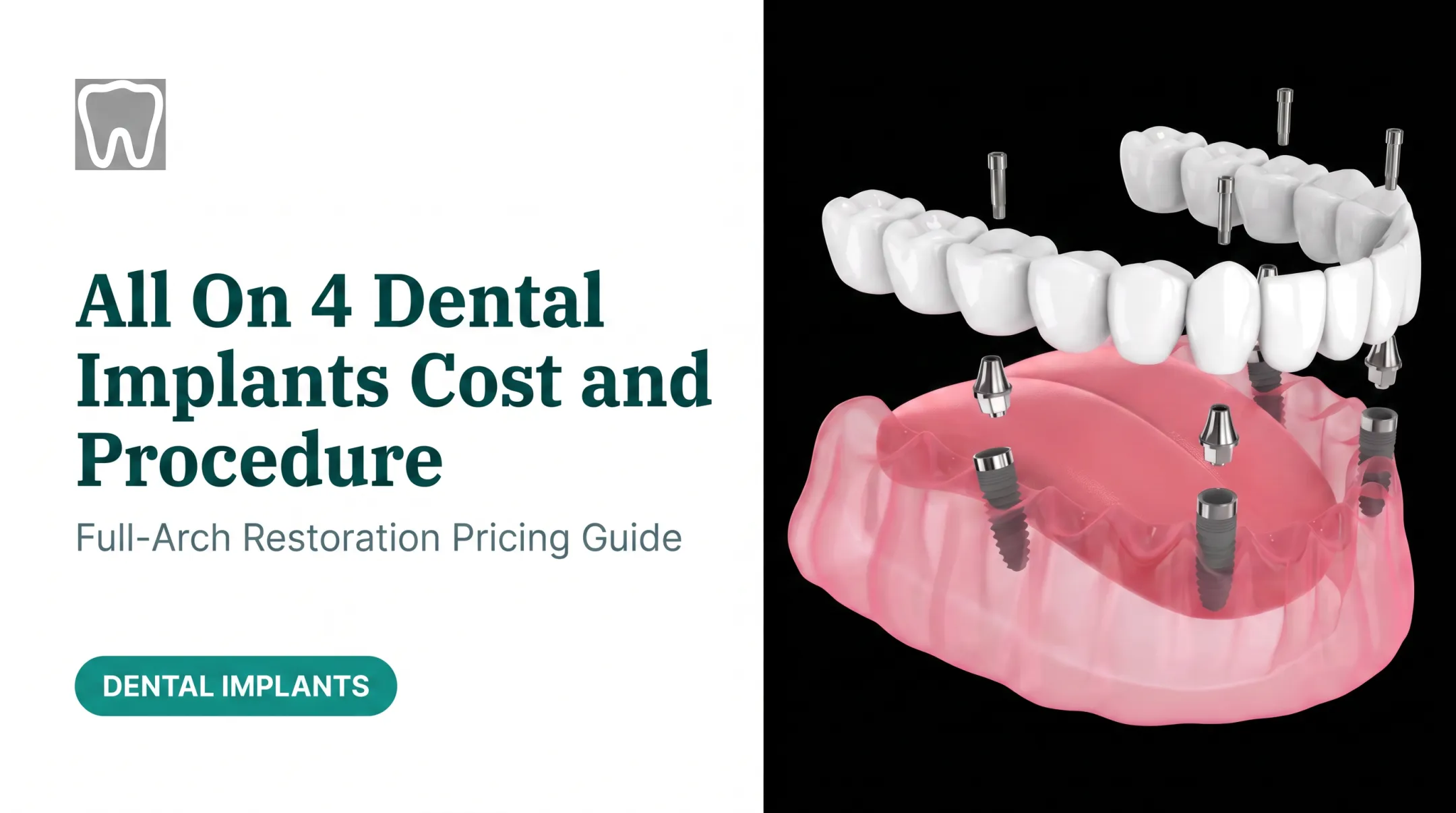
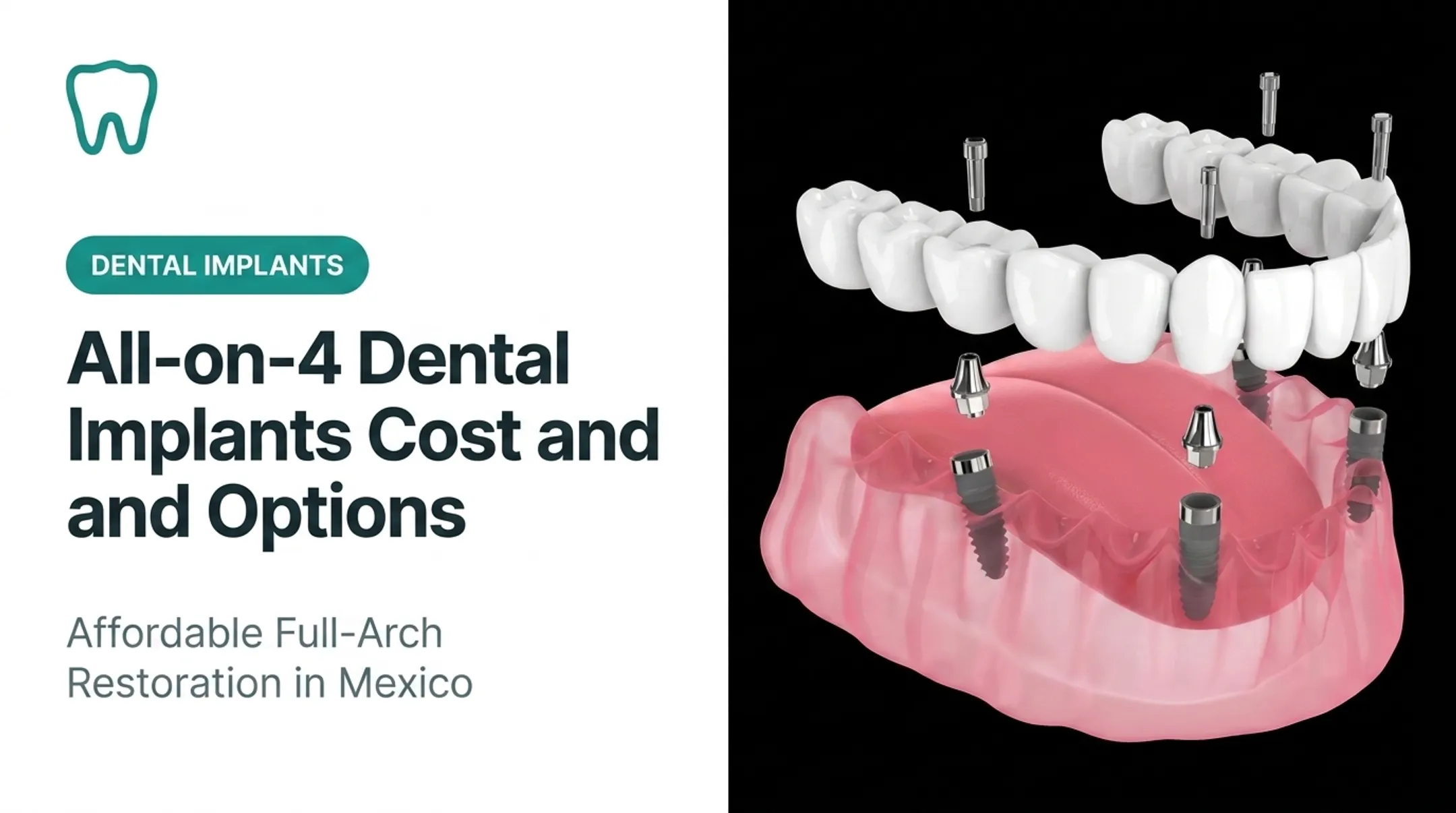
All-on-4 is a full-arch restoration technique that anchors an entire row of teeth on just four implants: two placed vertically at the front, and two angled up to 45 degrees toward the back of the jaw.
That angle is deliberate engineering. Angling the posterior implants lets the surgeon reach denser, more available bone while avoiding nerves and the sinus cavity.
A 2014 peer-reviewed review confirmed this design supports immediate loading and shorter cantilevers in properly selected patients. Many people walk out with temporary teeth the same day as surgery.

Why Patients Choose It
- Fewer surgical sites means faster healing
- Often eliminates the need for bone grafting
- Same-day function with a temporary fixed bridge
- Lower overall cost compared to placing 6-8 individual implants
For patients needing extra support, the clinic also offers All-on-6 (six implants, from $8,000 per arch) and its patented 3-ON-8™ protocol. That approach uses eight implants split into three independent bridges, which spreads chewing force across more support points and allows localized repair if one segment ever needs attention.
Use Cases of All-on-4
All-on-4 fits patients who are missing most or all teeth in an arch, or current denture wearers ready to upgrade to something fixed. It's built for a streamlined path: extraction to fixed teeth in a single visit, which is exactly why it appeals to patients traveling for treatment.
The data backs up patient satisfaction. A 2017 systematic review found 95.6% of patients rated their outcome as excellent, with a minimum implant survival rate of 97.6% at 36 months.
A separate longitudinal study tracking 245 patients and 980 implants found patient-related success of 94.8% at 5 years, with prosthesis survival holding at 99.2% over a decade.

What Is Traditional Implant Treatment?
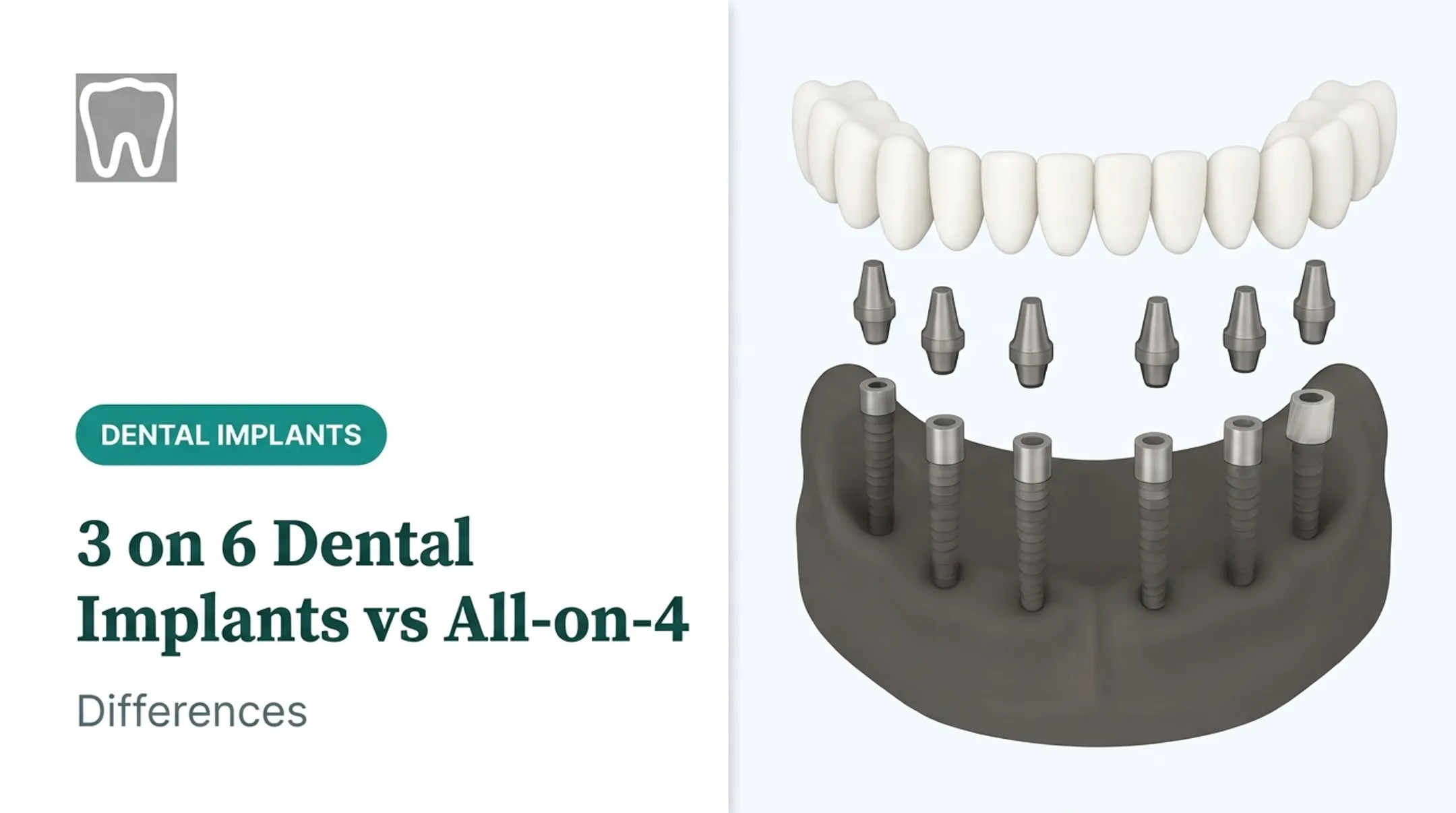
Traditional implant treatment places an individual titanium post for each missing tooth. For full-mouth cases, that typically means 6-8 implants per arch, each supporting its own crown or contributing to a segmented bridge.
Core benefits:
- Preserves healthy adjacent teeth (no grinding down neighboring teeth for a bridge)
- Precise, individualized restoration per tooth
- Strong long-term durability with proper maintenance
Because traditional implants rely on healthy, sufficient bone at each site, grafting or a sinus lift is a common add-on when bone density falls short. According to Dr. Moguel's clinic documentation, a standard graft adds roughly 3-4 months of healing, while a sinus lift can require 6-9 months before an implant can even be placed.
Use Cases of Traditional Implants
This approach best fits patients missing 1-3 teeth with good bone density who'd rather not touch healthy areas of the mouth. Picture someone missing a molar on one side and a premolar on the other — non-adjacent gaps. Placing individual implants at each site, rather than connecting them under one prosthesis, preserves the natural structure in between.
Long-term data supports the investment. A 20-year prospective study found a 93% implant survival rate over two decades.
A 2024 meta-analysis put mean survival at 92% with a 95% confidence interval of 82%-97%. With correct placement and maintenance, these implants often outlast most other dental work.

All-on-4 vs Traditional: What Is Better?
Neither wins outright. The right call depends on:
- Bone density: moderate bone loss favors All-on-4's angled placement
- Number of missing teeth: full-arch loss vs. a few scattered gaps
- Budget: per-arch cost vs. per-tooth cost adds up differently
- Timeline: weeks vs. potentially a year with grafting
- Maintenance preferences: one connected prosthesis vs. individual crowns
General rule of thumb:
- Choose All-on-4 for full-arch loss, bone-loss concerns, and a faster turnaround
- Choose traditional implants for partial tooth loss when existing bone is strong and worth preserving
None of this should be guessed. A 3D Cone Beam CT scan is non-negotiable before committing to either path. It is the only way to see bone density, width, and nerve position in three dimensions instead of relying on a flat 2D X-ray.
Why Patients Choose Dental Implants in Mexico for Full-Arch Treatment
US and Canadian patients cross the border for All-on-4, All-on-6, and 3-ON-8™ protocols with Dr. José Moguel, a board-certified periodontist with 38+ years of experience and 17,000+ implants placed.

What patients get:
- 60–70% cost savings versus typical US pricing (often $20,000–$30,000 per All-on-4 arch vs. $6,000–$9,000 in Los Algodones)
- American-standard technology, including 3D Cone Beam CT imaging and an in-house digital workflow
- Premium FDA-approved implant brands: Nobel Biocare, Straumann, and MegaGen
- Bilingual staff and travel guidance, including Yuma, Arizona hotel options and an Andrade, California border-crossing checklist
The clinic is about a three-minute walk from the Andrade border crossing, so the trip in for treatment stays simple and predictable.
Ready to find out which option fits your bone structure and goals? Book a free, no-obligation consultation to get a personalized treatment plan.
Conclusion
Neither All-on-4 nor traditional implants wins for every patient. The better fit depends on your situation:
- Bone density and whether grafting is likely
- How many teeth you need to replace
- Budget and how fast you want fixed teeth
Both can deliver stable, long-lasting function when planned and placed by an experienced implant specialist.
Full-arch loss with a need for speed and lower overall cost points toward All-on-4. A few missing teeth and solid bone favor traditional implants for precise, tooth-by-tooth restoration.
Get a consultation with 3D imaging before you commit, so the plan matches your bone, timeline, and budget—not a generic default.
Frequently Asked Questions
Which is better: traditional dental implants or All-on-4?
Neither is universally better. All-on-4 suits full-arch cases with some bone loss, while traditional implants work best for patients with strong bone and only a few missing teeth.
At what age should you not get dental implants?
There's no strict upper age limit. Candidacy depends on overall health, bone density, and healing capacity, not age alone. Implants remain a predictable option for many older patients who are healthy enough to heal.
How much does All-on-4 cost compared to traditional implants?
All-on-4 starts from $6,000 per arch at Dental Implants in Mexico, versus $1,500 per traditional single-tooth implant. Once you need 6+ individual implants, All-on-4 usually becomes the more cost-effective full-arch option.
How long do All-on-4 implants last?
The implant posts themselves can last decades with proper care. The prosthesis attached to them may need replacement or relining after 10-15 years of daily wear.
Can I get All-on-4 if I have bone loss?
Often, yes. The angled posterior implant placement reaches denser bone and frequently allows patients with moderate bone loss to skip grafting entirely. A CBCT scan confirms candidacy.
Is recovery faster with All-on-4 than traditional implants?
Generally, yes. All-on-4 offers same-day temporary teeth, while traditional implants often involve a staged healing process (especially with grafting) that stretches the overall timeline.