
Reading about "benefits" online is easy. Understanding how those benefits actually play out during recovery, in your monthly budget, and ten years down the road is harder. This article breaks down exactly that, plus what happens if treatment gets delayed, and how patients from the US and Canada are accessing this care affordably in Los Algodones, Mexico.
TL;DR
- Full mouth implants replace an entire arch with 4–8 implants, restoring permanent chewing function
- Restored chewing, bone preservation, natural aesthetics, and stronger long-term value than dentures
- Systematic reviews report survival rates as high as 99.8% beyond 24 months
- Dr. José Moguel cites a 98%+ success rate across 17,000+ implants placed
- Patients traveling to Los Algodones often save 60–70% versus U.S. prices with an ADA/ADM board-certified periodontist
What Are Full Mouth Dental Implants?
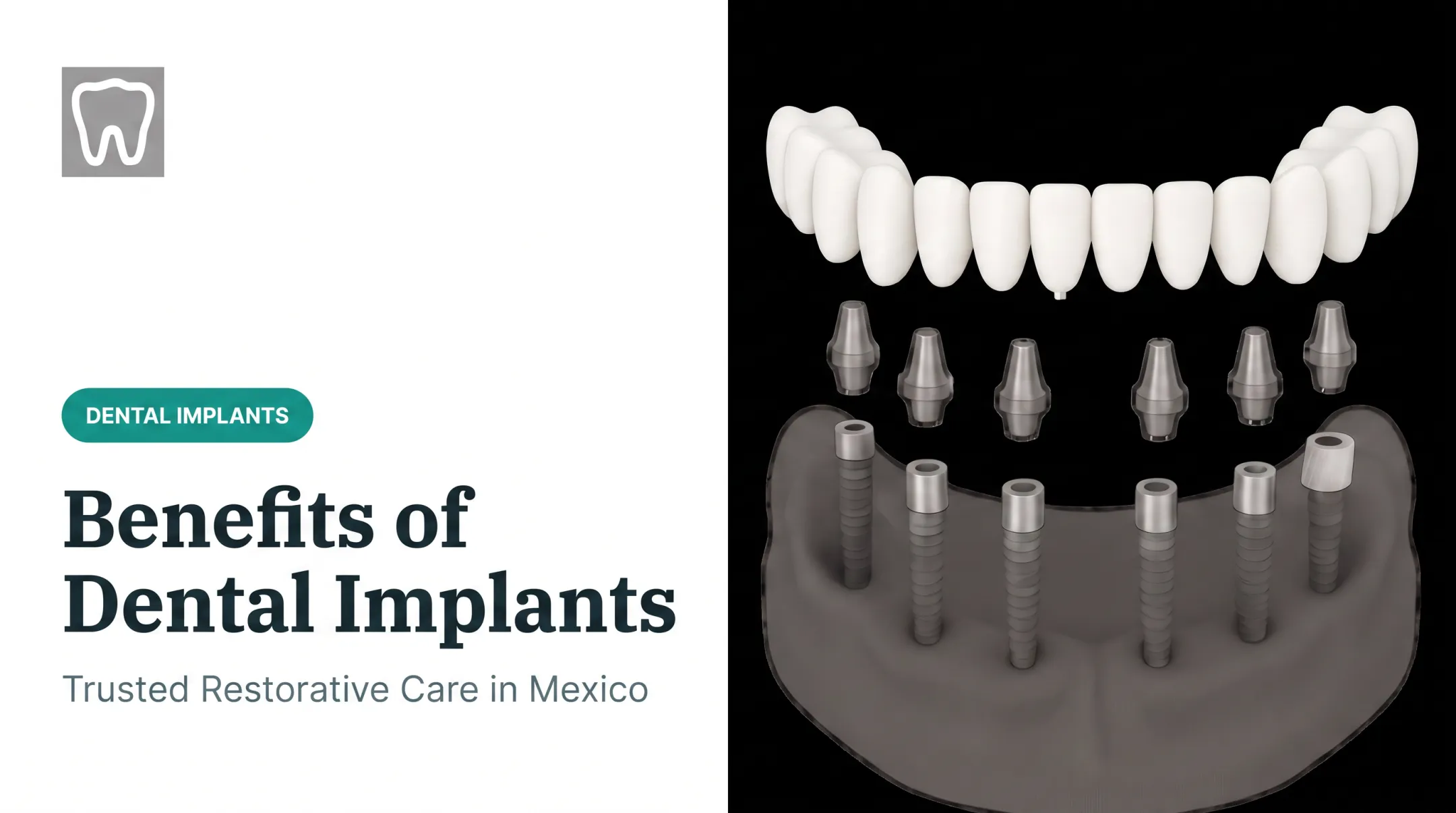
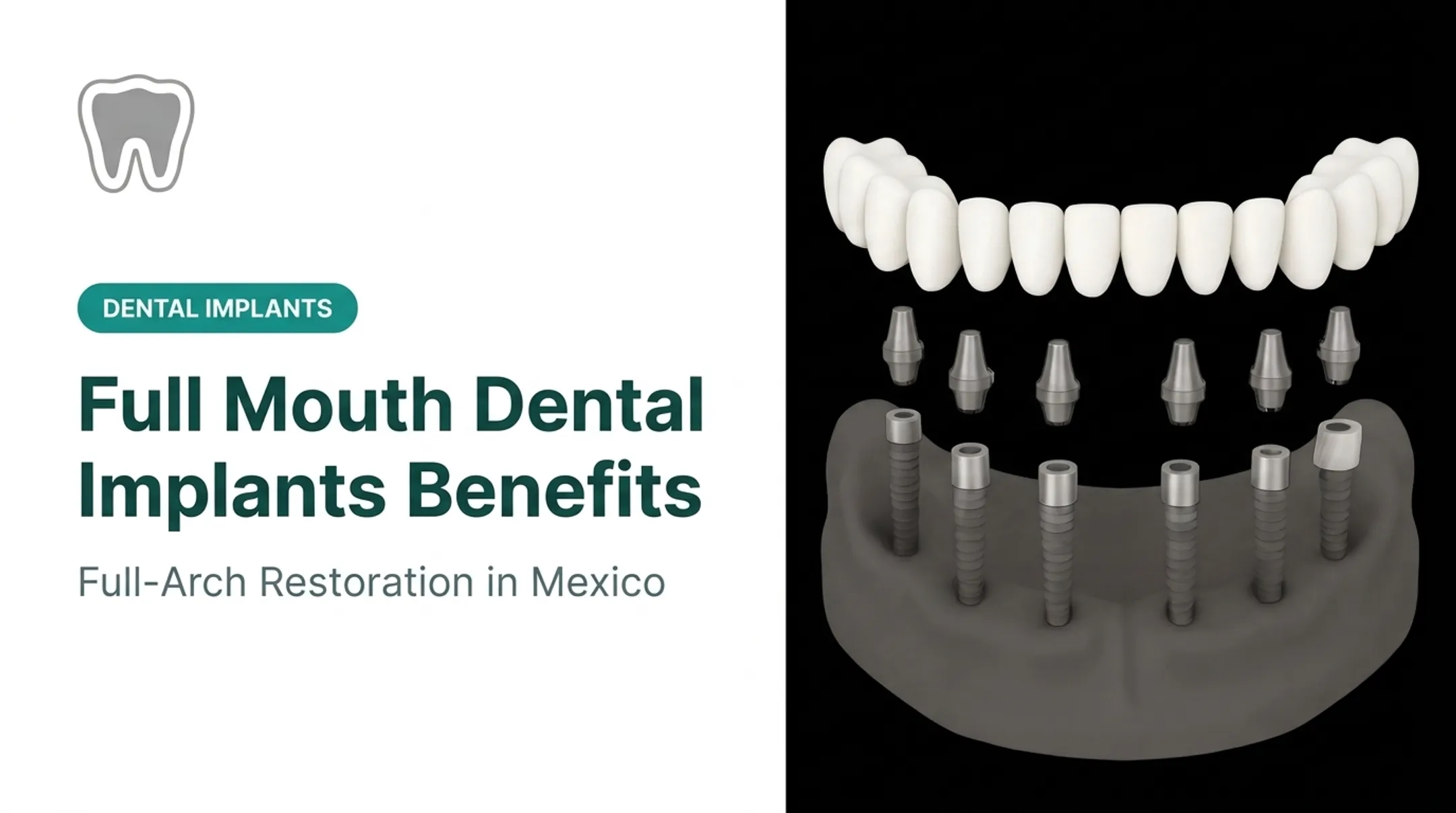
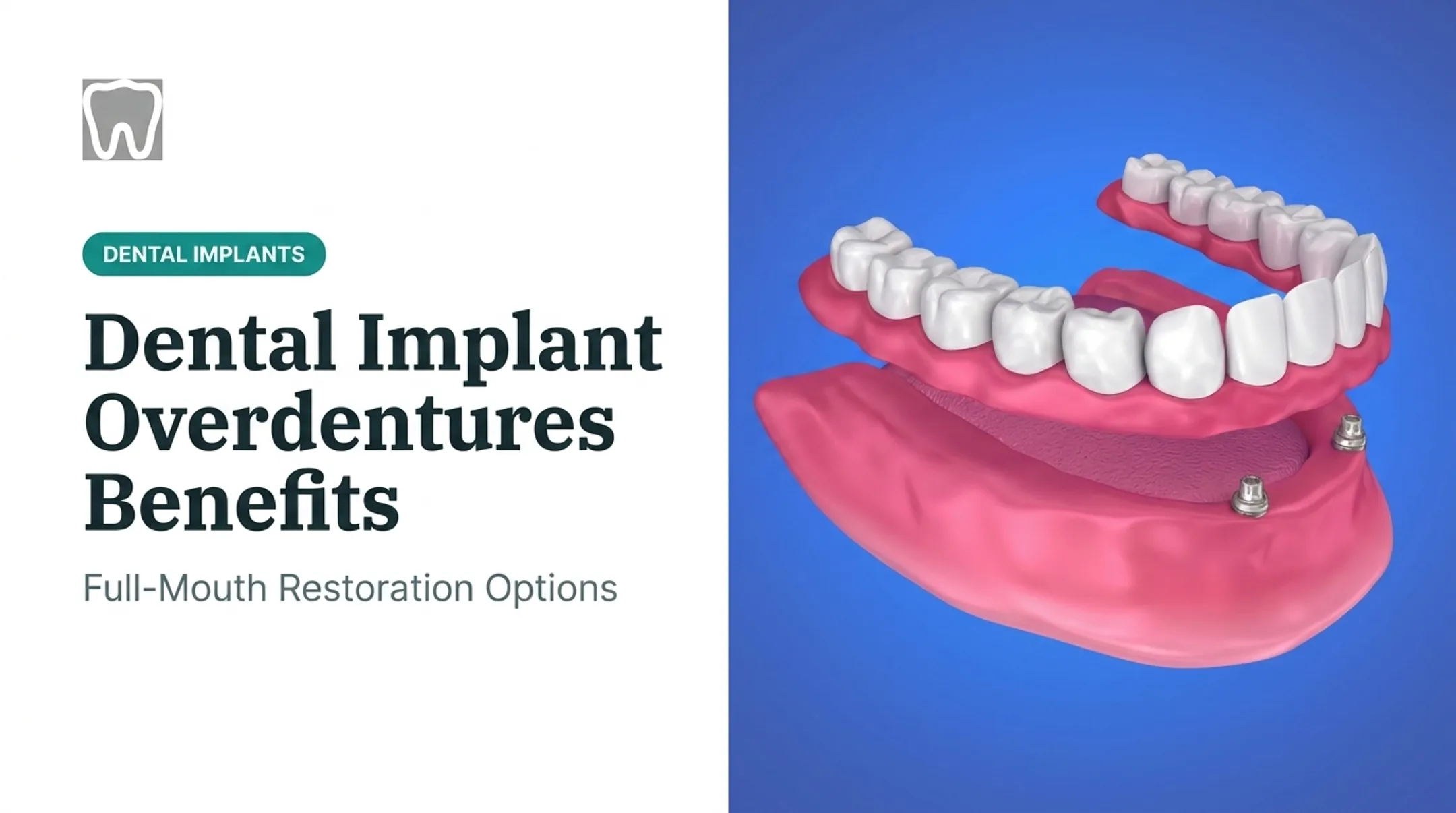
Full mouth dental implants are titanium posts placed in the jawbone that anchor a complete, fixed arch of prosthetic teeth. They replace all or most missing or failing teeth in one arch, or both.
This approach is typically used for patients dealing with:
- Extensive tooth loss
- Failing or ill-fitting dentures
- Severe periodontal disease
Protocols vary by how many implants are placed and how the bridge is designed:
- All-on-4: Four implants per arch supporting one fixed bridge
- All-on-6: Six implants per arch for added stability
- 3-ON-8™: Eight implants supporting three independent bridges (Dr. Moguel’s patented protocol), so one section can be repaired without touching the rest

Full mouth implants restore lifelong chewing function, speech clarity, and confidence.
Key Benefits of Full Mouth Dental Implants
The benefits below focus on outcomes patients actually track, not abstract marketing claims: chewing ability, appearance, bone health, longevity, and lifetime cost.
Restored Chewing Function and Comfort
Loose dentures slip. They restrict diet. They require adhesives that still fail at the worst moments. Fixed implant-supported teeth eliminate that entirely. A 2020 randomized clinical trial found that patients with implant-supported fixed dentures had significantly higher masticatory efficiency compared to conventional denture wearers, particularly during early chewing cycles. In the clinic's own case history, one 3-ON-8 patient achieved 100% restoration of chewing force after full healing, while a separate All-on-4 case reported 90% restoration. What patients notice: stronger bite, wider diet choices, and day-to-day comfort—especially after years of dentures, when something as simple as an apple still gives them pause.
Jawbone Preservation and Facial Structure
Missing teeth don't just leave gaps—they trigger bone loss. Without the stimulation of tooth roots, the jawbone resorbs over time, and the face begins to collapse inward around the mouth. A 2016 systematic review documented continuous residual ridge reduction in denture wearers, with the sharpest losses occurring in the anterior mandible during the first years of denture use. Implants, by contrast, transmit chewing forces into the bone the way natural roots do, which can help slow that deterioration. What this protects: bone density, facial support, and the odds of needing future grafting. The difference is usually clearest after a decade of dentures or when sagging around the mouth is already visible.
Natural Appearance and Improved Confidence
Custom-shaded, custom-shaped prosthetics are designed to look like real teeth, not a denture-store smile. More importantly, a fixed restoration doesn't shift when you laugh, talk, or eat in public. A 2024 comparison of 200 patients found fixed full-arch implant prostheses scored dramatically better than dentures on the Oral Health Impact Profile (9.0 vs. 21.0, lower is better) and self-esteem measures. A gap that large often means the difference between avoiding photos and forgetting about your teeth in daily life. What improves: smile aesthetics, speech clarity, and self-esteem—particularly when most or all visible front teeth are missing.
Long-Term Durability and Value
Dentures typically need replacing every 5-10 years, according to the American College of Prosthodontists' replacement guidance. Implants are built for a different timeline. A 2020 retrospective study of full-arch implants reported 93.3% survival at 10 years and 87.1% survival at 20 years. The prosthetic bridge itself may need updating sooner, but the implant fixtures underneath can outlast multiple denture replacement cycles. Weighing the numbers:
| Factor | Dentures | Full Mouth Implants |
|---|---|---|
| Replacement cycle | Every 5-10 years | Fixtures: 10-20+ years |
| Daily maintenance | Adhesives, soaking | Brush like natural teeth |
| Bone preservation | Ongoing resorption | Stimulates bone |
| Younger patients or anyone wanting a one-time, permanent solution tend to find the upfront cost pays off over a lifetime. |

Affordable Access Through Cross-Border Care
Here's where cost and access collide. In the US, full-arch implant treatment routinely runs into tens of thousands of dollars per arch. At Dental Implants in Mexico, listed "from" pricing starts at $6,000 for All-on-4, $8,000 for All-on-6, and $15,000 for the 3-ON-8™ protocol. Those plans use the same premium implant brands—Nobel Biocare, Straumann, and MegaGen—also found in top US clinics. Dr. José Moguel brings 38+ years of clinical experience and has placed more than 17,000 implants, with board certification through both the ADA and ADM. Full-arch results hinge on precision planning and surgical experience, not brand labels alone. What changes for patients: total treatment cost, access to care, and how soon treatment can start—especially for anyone who put plans on hold over price alone.
What Happens When Full Mouth Implants Are Delayed or Ignored
Putting off treatment doesn't freeze the problem in place. It tends to make things worse:
- Accelerated jawbone loss and facial collapse around the mouth
- Worsening bite dysfunction that limits nutrition and food variety
- Increased gum complications from ill-fitting dentures or exposed sockets
- Higher eventual costs once bone grafting becomes necessary
- Reduced candidacy for certain implant protocols as bone resorption continues
None of this means the door closes forever. Even severely resorbed jawbones can often be treated with grafting or protocol adjustments. But the longer treatment waits, the more complex and expensive it usually becomes.
How to Get the Most Value from Full Mouth Dental Implants
Full mouth implant value isn’t left to chance. A few controllable choices shape durability, comfort, and long-term cost.
- Choose a board-certified specialist. A periodontist or oral surgeon with documented full-arch experience, not just general dentistry credentials.
- Insist on thorough evaluation. Require 3D Cone Beam CT imaging to map bone density, nerve pathways, and sinus structures before any surgical plan is set.
- Commit to aftercare. Salt-water rinses, soft-bristle brushing, and scheduled follow-ups during the 4-6 month healing window between temporary and final restorations.
- Compare transparent, itemized pricing. Free consultations let you evaluate options before committing to any provider.

Dental Implants in Mexico follows this same path: a 3D CBCT scan up front, clear itemized planning, and a lifetime warranty on implants.
Conclusion
Full mouth dental implants deliver benefits that compound over time: better chewing, preserved bone, a natural smile, and long-term value that dentures simply can't match.
But the results depend on who places them. An experienced, board-certified provider directly affects success rates and how predictable your outcome will be.
If you're weighing your options, a free consultation is the lowest-risk way to find out whether you're a candidate and what treatment would realistically cost.
Frequently Asked Questions
Can I get dental implants in my whole mouth?
Yes. Protocols like All-on-4, All-on-6, and 3-ON-8™ are specifically designed to replace an entire arch of teeth using strategically placed implants rather than one implant per missing tooth.
How painful are full mouth dental implants?
You’ll be under local anesthesia with IV conscious sedation, so you feel nothing during surgery. Mild discomfort afterward is typically managed with medication for a few days.
What is the average cost of full mouth dental implants?
In the US, full-arch treatment often costs well over $10,000 per arch. In Los Algodones, Mexico, pricing starts around $6,000–$15,000 depending on protocol, with full-mouth reconstruction typically totaling $16,000–$24,000.
How many implants do you need for a full set of teeth?
Most protocols use 4 to 8 implants per arch. All-on-4 uses four, All-on-6 uses six, and 3-ON-8™ uses eight, split into three independent bridges for added redundancy.
What is the success rate of full mouth dental implants?
Published research cites survival rates as high as 99.8% beyond 24 months for All-on-4 restorations. Dr. Moguel's practice reports a 98%+ verified success rate, though outcomes depend heavily on provider experience and patient bone health.
How long will full mouth dental implants last?
Implant fixtures can last 10-20+ years or longer with proper care, per long-term studies. The visible prosthetic bridge may need repair or replacement after 10-20 years depending on wear and maintenance.