
Here's where the confusion usually starts: "screwless" doesn't mean there's no screw anywhere in the system. It means the visible crown attaches to the abutment with dental cement or a precision friction-fit, rather than a screw running through the tooth. Patients comparing quotes often assume they're looking at a completely different implant system when, in reality, the titanium post underneath is identical.
This guide breaks down exactly how screwless (cement-retained) implants work, stage by stage, so you can walk into a consultation asking the right questions.
TL;DR
- Screwless implants attach the crown with dental cement or friction-fit instead of a screw.
- Placement and healing match traditional implants; only the crown attachment method differs.
- Main benefit: no visible screw hole, giving a more natural look, especially on front teeth.
- Main trade-off: harder to retrieve or repair, and leftover cement can irritate gums if cleanup is incomplete.
- Best for aesthetic zones when bone volume and gum tissue are healthy.
What Are Screwless Dental Implants?
A screwless implant is simply a crown that's bonded to the abutment with cement or a tight friction-fit connection, instead of being secured with a screw through an access hole. That's the entire distinction.
The problem this solves: screw-retained crowns need a small hole drilled through the biting surface so the dentist can reach the screw. That hole gets filled with composite afterward, but it can still show as a faint discoloration or create a minor weak point in the crown. Cement retention skips this issue entirely—there's no channel to fill because there's no screw to reach.
What screwless implants are not: a separate implant system. The titanium or zirconia fixture placed into the jawbone is the same fixture used in screw-retained cases. The difference happens entirely at the crown stage, months after the implant has already fused with the bone.
There are two versions worth knowing:
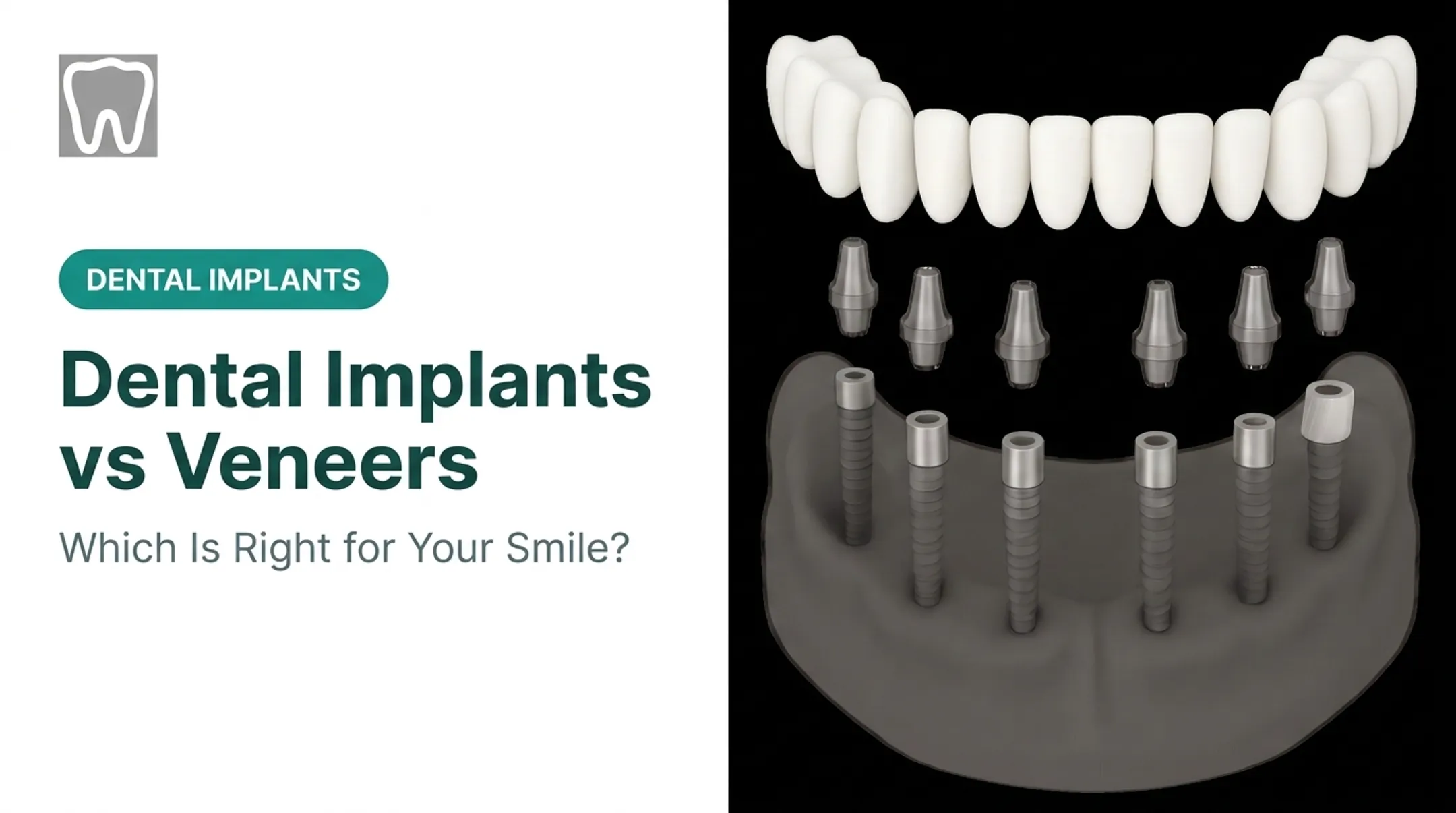
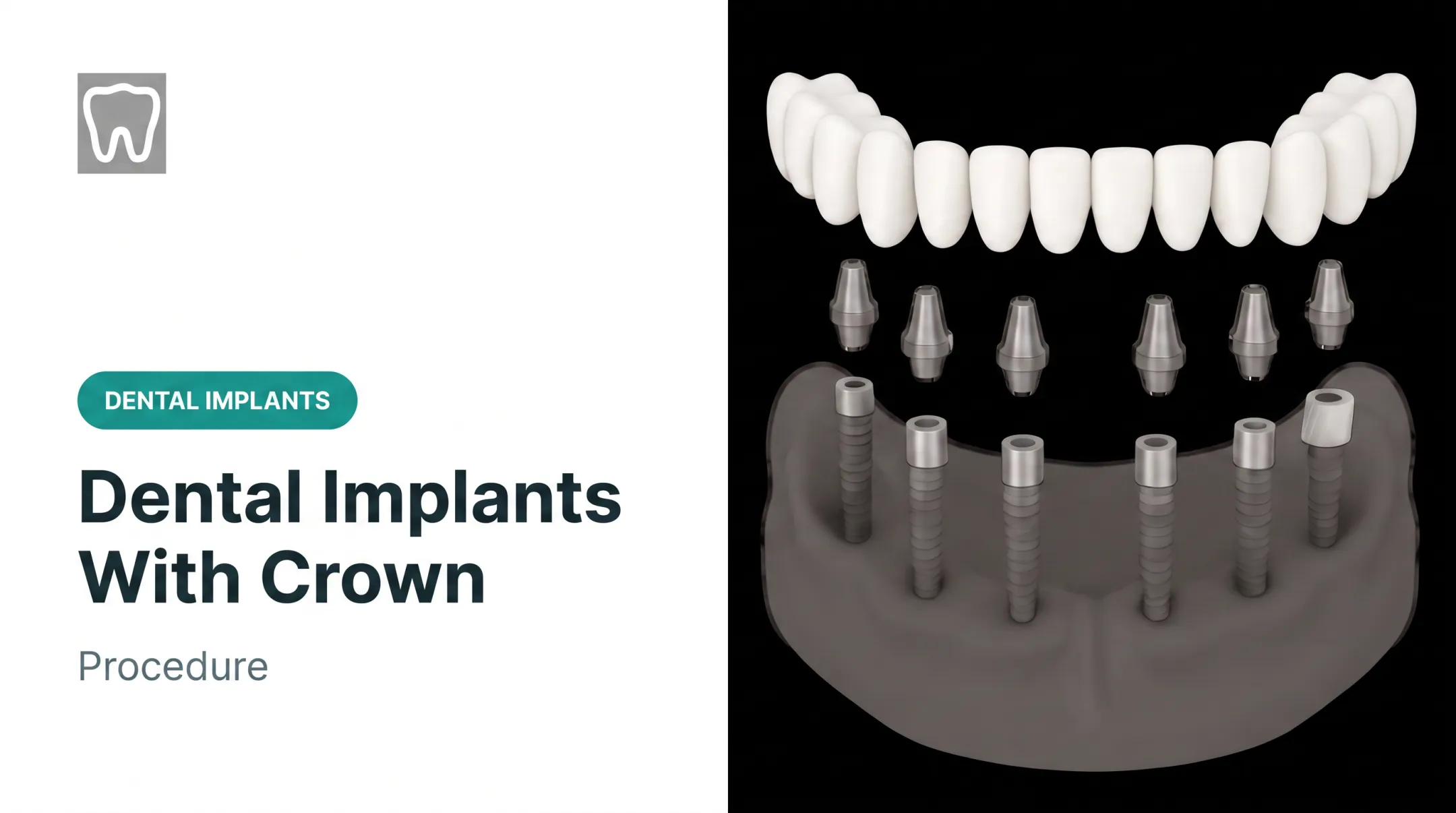
- Cement-retained titanium implants – a two-piece system where an abutment screws into the fixture, and the crown is then cemented onto that abutment.
- One-piece zirconia/ceramic implants – often skip the separate abutment step altogether, with the crown bonded directly onto the exposed portion of a single-component implant.
Despite screw-retained crowns being easier to maintain long-term, cement retention remains popular for one simple reason: it looks better in the smile zone, particularly on front teeth where a screw hole would be visible when you laugh or talk.

How Do Screwless Dental Implants Work?
The process follows the same basic sequence as any implant treatment: placement, healing, abutment fitting, and finally, crown bonding. The only unique part happens at the very end.
Implant Placement
A biocompatible titanium or zirconia post is surgically placed into the jawbone under local anesthesia. For a single tooth, placement typically takes under an hour.
Success depends on enough bone volume and density to support the fixture. That is assessed beforehand with 3D Cone Beam CT imaging.
If imaging shows insufficient bone, a bone graft or sinus lift may be needed before placement can move forward. Grafts typically require an additional 3-4 months of healing before the site is ready.
Abutment Fitting and Cementation
Once the implant fuses with the jawbone through osseointegration (usually 3-4 months in the lower jaw and 6-8 months in the upper jaw), a custom abutment is attached. Digital scans then guide fabrication of the final crown.
What makes the restoration screwless is the final connection: the dentist bonds the crown with dental cement or a precision friction-fit, so no screw access channel is needed.
This matters for fit accuracy and bite alignment. A passive, well-seated crown reduces unnecessary stress on the surrounding bone and gum tissue, which supports longer-term stability.

Cement Cleanup and Fit Verification
This is the stage where screwless implants require the most skill. Leftover cement trapped under the gumline is the single biggest risk with this method.
Dentists control for this by:
- Checking margins to make sure the crown edge is accessible for cleanup, not buried too deep beneath the gum.
- Adjusting occlusion so the bite feels natural and doesn't overload the implant.
- Inspecting tissue around the crown for any signs of irritation before finalizing the case.
Cleanup deserves that attention. In a prospective clinical and endoscopic study, excess cement was linked to signs of peri-implant disease in 81% of cases. After the excess cement was removed, those signs cleared in 74% of the affected implants (Wilson et al., 2009).
Cement retention remains a valid option when the dentist is meticulous about margin access and residual cement removal.
Final Restoration
The end result is a crown with no visible hardware, custom-shaded and contoured to match neighboring teeth. It functions and looks like a natural tooth, whether it's a single front-tooth replacement or part of a larger multi-unit restoration.
Done well, and maintained with good oral hygiene, implant restorations have a clinical success rate above 98% and are built to last for decades.

Screwless vs. Screw-Retained Implants: Key Differences
| Factor | Screwless (Cement-Retained) | Screw-Retained |
|---|---|---|
| Aesthetics | No visible access hole; clean, natural look | Small filled hole may show, especially up close |
| Best use case | Front, smile-zone teeth | Posterior, high-load teeth |
| Retrievability | Difficult to remove; often requires replacing the crown if damaged | Can be unscrewed for repair or maintenance |
| Main risk | Residual cement causing gum irritation or inflammation | Screw loosening or fracture over time |
Research shows neither option is a clear universal winner. A systematic review found no significant difference in marginal bone loss between the two methods (Gaddale et al., 2020).
Full-arch data shows a trade-off: more biologic complications with cemented restorations, and more technical complications with screw-retained ones. The right choice depends on your specific case, not a blanket rule.

Where Screwless Implants Fit Best
Screwless implants work best for single anterior tooth replacement, where appearance matters more than easy retrievability.
Good candidates typically have:
- Adequate restorative space for a well-fitted crown
- Healthy gum tissue with an accessible margin for cement cleanup
- Sufficient bone density for a passive, stable fit
For full-arch or high-load restorations, priorities shift toward stronger, retrievable fixation. All-on-4, All-on-6, or Dr. Moguel's patented 3-ON-8™ protocol are generally preferred over cement-retained crowns in full-mouth cases. The 3-ON-8™ approach uses 8 titanium implants to support 3 independent bridges.
These systems favor long-term serviceability across a full arch, where retrieving and maintaining multiple units matters more than in a single-tooth scenario.
Conclusion
The surgical foundation of a screwless implant is identical to a traditional one. You get the same titanium or zirconia post, osseointegration timeline, and imaging and planning process. The only difference is how the crown attaches at the very end.
Understanding that distinction helps you ask better questions during a consultation and compare quotes accurately.
Dr. José Moguel, a board-certified periodontist with over 38 years of experience and more than 17,000 implants placed, offers free consultations that include 3D CT imaging and a bone-density assessment. That visit can clarify whether a screwless, screw-retained, or full-arch protocol fits your case.
Frequently Asked Questions
What is the average cost of screwless dental implants?
Cost varies by material, case complexity, and clinic location. Screwless crowns are often comparable to or slightly higher than screw-retained ones due to the precision required for cementation.
How are screwless dental implants put in?
The implant post is surgically placed and allowed to fuse with the jawbone over several months. Once healed, an abutment is attached and the crown is cemented or friction-fit into place.
How long do screwless dental implants last?
With proper hygiene and regular checkups, these restorations can last many years, similar to screw-retained implants. Clinical success rates exceed 98% when a specialist places them.
Are screwless dental implants any good?
Yes, they're a proven, effective option, especially for a natural look in the smile zone. The main trade-off is reduced retrievability if repairs are needed later.
At what age should you stop getting dental implants?
There's no strict age cutoff. Eligibility depends on bone health, gum condition, and overall medical status rather than age alone.
How do screwless dental implants stay in your mouth?
Dental cement or a precision friction-fit bonds the crown to the abutment, which is anchored to the implant post that has fused with your jawbone.