
Introduction
Tooth loss catches up with most of us eventually. By retirement age, many seniors are missing at least one tooth, and dentists agree implants are the gold standard for replacing them. Tooth loss catches up with most of us eventually. By retirement age, many seniors are missing at least one tooth, and dentists agree implants are the gold standard for replacing them.
The problem? A single implant can run $3,500 to $5,000 in the US, and full-arch treatment often climbs past $20,000. For retirees living on fixed incomes, that price tag can feel impossible. This guide breaks down what drives implant costs, which financing and insurance options actually help, and cheaper alternatives worth considering.
It also covers a route more seniors are exploring every year: traveling to Mexico for board-certified implant care. With the right research, you can get safe, high-quality implants without touching your retirement fund.
Key Takeaways
- Single-tooth implants typically cost $3,500-$5,000 in the US, but often $1,500-$2,500 at established Mexico clinics
- Medicare generally does not cover implants, making financing, discount plans, or cross-border care essential alternatives
- Clinics in Los Algodones, Baja California, can cut costs by roughly 60-70% compared to US pricing
- Dentures, bridges, and implant-supported dentures offer lower upfront costs than replacing every missing tooth with individual implants
- Experience and board certification matter more than finding the absolute lowest price
Understanding the Cost of Dental Implants for Seniors
What a Single-Tooth Implant Includes
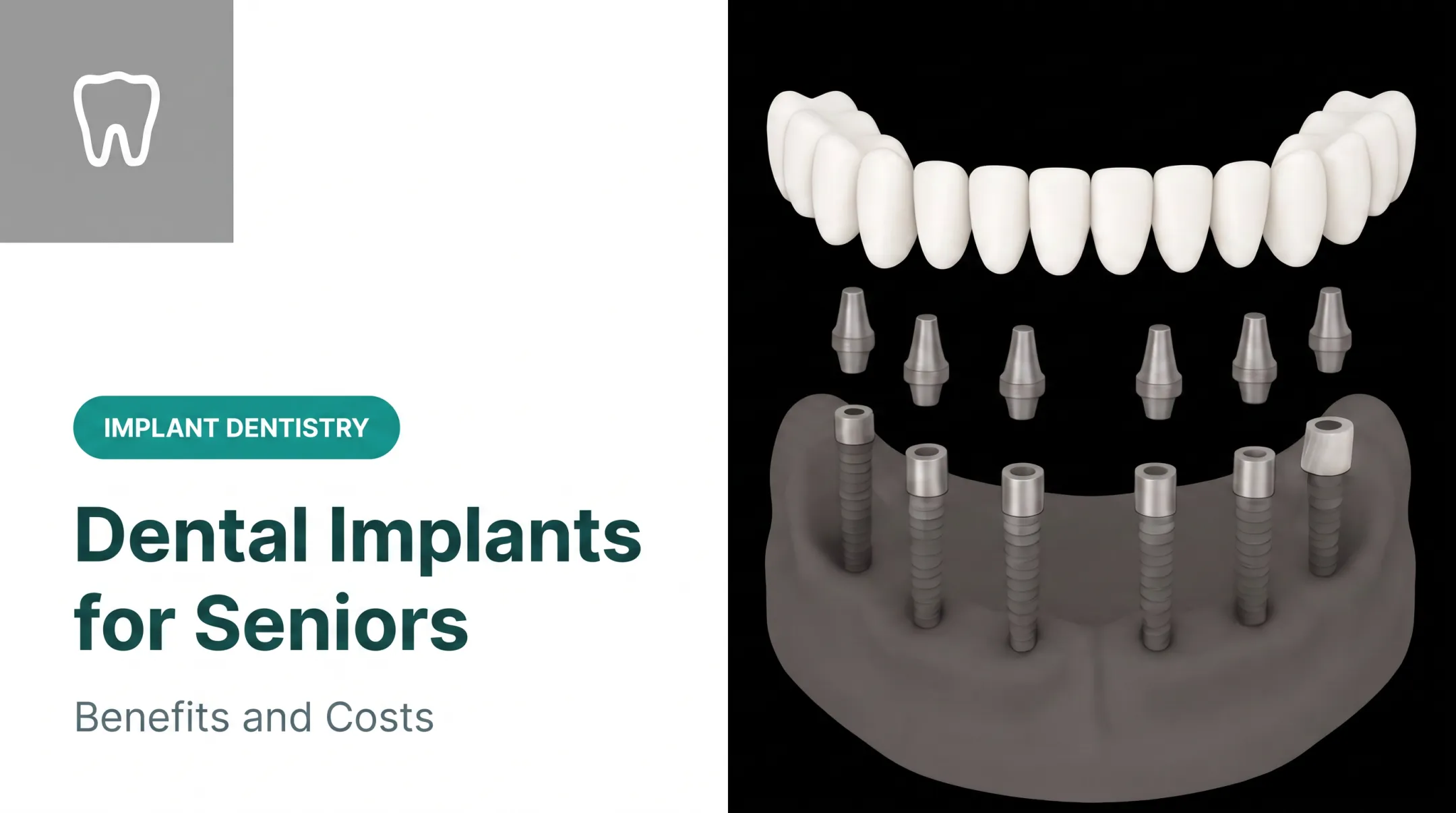
A standard implant quote covers three parts: the titanium post (the artificial root), the abutment (the connector), and the crown (the visible tooth). Together, these typically cost $3,500-$5,000 in the US.
That cost is worth it for most seniors. Unlike dentures, implants fuse with the jawbone and help prevent the bone loss that follows missing teeth. They also restore near-full chewing function, so meals are less restricted.
Full-Arch Options: All-on-4 and All-on-6
When multiple teeth are missing, full-arch solutions become more economical per tooth than replacing each one individually.
- All-on-4: Uses four implants per arch to support a full bridge; US pricing runs $20,000-$35,000
- All-on-6: Uses six implants for extra stability; US pricing runs $25,000-$40,000

Either option suits seniors with extensive tooth loss who want a fixed, non-removable solution.
What Drives the Price
Several factors push implant costs up or down:
- Material quality – titanium is standard and usually costs less; zirconia implants and crowns typically sit at the high end of US single-tooth pricing or above
- Geographic location – urban and coastal US clinics tend to charge more; Mexico border clinics commonly price 60–70% lower for comparable procedures
- Surgeon experience – specialists with advanced training and high case volumes often charge a premium, but lower complication risk
- Imaging technology – practices using 3D scanning for precise planning may build that cost into the quote
Ask for an itemized breakdown. Consultation, imaging, surgery, materials, and follow-up visits should all be listed. Watch for hidden extras like sedation fees or lab charges added after the fact.
Budgeting for Bone Grafting
Many seniors have experienced bone loss from years of missing teeth or wearing dentures. If your jawbone can't support an implant without help, you'll likely need a bone graft or sinus lift first.
- Bone grafting: $1,500-$3,000 in the US
- Sinus lift surgery: $2,500-$4,000 in the US
These are preparatory costs, not optional add-ons, so budget for them before committing to a treatment plan.
How Traveling to Mexico Helps Seniors Access Affordable Dental Implants
The Dental Tourism Model
Clinics near the US-Mexico border have built entire practices around serving American and Canadian patients. Los Algodones, Baja California, nicknamed "Molar City," is one of the largest dental tourism destinations in the world. Credentialed periodontists there use the same premium implant brands found in US offices, including Nobel Biocare and Straumann, while charging a fraction of US prices.
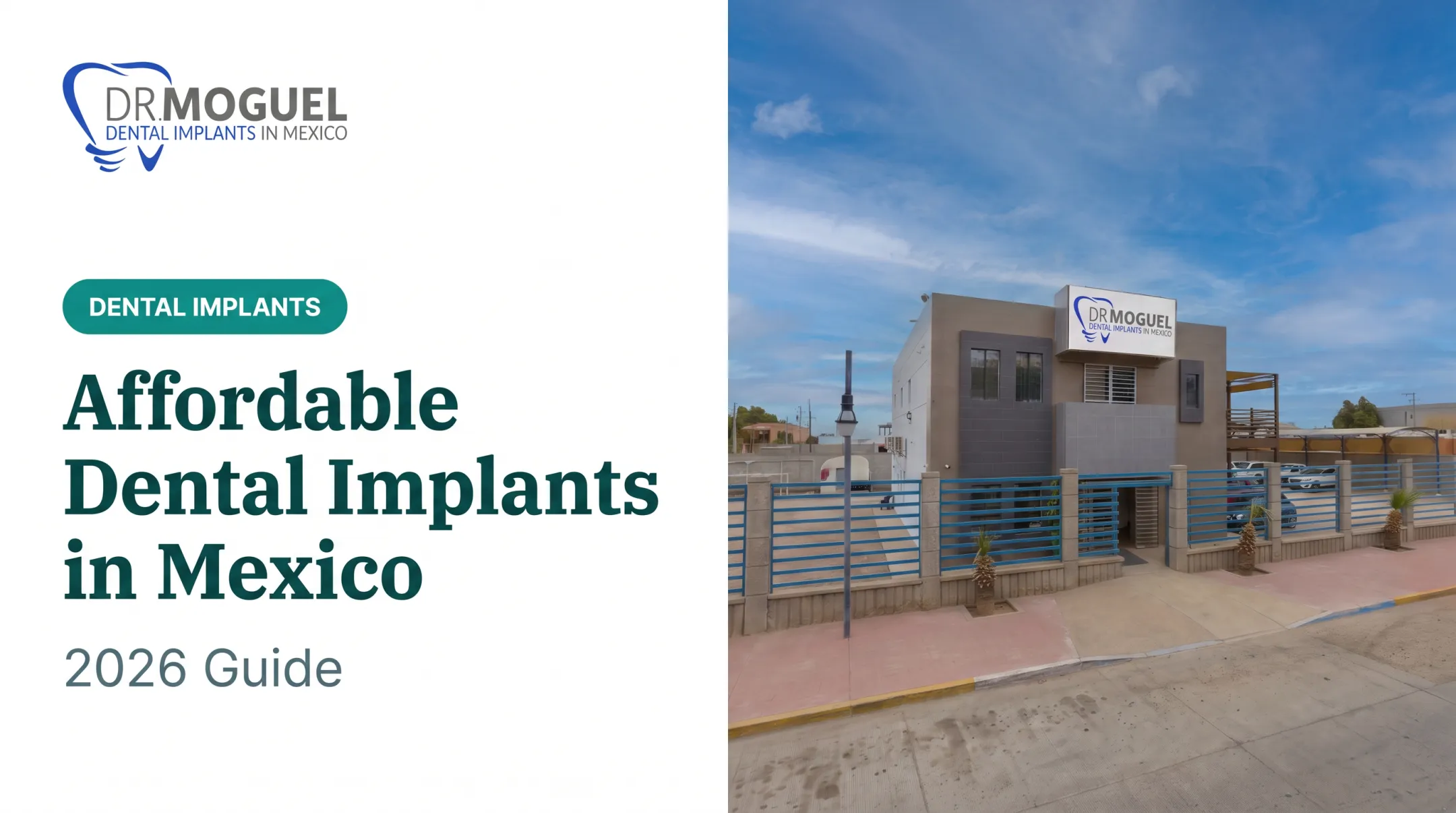
Dental Implants in Mexico, led by Dr. José Moguel, illustrates the model. Dr. Moguel has over 38 years of clinical experience and has placed more than 17,000 implants, offering All-on-4, All-on-6, and a patented 3-ON-8™ protocol for full-mouth restoration.
Real Cost Comparisons
The savings gap is significant:
| Treatment | US Price | Mexico Price |
|---|---|---|
| Single-tooth implant | $3,500-$5,000 | $1,500-$2,500 |
| All-on-4 (per arch) | $20,000-$35,000 | $6,000-$9,000 |
| All-on-6 (per arch) | $25,000-$40,000 | $12,000-$16,000 |
| Implant-supported dentures | $10,000-$14,000 | $3,500-$5,500 |

One patient, a retired teacher from Tucson, had 16 premium implants and fixed zirconia bridges placed for less than $18,000, versus a $58,000 quote he'd received in Phoenix. That's the scale of savings some seniors are finding just across the border.
Addressing Common Senior Concerns
Traveling for medical care raises fair questions. Here's what typically eases those worries:
- Proximity - the Los Algodones clinic sits roughly a three-minute walk from the Andrade, California border crossing, with Yuma International Airport just 15 minutes away
- Travel logistics - bilingual coordinators help arrange hotels in Yuma or Los Algodones and plan the visit around your schedule
- Communication - English-speaking staff handle scheduling, consultations, and aftercare instructions

Safety Reassurances
Board certification is worth checking closely. Dr. Moguel holds certification from the American Dental Association (ADA) and Asociación Dental Mexicana (ADM), uses American-standard sterilization protocols, and offers a lifetime warranty on implants placed at the clinic. Consultations are free, and quotes are meant to be transparent from the start.
Before booking anything, verify credentials directly, read recent patient reviews, and request an itemized quote in writing. That last step protects you from surprise charges after you've already crossed the border.
Financing, Insurance, and Assistance Options for Seniors
Medicare rarely covers dental implants. Medicare.gov states plainly that Original Medicare does not cover routine dental services, dentures, or implants in most circumstances. Coverage kicks in only in narrow medical exceptions, such as dental work required before a transplant or cancer treatment.
Medicare Advantage (Part C) plans may include limited dental benefits. Coverage often comes with annual dollar caps and may apply only to preventive care. Call your plan directly and ask specifically about implant coverage before assuming anything is included.
Beyond Medicare, seniors have several paths to fund treatment:
- Dental discount plans that lower fees at participating providers
- Third-party medical credit lines with promotional interest-free periods for qualified applicants
- In-house payment plans that split total cost into installments, including at many cross-border clinics
- Dental school programs where supervised students perform procedures at reduced rates
- Nonprofit or sliding-scale programs, with availability that varies by region
Ask your dentist or clinic about local grants or assistance programs. Some clinics also help assemble receipts and procedure codes for insurance reimbursement, and many US dental plans will reimburse out-of-country care when that documentation is complete.
Comparing Implants to Cheaper Alternatives
Implants aren't the only option, and for some seniors, they're not the right one. Here's how the alternatives stack up:
| Option | Upfront Cost | Durability | Daily Comfort |
|---|---|---|---|
| Full dentures | Lowest | ~10 years average lifespan | Can slip, requires adhesive |
| Partial dentures | Low | Moderate | Removable, some movement |
| Traditional bridge | Moderate | 10+ years for ceramic bridges | Fixed, but relies on adjacent teeth |
| Implant-supported (snap-in) dentures | Moderate | Long-lasting (2–4 implants) | Much more stable than removable dentures |
| Full implants | Highest | Often lifetime | Closest to natural teeth |

Snap-in dentures are a practical middle path for budget-conscious seniors. Two to four implants anchor a removable denture for $3,500–$5,500 in Mexico, versus $10,000–$14,000 in the US. You get far more stability than a standard denture without paying full implant prices.
The tradeoff: cheaper alternatives often need more frequent adjustments or replacements. A denture that costs less upfront may need relining or replacing every decade, while a well-placed implant can last a lifetime. Factor that into your long-term math, not just the sticker price.
Choosing the Right Provider and What to Expect
Questions to Ask During Consultation
Before you commit to any provider—local or abroad—ask:
- How many implants have you personally placed? Experience reduces complication risk.
- What materials will you use? Titanium versus zirconia affects both cost and longevity.
- What's the full timeline? Some cases need staged treatment over months; others qualify for same-day options.
- What's the total cost, itemized? Get consultation, surgery, materials, and follow-up spelled out separately.
What Same-Day Implants Involve
"Teeth in a Day" protocols use digital pre-planning. 3D scans create a surgical guide, and an immediate bridge is made before you sit in the chair. The surgical visit typically takes 2-3 hours under sedation and covers tooth removal, implant placement, and site preparation.
You leave with a temporary fixed smile. Full bone fusion takes 4-6 months, after which the temporary bridge is swapped for a permanent zirconia or porcelain one.
Not everyone qualifies. Bone density, gum health, and medical history all affect candidacy. A thorough consultation matters more than a fast timeline.
Do Your Homework Regardless of Location
Whether you're staying local or traveling for treatment, research the same way:
- Check board certifications independently. Don't rely only on the provider's website
- Read recent reviews, not just testimonials on the provider's own site
- Ask to see before-and-after cases similar to your situation
- Confirm warranty terms in writing before treatment begins
Frequently Asked Questions
How can seniors get affordable dental implants if they can't afford them?
Look into in-house payment plans, dental discount memberships, and third-party medical financing first. Cross-border options like clinics in Los Algodones, Mexico, can also cut costs by 60-70% compared to US pricing.
Are there free dental implants for seniors?
Fully free implants are rare. Dental schools, some nonprofits, and occasional clinical trials offer reduced-cost or subsidized care, but availability varies widely by region and often involves a waitlist.
Are dental implants worth it for seniors?
Despite the higher upfront cost, implants generally offer better long-term value than dentures. They preserve jawbone density, restore near-full chewing function, and can last a lifetime with proper care.
What is a cheaper alternative to a dental implant?
Traditional dentures, bridges, and implant-supported (snap-in) dentures all cost less upfront than full implants. Snap-in dentures offer a middle ground: more stability than removable dentures, at a lower cost than full implants.
How much does a single-tooth dental implant cost?
In the US, a single-tooth implant typically runs $3,500 to $5,000 for the post, abutment, and crown. In Los Algodones, Mexico, comparable treatment often costs 60–70% less, though final fees still depend on materials and case complexity.
Can a dental implant be done in one day?
Yes, for qualifying candidates. Same-day protocols can place the implant and a temporary restoration in one visit, with the permanent crown or bridge fitted after healing.