
Costs vary widely depending on material grade, number of implants, clinical complexity, and where you get treated. A single zirconia crown in the US might cost triple what the same procedure runs in Mexico.
This guide breaks down real pricing ranges, what pushes costs up or down, and how to budget for treatment — including how cross-border care can cut your total bill substantially.
Key Takeaways
- Zirconia typically costs more than titanium due to material and lab complexity
- Final price hinges on brand, customization, surgical difficulty, and clinic location
- Full-arch zirconia restorations cost substantially more than single-tooth replacements
- Treatment in Mexico can reduce total costs by roughly 60-70% versus US pricing
- Choose based on aesthetics, durability, and lifetime cost—not sticker price alone
How Much Do Zirconia Dental Implants Cost? (Pricing Overview)
Zirconia implants don't have one fixed price. Costs shift based on the implant brand, the complexity of your case, and where you get treated. Common pricing mistakes to avoid:
- Comparing a fixture-only quote to a complete-implant quote
- Ignoring bone grafting or sinus lift fees until the final invoice
- Assuming lab and crown fabrication costs are already baked in
Single Zirconia Implant (Fixture Only)
There's no reliable published national US price for a zirconia fixture sold on its own. Most clinics quote it bundled with the abutment and crown, so treat any "fixture-only" number with caution and ask for an itemized breakdown. At Dental Implants in Mexico, zirconia implant treatment is listed at $1,200–$1,800, compared with typical US pricing of $3,500–$5,000 for comparable work (about 60–70% savings).
Complete Single Implant (Fixture + Abutment + Crown)
A complete single zirconia tooth typically includes:
- Surgical placement of the implant
- Custom abutment
- Custom-shaded zirconia crown This option suits patients replacing one visible tooth or anyone with a metal sensitivity. One documented case at the clinic (an anterior tooth needing immediate extraction and implant placement) cost $1,350 versus a US quote of $4,800—a savings of $3,500. The four-month case included a temporary crown during healing, digital scans, and a translucent ceramic final crown.
Full-Arch / All-on-X Zirconia Solutions
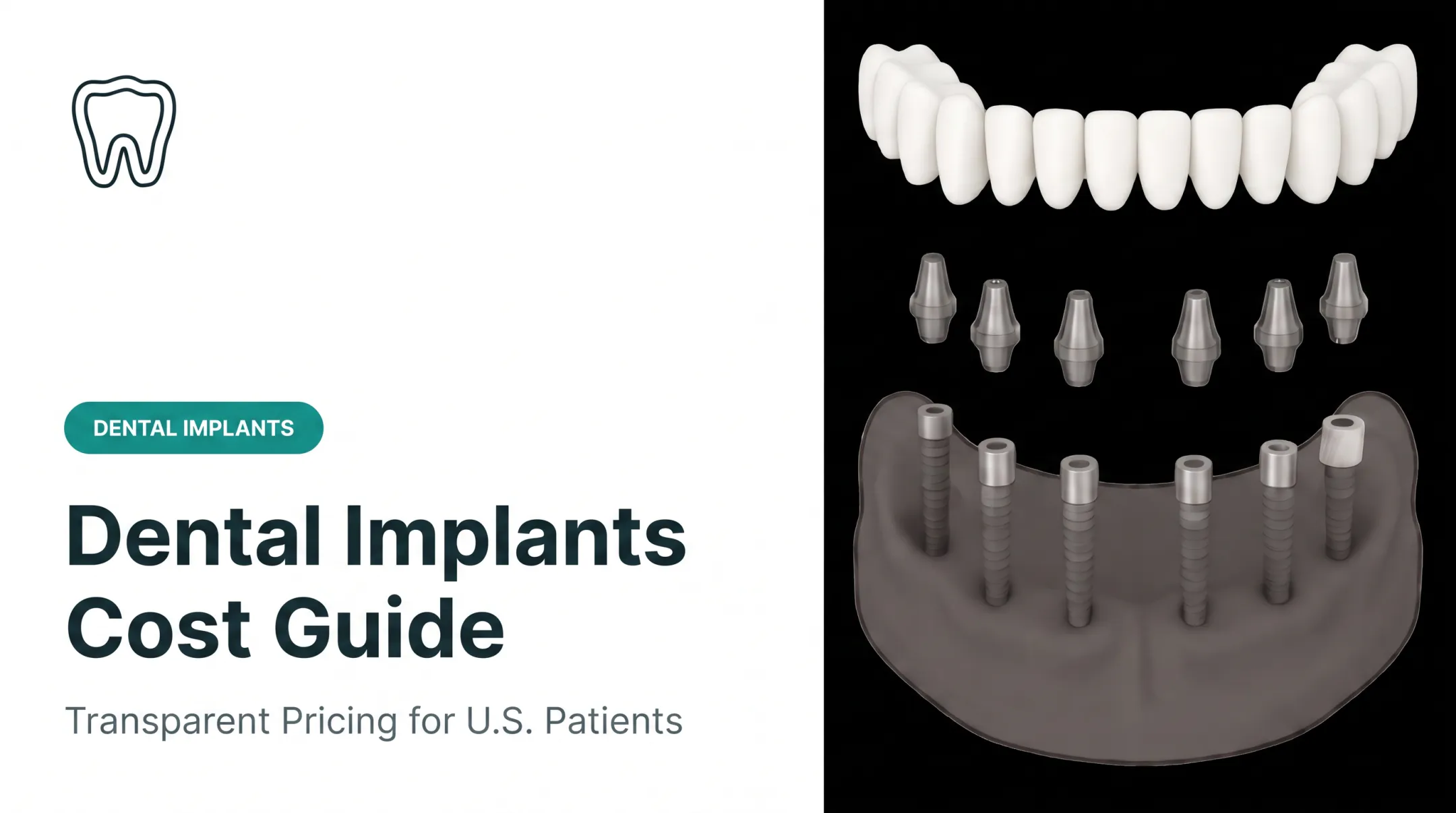
Full-arch treatment typically includes multiple implants, a custom zirconia bridge, and lab fabrication of the final prosthesis. Pricing scales with the number of implants:
| Protocol | Mexico Pricing (per arch) | US Pricing (per arch) |
|---|---|---|
| All-on-4 | $8,000-$12,000 | $20,000-$35,000 |
| All-on-6 | $12,000-$16,000 | $25,000-$40,000 |
| 3-ON-8™ | $16,000-$20,000 | $26,000-$38,000+ |
| The 3-ON-8™ protocol, developed by Dr. José Moguel, uses eight implants and three independent zirconia bridges per arch. That layout is designed for maximum strength and stability in a full-mouth restoration. |

Key Factors That Affect the Cost of Zirconia Implants
Pricing depends on material, clinical, and logistical factors working together, not any single line item.
Implant Brand and System
Premium systems from Nobel Biocare, Straumann, and MegaGen are backed by decades of clinical research. Budget or unbranded systems cost less upfront but come with less predictable long-term outcomes. Dr. Moguel's clinic uses only these premium, FDA-approved systems, never generic implants.
Number of Implants and Case Complexity
- Single-tooth cases are the least complex and least expensive
- Multi-tooth cases scale roughly linearly with implant count
- Full-arch cases (All-on-4, All-on-6, 3-ON-8™) cost the most due to bridge fabrication
- Two-piece systems cost more than one-piece designs because the abutment and crown are fabricated separately
Diagnostic and Preparatory Procedures
3D CBCT imaging and digital scanning are standard for accurate treatment planning. When bone density is insufficient, patients may also need:
- Bone grafting: $400-$800 in Mexico vs. $1,500-$3,000 in the US
- Sinus lift surgery: $600-$900 in Mexico vs. $2,500-$4,000 in the US

One documented case used CBCT imaging to confirm more than 1.5 cm of bone height gained in the posterior sinus before proceeding with an upper All-on-6 zirconia bridge.
Dental Laboratory and Customization Fees
Custom shade-matching and CAD/CAM crown fabrication add cost but deliver a natural-looking result. An in-house lab generally shortens turnaround and reduces fees by keeping production under clinic control.
Clinician Expertise and Location
A board-certified periodontist's experience directly affects both outcomes and fees. Dr. Moguel has placed over 17,000 implants across 38+ years of practice. Geography plays a major role too. Clinics in Los Algodones, Mexico, routinely price treatment 60-70% below comparable US clinics.
Zirconia vs Titanium — Cost and Value Comparison
Zirconia commands a premium over titanium, largely due to material sourcing and manufacturing precision.
Upfront Cost
- Titanium: Lower fixture cost, decades of manufacturing efficiency
- Zirconia: Often 20-30%+ higher due to material and fabrication complexity, though at the clinic level, the gap can be a few hundred dollars depending on the case
Aesthetics and Long-Term Value
- Titanium: Can show a gray shadow through thin gum tissue over time
- Zirconia: Metal-free, natural white appearance, no allergy risk (a strong pick for patients with metal sensitivities)
Durability and Track Record
- Titanium: Decades of proven survival data and higher fracture toughness
- Zirconia: A 2023 systematic review estimated 95.1% cumulative survival at 10 years, though it remains a newer material with less long-term data and can be more brittle under high bite forces

Neither material universally wins. Titanium suits high-load, full-arch cases where strength matters most. Zirconia suits visible teeth where aesthetics and biocompatibility take priority.
Cost Breakdown: What's Included Beyond the Implant Itself
Total treatment cost extends well past the implant fixture itself.
- Surgical placement fees (one-time): anesthesia, surgeon’s fee, and facility costs
- Abutment and custom crown fabrication (one-time): lab craftsmanship, shade-matching, and CAD/CAM milling
- Follow-up visits and maintenance (recurring): checkups, cleanings, and occasional adjustments
Warranty coverage also affects long-term cost. Implant hardware often carries a lifetime warranty, while prosthetic crowns, bridges, and zirconia arches typically carry a 5-year warranty contingent on regular professional cleanings.
How to Get the Best Value on Zirconia Implants
The lowest price isn't always the best value. Fit, materials, and the surgeon's track record matter just as much as the number on the quote.
- Ask for an itemized quote covering surgery, materials, and lab fees before committing to anything.
- Consider dental tourism in Los Algodones, Mexico, where clinics offer American-standard technology and FDA-approved materials at a fraction of US pricing.
- Verify board certification (ADA/ADM) and clinical experience regardless of price point.
Dr. Moguel's clinic sits roughly a three-minute walk from the Andrade, California border crossing. Bilingual coordinators handle travel logistics and free treatment-plan consultations for patients arriving from the US and Canada.
Frequently Asked Questions
How much does a set of zirconia teeth cost?
Full-arch zirconia pricing ranges from roughly $8,000-$20,000 per arch in Mexico, versus $20,000-$38,000+ in the US, depending on the protocol chosen. Exact cost depends on the number of implants and case complexity.
How long do zirconia dental implants last?
Zirconia implants show an estimated 95.1% survival rate at the 10-year mark, based on pooled clinical data. Actual longevity depends heavily on oral hygiene, follow-up care, and regular professional cleanings.
Which is better, titanium or zirconium implants?
It depends on your case. Titanium offers stronger load-bearing performance for full-arch reconstructions, while zirconia offers superior aesthetics and no risk for patients with metal sensitivities.
Are zirconia implants covered by dental insurance?
Coverage varies by plan. Many treat implants as elective with limited or no coverage; others cover a portion. Financing and help with insurance documentation are often available either way.
Why are zirconia implants more expensive than titanium?
Zirconia requires more precise manufacturing, and two-piece systems add ceramic abutments plus extra laboratory handling. Custom shade-matching for a natural look also adds to the final cost.
Can I save money by getting zirconia implants in Mexico?
Yes. Cross-border patients typically save 60-70% compared with US pricing, while still receiving treatment from board-certified specialists using the same premium implant brands.