
But patients don't just want the pitch. They want to know: does chewing actually get better? Does this protect my jaw long-term? What will it really cost, and is it worth traveling for treatment?
This article breaks down what full mouth implants are, the benefits backed by research, what drives cost, and how to choose a provider that gets you a lasting result.
TL;DR
- Full mouth implants use 4–8 implants per arch for a fixed, permanent tooth replacement
- Restored chewing force, jawbone preservation, and durability that outlasts dentures
- Treatment typically runs 3-6 months, often with fixed temporary teeth on day one
- Mexico-based care can cut costs by 60-70% versus comparable U.S. treatment
- Provider experience and aftercare protect long-term results
What Are Full Mouth Dental Implants
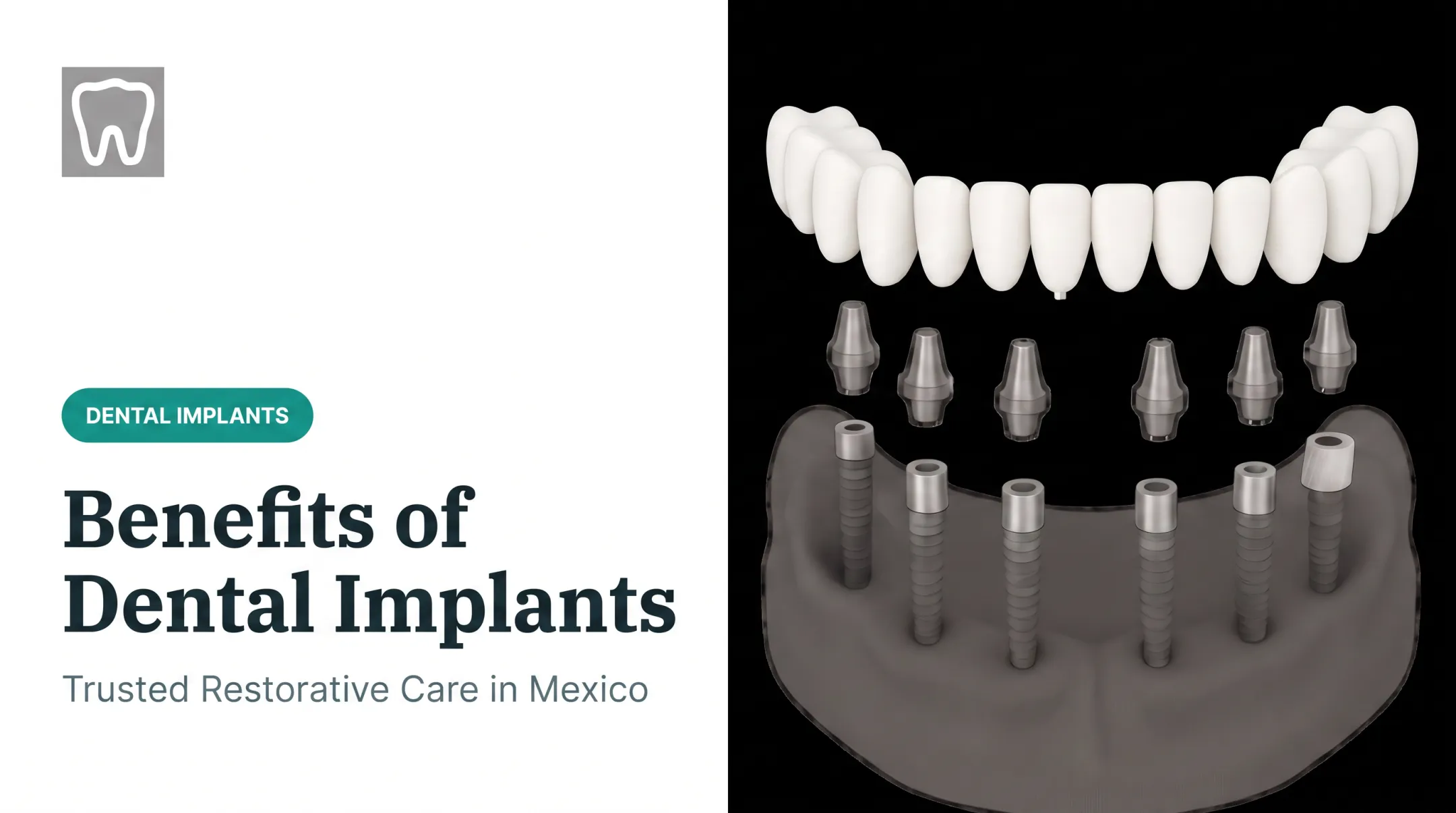
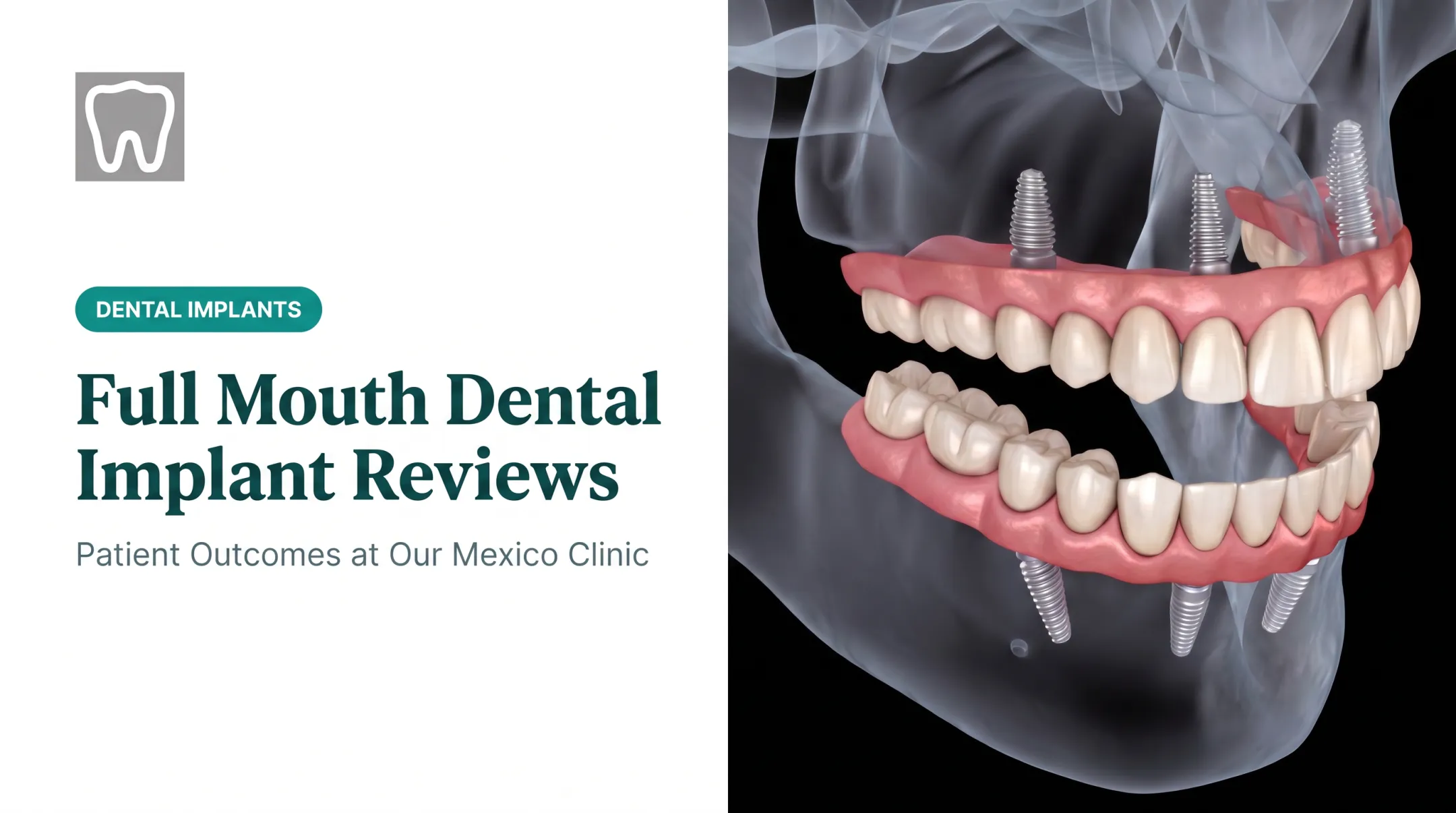
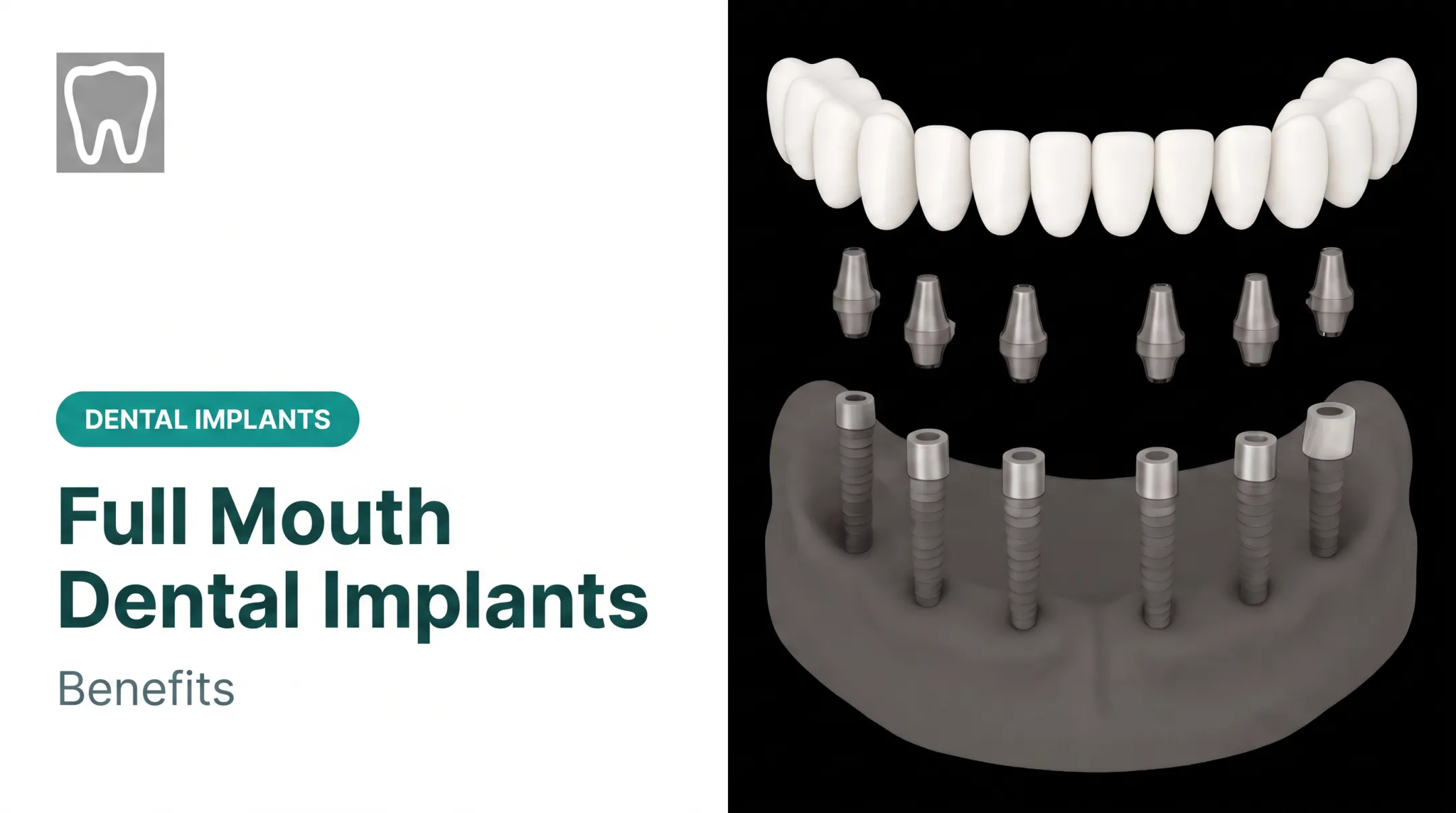
Full mouth dental implants use a set of implants, commonly four to eight per arch, to anchor a full, fixed prosthetic arch of replacement teeth. Unlike a single-tooth implant that replaces one missing tooth, or a partial bridge that fills a gap, this approach rebuilds an entire arch at once.
It's typically recommended for patients missing most or all their teeth in an arch. Protocols vary by implant count and bone requirements:
- All-on-4: 4 implants per arch, often works without grafting by using denser anterior bone
- All-on-6: 6 implants per arch, added stability for more bone-compromised cases
- 3-ON-8™: 8 implants per arch, a protocol developed by Dr. José Moguel supporting a custom zirconia bridge

Beyond appearance, the treatment restores the ability to eat, speak, and live without thinking about your teeth.
Key Benefits of Full Mouth Dental Implants
These benefits aren't abstract. They show up in chewing force, bone scans, and how long the work actually lasts.
Restored Chewing Function and Diet Freedom
Dentures reduce chewing capacity because they rest on the gum and shift under pressure. Implants anchor directly to the jawbone, so the bite doesn't slip.
A 2017 crossover trial found implant-retained overdentures nearly doubled bite force, from 62.90 N with conventional dentures to 132.20 N, a 110% increase. Patients also needed far fewer chewing strokes to break down food to the same particle size (PMC clinical trial).

That's an overdenture study, not a fixed full-arch bridge, but the pattern holds in real cases:
- Arthur V., 68, couldn't chew solid food before treatment. After full upper-and-lower 3-ON-8™ restoration, he reported 100% restoration of chewing force
- Robert T., a longtime denture wearer, described eating steak and apples again "for the first time in 10 years" after treatment
Who benefits most: patients who've spent years avoiding certain foods or dealing with dentures that shift mid-meal.
Jawbone Preservation and Facial Structure
Missing tooth roots means no stimulation to the jawbone, and bone starts to resorb. A 2016 systematic review found that implant overdenture treatment reduced annual bone loss by roughly 1 mm per year compared to conventional dentures (Springer systematic review). The sharpest resorption otherwise occurs in the first few years of denture wear.
Implants recreate that root-like stimulation. Over time, this:
- Preserves natural facial contours
- Prevents the sunken, collapsed look common in long-term denture wearers
- Reduces the odds you'll need bone grafting down the road
Who benefits most: long-term denture wearers already noticing facial changes, and newer patients who want to act before bone loss accelerates.
Long-Term Durability and Value
Dentures need relines, adhesives, and eventual full replacement. Implants are built to last.
Long-term data backs this up:
- A 2011 study of 245 patients tracked implant-supported prostheses for up to 10 years: 99.2% prosthesis survival, 94.8% implant-related success
- A 2019 study following patients for 10-18 years found 98.8% prosthetic survival
- A 2020 cohort with 10.7-year average follow-up reported 93.3% implant survival at 10 years

Set that against adhesives, relines, and replacements every few years, and the long-term cost case for implants gets clearer. Even the customized bridge on an All-on-4 case typically only needs maintenance after 10-15 years of normal wear.
Who benefits most: anyone tired of incremental fixes who wants one permanent solution.
What Drives the Cost, and Why Many Patients Look Beyond the US
Full mouth implant pricing depends on a handful of variables:
- Number of implants — four, six, or eight per arch
- Materials — titanium implants, zirconia versus acrylic bridges
- Additional procedures — bone grafting, sinus lifts if bone volume is low
- Provider expertise — board-certified specialists versus general practices
In the U.S., a single arch of fixed full-arch implants can run $14,000-$36,000, according to ClearChoice's published 2026 cost guide, with full mouth reconstruction reaching $45,000-$65,000 for both arches. That price range is pushing more patients to look at cross-border care.
Dental Implants in Mexico, based in Los Algodones, is one example. The clinic is led by Dr. José Moguel, a board-certified periodontist with over 38 years of experience and more than 17,000 implants placed.
Patients receive the same implant brands used in many U.S. clinics: Nobel Biocare, Straumann, and MegaGen. Full mouth reconstruction in Mexico typically runs $16,000-$24,000, compared with $45,000-$65,000 north of the border.

Before choosing any provider, compare the total treatment cost—consultation, imaging, surgery, and prosthetics—not just the headline implant price. Verify credentials, confirm materials used, and ask about warranty terms in writing.
What Happens When Tooth Loss Is Left Untreated
Delaying full mouth restoration doesn't pause the problem. It compounds it.
- Bone deterioration accelerates. The longer teeth are missing, the more the jaw resorbs, which can make future implant placement more complex and costly.
- Eating and speaking stay difficult. Patients missing most or all teeth often shift to diets lower in fiber and higher in saturated fat because chewing is hard.
- Remaining teeth shift. Gaps allow neighboring teeth to drift, throwing off bite alignment over time.
- Confidence drops. Struggling to eat in public or speak clearly leads many patients toward social withdrawal.
- Temporary fixes wear thin. Ill-fitting dentures need constant adjustment, relining, and adhesive just to function day to day.
None of this reverses on its own. Addressing full-arch tooth loss sooner keeps treatment simpler and protects long-term oral function.
Getting the Most Value from Full Mouth Dental Implants
The implant itself is only part of the equation. Outcomes hinge on who places it and how you care for it afterward.
Choose experience over the lowest price. A board-certified specialist with a documented track record matters more than picking the cheapest quote. Dr. Moguel's clinic reports a 98%+ clinical success rate across 17,000+ placements, above the international average of 95-97%.
Insist on thorough diagnostics before treatment. A proper plan starts with 3D CBCT imaging, not flat 2D X-rays. This lets the specialist assess bone density in three dimensions and plan implant length, width, and position before any drilling starts.
Protect your investment with aftercare. Long-term success rests on a few basics:
- Brushing twice daily and flossing around the prosthesis
- Avoiding smoking
- Keeping up with regular professional cleanings
The right clinic also removes friction before treatment starts. Free consultations, transparent pricing, and travel support (including the coordination Dental Implants in Mexico offers for patients crossing from Yuma, Arizona) make planning easier before you commit.
Full mouth implants deliver lasting value through restored function, preserved bone, and results measured in decades rather than years. That outcome starts with choosing the right provider from day one.
Frequently Asked Questions
How much do full dental implants cost?
Cost depends on the number of implants, materials used, and whether bone grafting is needed. U.S. pricing often runs $14,000-$36,000 per arch, while Mexico-based clinics can offer comparable treatment for 60-70% less.
Can I have all my teeth pulled and get full dental implants on the same day?
Often, yes. Techniques like All-on-4 allow fixed temporary teeth to be attached the same day as surgery. The final, permanent prosthesis still requires several months of healing before placement.
How long does it take to get full dental implants?
Most treatment timelines run 3-8 months from consultation to final restoration, depending on bone health and how quickly the implants integrate. All-on-4 tends toward the shorter end; protocols with more implants may take longer.
How long does it take to recover from full dental implant surgery?
Initial recovery from surgery takes a few days to two weeks. Full osseointegration, where the implant fuses with the jawbone, generally takes 4-6 months.
How many dental implants are needed for a full set of teeth?
Most full-arch restorations use between 4 and 8 implants per arch, depending on bone density and the chosen protocol: All-on-4, All-on-6, or an 8-implant approach like 3-ON-8™.
How long do full dental implants last?
The implant posts themselves can last decades, often a lifetime, with proper care. The prosthetic bridge sitting on top may need replacement or maintenance after 10-20 years of normal wear.