
Full-arch tooth replacement no longer means resigning yourself to a removable appliance. All-on-4 dental implants replace an entire arch of teeth using just four strategically placed implants, often with a fixed set of teeth attached the same day as surgery.
This guide covers how All-on-4 works, who qualifies, what recovery looks like, and why a growing number of US and Canadian patients travel to Mexico for treatment.
Key Takeaways
- Four implants support a full fixed arch, often with same-day temporary teeth
- Angled posterior implants frequently eliminate bone grafting
- Well-maintained All-on-4 implants can last decades or a lifetime
- Board-certified care in Mexico can cut costs roughly 60–70% versus U.S. pricing
What Are All-on-4 Dental Implants?
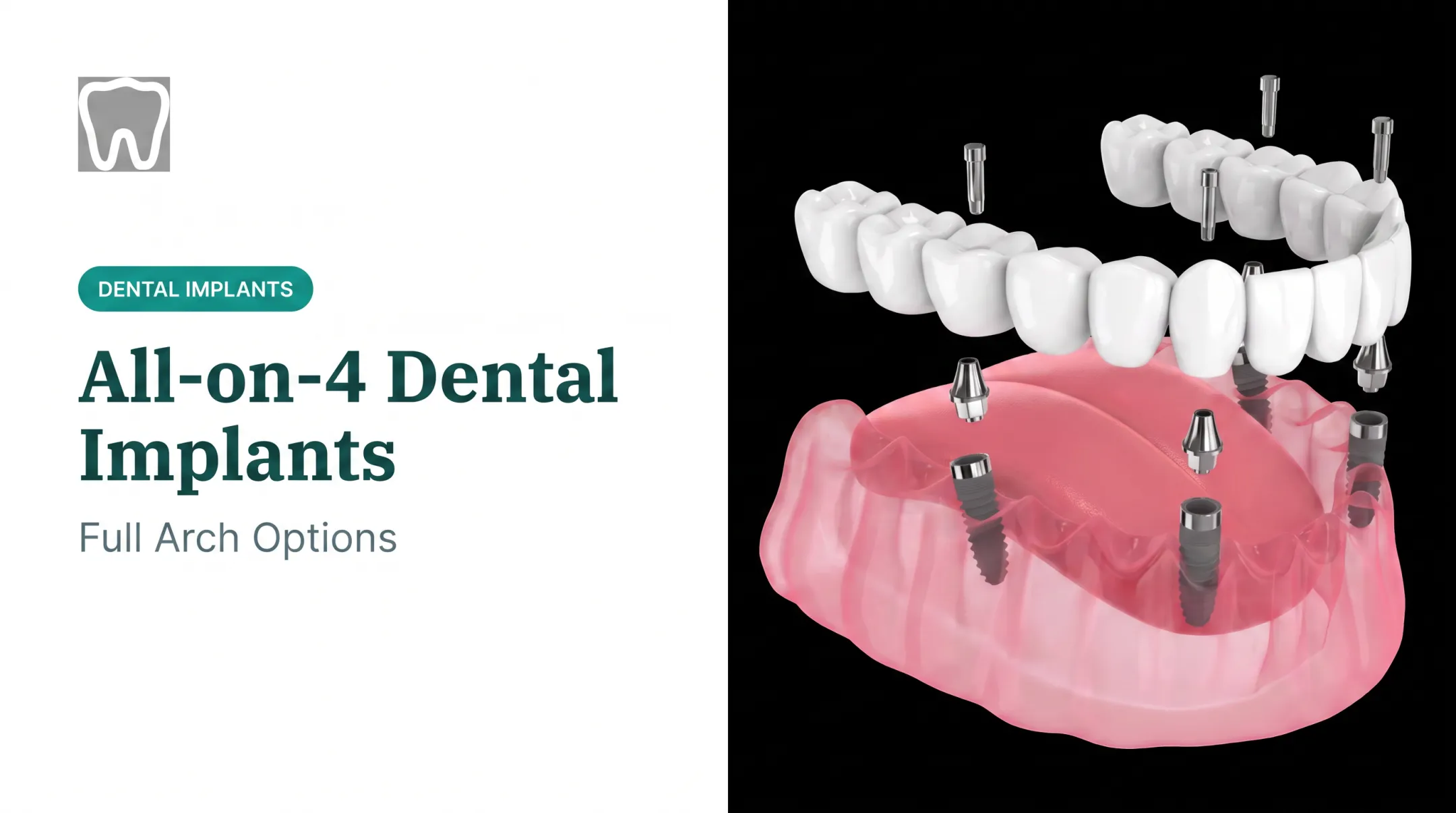
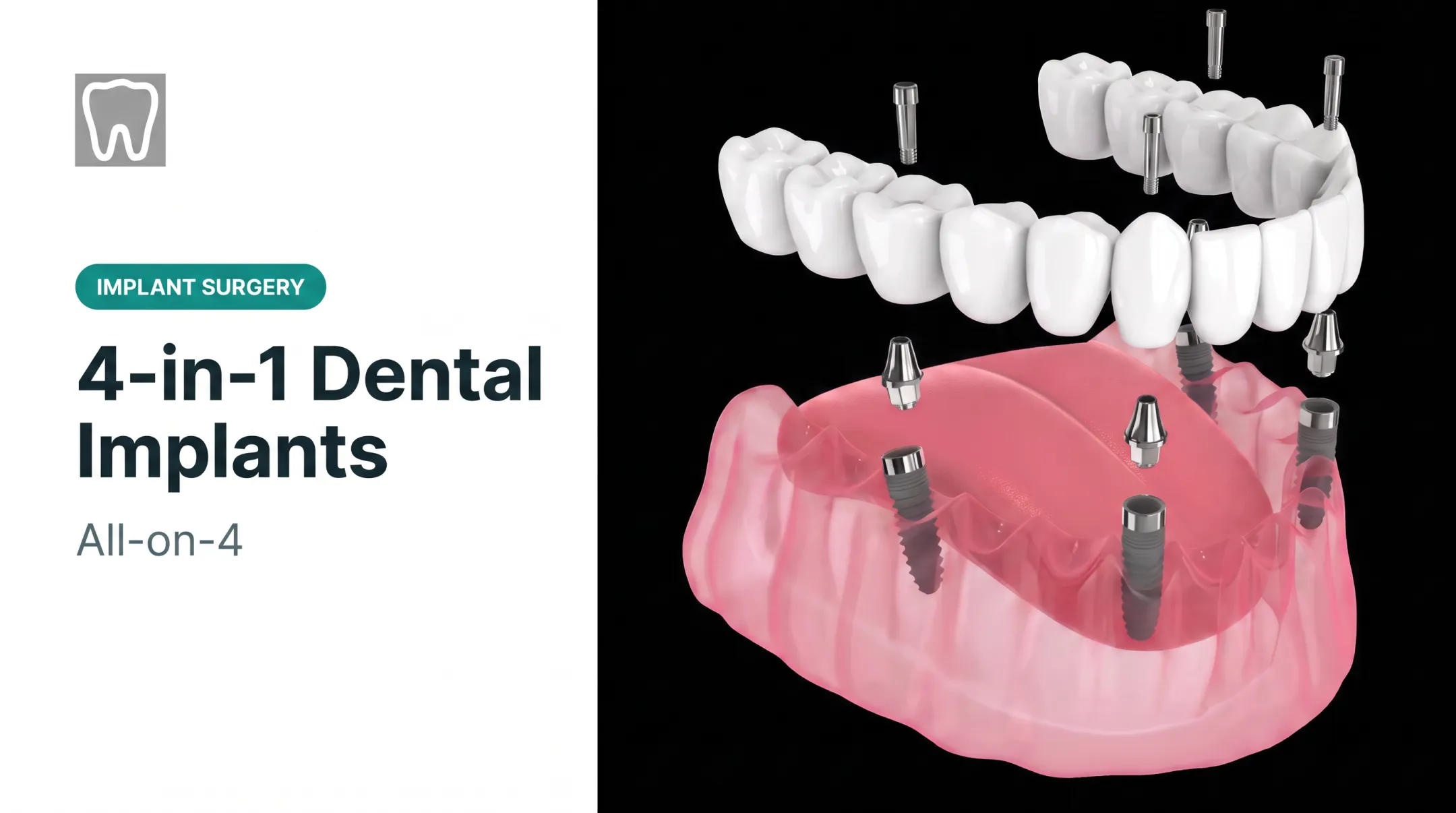
All-on-4 uses four titanium posts per arch to anchor a complete set of replacement teeth. Two implants go in vertically at the front of the jaw, where bone is typically denser.
The other two are tilted up to 45 degrees at the back. That angle uses existing bone more efficiently and sidesteps anatomical obstacles like the sinus cavity or nerve pathways.

Nobel Biocare, the manufacturer that popularized this treatment concept, describes it as a graftless approach when patient selection criteria and adequate implant stability are met Nobel Biocare's All-on-4 treatment overview. Not every patient skips grafting, but many do.
All-on-4 vs. All-on-6 vs. Full-Mouth Reconstruction
These terms get used interchangeably, but they're not the same treatment:
- All-on-4 — four implants per arch, one continuous fixed bridge, generally suited to lower-to-moderate bone density
- All-on-6 — six implants per arch for added stability, generally requiring more bone volume
- Full-mouth reconstruction — a broader, customized combination that may include extractions, grafting, sinus lifts, and any of the above protocols
A five-year randomized trial comparing four versus six implants found no statistically significant difference in implant failure, prosthetic failure, or bone loss between the two groups five-year RCT comparing All-on-4 and All-on-6. More implants isn't automatically better; it depends on your anatomy.
The fixed arch itself is usually made from zirconia (durable, metal-free, resistant to staining) or an acrylic-titanium hybrid. Zirconia is usually preferred for aesthetics and longevity, though hybrid bridges remain common in certain cases, including immediate lower-arch restorations after extractions.
Benefits of All-on-4 Dental Implants
Unlike traditional dentures, All-on-4 teeth don't come out. There's no soaking overnight, no adhesive paste, no worrying about a plate shifting mid-meal.
Key advantages include:
- Teeth stay fixed in place, with no adhesives or nightly removal
- Surgery is faster than placing six to eight individual implants
- Functional biting pressure preserves jawbone and helps prevent facial collapse common with long-term dentures
- Angled posterior placement often reduces grafting by using available bone and clearing sinus or nerve obstacles
- Implants can last 20+ years or a lifetime with proper maintenance
Clinical results support these advantages. A 2011 longitudinal study of 245 patients and 980 implants reported implant-level success of 94.8% at 10 years, with prosthesis survival at 99.2%.
A 2017 systematic review found survival rates as high as 99.8% beyond 24 months, though the underlying studies varied in follow-up length and quality.

At Dr. José Moguel's clinic, every case begins with 3D CBCT imaging to determine whether grafting can be avoided. If a scan shows insufficient bone to anchor an implant securely, grafting may still be recommended, sometimes performed during the same surgery.
The All-on-4 Treatment Process & Who Qualifies
Are You a Good Candidate?
All-on-4 is a strong fit if you:
- Are missing most or all teeth in an arch, or have teeth that are failing and need extraction
- Currently wear dentures and want a permanent, fixed alternative
- Have adequate bone density, or bone that can be worked with using angled placement
- Are in good enough general health to undergo implant surgery
A consultation with 3D Cone Beam CT imaging is required to confirm candidacy. This imaging isn't optional. It is how the surgeon maps nerve pathways, measures bone width, and plans exact implant angles before ever touching a drill.
Step-by-Step Procedure
- Consultation and digital scanning — a comprehensive exam plus 3D CBCT imaging to evaluate bone and plan implant positions
- Implant placement surgery — usually under local anesthesia; oral or IV conscious sedation is available for anxiety or complex cases. IV sedation patients must fast 8 hours and arrange a ride home
- Same-day temporary teeth — a fixed provisional bridge is often attached the same day, letting patients leave with teeth in place
- Healing period — osseointegration (implants fusing with bone) generally takes 3 to 6 months, during which a soft-food diet is essential
- Final restoration — once healing is confirmed, a custom zirconia or ceramic-hybrid arch is fitted, matched in shade and shape for a natural result

If you are traveling for treatment, build the fasting window and ride home into your border-crossing and hotel plan so surgery day stays simple.
Why Many Patients Choose Mexico for All-on-4 Treatment
Cost is the primary driver. According to the Academy of General Dentistry's 2020 report on dental tourism, patients can save an estimated 40-65% in Mexico on many dental treatments.
Los Algodones, near Yuma, Arizona, is a major dental-tourism hub known as "Molar City." For All-on-4 specifically, US pricing often runs $20,000-$30,000 per arch, while comparable treatment in Mexico can land around $8,000-$12,000, roughly a 60-70% reduction.
Reputable clinics in the region use the same implant brands and technology found in US practices: Nobel Biocare, Straumann, and MegaGen systems, digital scanning, CAD/CAM labs, and 3D CBCT imaging.
Those savings only hold up when the clinician and facility meet the same standards you would expect at home. One example is Dr. José Moguel's clinic in Los Algodones.
Dr. José Moguel's Clinic in Los Algodones
Dr. Moguel is a board-certified periodontist with 38+ years of clinical experience and more than 17,000 implants placed. He developed the patented 3-ON-8™ protocol, which uses eight implants per arch to support three independent bridges. That design gives patients more structural redundancy than standard All-on-4.
The clinic sits minutes from the Andrade, California border crossing and provides:
- Bilingual coordinators for treatment planning and scheduling
- Travel and hotel coordination, including options at Hacienda Los Algodones or across the border in Yuma
- A lifetime warranty on implant hardware and a five-year warranty on prosthetic bridges with regular cleanings
Verify Before You Travel
Before choosing any provider abroad, confirm:
- ADA and ADM board certification
- Government-issued professional credentials (cédula profesional)
- Facility accreditation and sterilization standards
- What's included in the quoted price: imaging, extractions, temporary and final prostheses, follow-up
A low quoted price without verified credentials is a risk.
Recovery, Care & Alternatives
Recovery is staged, and your surgeon will tailor the timeline to your case. Most patients move through diet in three phases:
- Weeks 1–2: Liquids and soft foods only
- Weeks 3–6: Semi-soft foods as comfort allows
- Months 2–6: Gradual return to normal eating as implants integrate

Daily care essentials:
- Brush gently after meals and before bed, avoiding the surgical site for the first 48 hours
- Use interdental brushes or water flossers designed for fixed implant bridges
- Attend professional cleanings every two to six months, as recommended by the American College of Prosthodontists
When Might a Dentist Recommend Something Else?
| Option | Best For |
|---|---|
| Traditional dentures | Lower budget or health limits; OK with removability |
| All-on-6 | More available bone; wants added stability |
| Individual implants | Only a few missing teeth, not a full arch |
| 3-ON-8™ | Segmented bridges that can be repaired independently |
Bone volume, budget, and long-term goals all factor into which protocol makes sense. A 3D scan comes first so the recommendation matches your anatomy and goals.
Frequently Asked Questions
How soon can I eat normally after All-on-4 implants and are there any food restrictions?
Expect liquids and very soft foods for the first couple of weeks, progressing to semi-soft foods over the following weeks. Full normal eating typically returns within a few months as healing completes.
What are the alternatives to All-on-4 implants?
Options include traditional removable dentures, All-on-6 (six implants for added stability), and individual implants for patients missing only a few teeth. The right choice depends on bone health, budget, and goals.
Can you switch from snap-on dentures to All-on-4 implants?
Yes. A consultation with 3D imaging assesses your bone structure and candidacy for immediate-load implants, then a customized plan outlines the transition to a fixed solution.
Do All-on-4 implants feel like real teeth?
Fixed, custom-shaded prosthetics closely mimic the appearance, feel, and biting function of natural teeth. Many patients report restored chewing force and no more adhesives or gum irritation.
How much do All-on-4 dental implants cost?
Costs vary by case complexity, materials, and whether grafting is needed. Mexico clinics often quote $8,000-$12,000 per arch, compared to $20,000-$30,000 in the US, roughly 60-70% in savings.
How long do All-on-4 implants last?
With proper oral hygiene and regular dental visits, All-on-4 implants can last 20+ years or even a lifetime. The prosthetic bridge itself typically carries a separate, shorter warranty period.