
If this sounds familiar, you're not alone. Multiple missing, decayed, or worn teeth affect how you eat, speak, and feel about yourself every single day.
Full mouth reconstruction offers a way forward. It's a comprehensive treatment plan combining implants, crowns, bridges, and gum therapy, all customized to your specific mouth. This guide covers who's a candidate, what the process involves, realistic costs, pain expectations, and why so many patients cross the border to Los Algodones, Mexico for expert, affordable care.
Key Takeaways
- Full mouth reconstruction coordinates multiple procedures in one plan—not a fixed package
- Candidacy hinges on dental condition and overall health, not age
- Mexico clinics often cost far less than comparable US care, with quotes tied to your procedure mix
- Recovery ranges from days for soft tissue to several months for full implant integration
- A board-certified specialist matters more than the cheapest option
What Is Full Mouth Dental Reconstruction?
The American College of Prosthodontists defines full mouth reconstruction as rebuilding or replacing all the teeth in a patient's mouth using restorative science paired with aesthetic goals. It's a broader concept than "restoration," which typically refers to fixing a single tooth.
Reconstruction addresses the whole system:
- Teeth (missing, decayed, or broken)
- Gums (disease or recession)
- Jawbone (density and structure)
- Bite alignment (how your teeth meet)
Because reconstruction touches so many areas, it often requires coordinated planning across periodontal, prosthodontic, and surgical expertise.
At Dental Implants in Mexico, that coordination is led by Dr. José Moguel, a board-certified periodontist with over 38 years of experience. He personally evaluates each case, builds the surgical blueprint, and performs the implant surgery. An in-house digital lab supports the final restorations.
Popular full-arch protocols like All-on-4 and All-on-6 fall under this reconstruction umbrella. So does the clinic's patented 3-ON-8™ protocol, which uses eight implants per arch to support three independent zirconia bridges instead of one continuous piece, offering built-in redundancy if a problem develops in one segment.

Signs You May Need Full Mouth Reconstruction
Common Warning Signs
Not sure if your situation calls for full reconstruction versus a simpler fix? Watch for these indicators:
- Multiple missing or broken teeth across your mouth
- Advanced gum disease with bleeding, recession, or loose teeth
- Severe tooth wear from grinding (bruxism)
- Chronic jaw pain or a bite that feels misaligned
- Tooth loss from trauma or injury
Who Is a Good Candidate
Age isn't the deciding factor here. What matters is your overall health and bone density.
The American Academy of Implant Dentistry notes that candidates need reasonable medical and oral health, an understanding of the procedure, and a commitment to hygiene afterward. Bone loss alone doesn't disqualify you, since grafting can often rebuild what's missing.
A thorough exam is non-negotiable. At Dental Implants in Mexico, includes 3D Cone Beam CT imaging to evaluate bone density and nerve pathways in three dimensions, plus digital scanning for precise bite analysis. Standard 2D X-rays simply can't show what CBCT reveals about implant feasibility.
Core Procedures Involved in Full Mouth Reconstruction
Dental Implants and Full-Arch Solutions
Titanium implants act as artificial tooth roots, anchoring crowns, bridges, or full-arch prosthetics directly into the jawbone. A 2019 systematic review pooling 18 studies found a 96.4% 10-year implant survival rate, though outcomes vary by implant system, patient health, and case complexity.
Full-arch protocols reduce the number of implants needed per jaw:
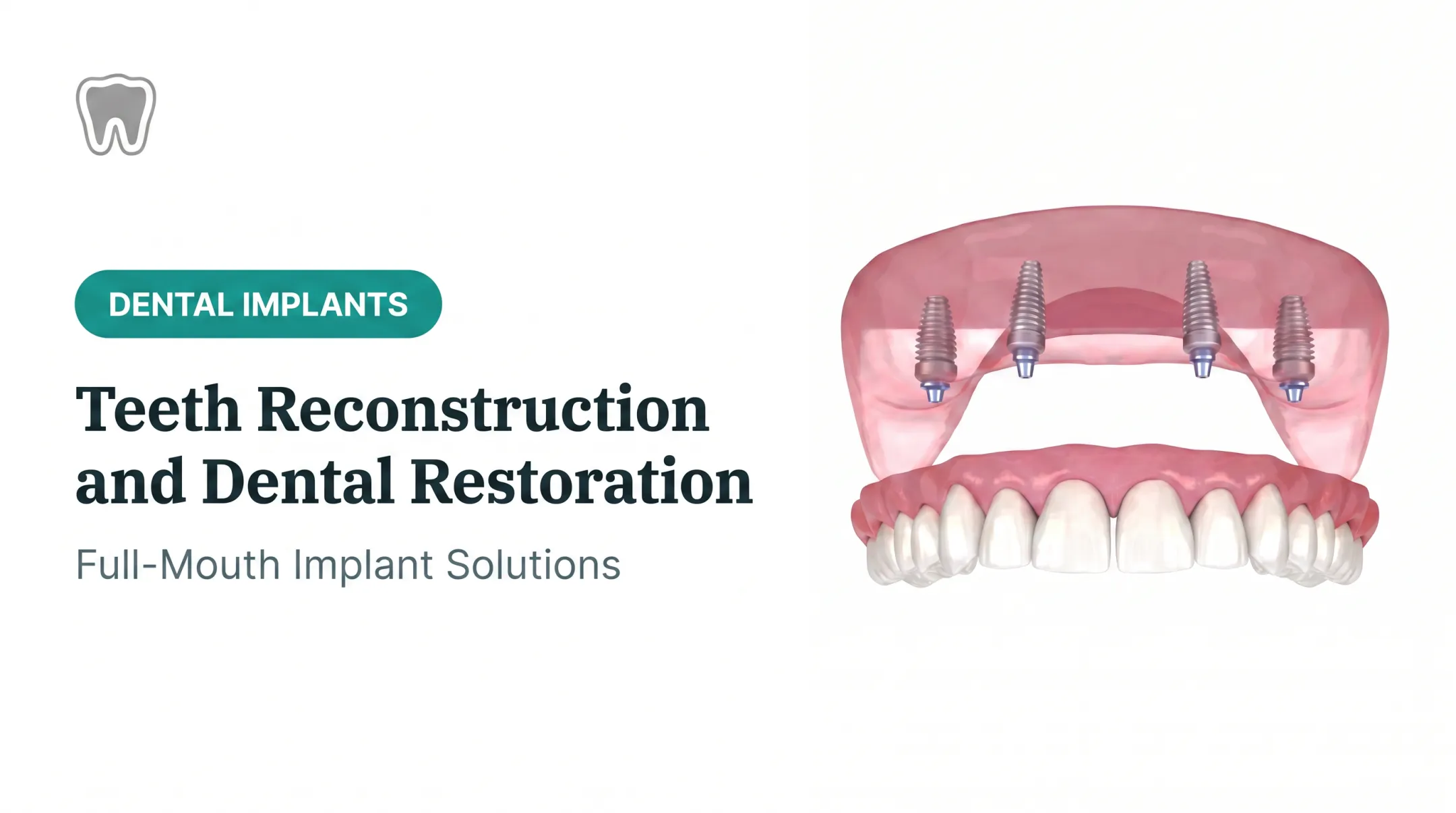
- All-on-4: Four implants (two angled) support a fixed bridge of up to 12 teeth. Recovery runs roughly 3-4 months.
- All-on-6: Six implants offer greater force distribution for patients with more bone density. Recovery runs roughly 4-5 months.
- 3-ON-8™: Eight implants per arch support three independent zirconia bridges, distributing chewing forces further and allowing localized repairs without replacing the whole prosthesis.
A five-year randomized study found no statistically significant survival difference between All-on-4 and All-on-6 — more implants aren't automatically better. Your anatomy determines the right fit.
Implant brand also affects long-term results. Premium systems such as Nobel Biocare, Straumann, and MegaGen are backed by decades of clinical research, unlike unbranded or generic alternatives.
Crowns, Bridges, and Dentures
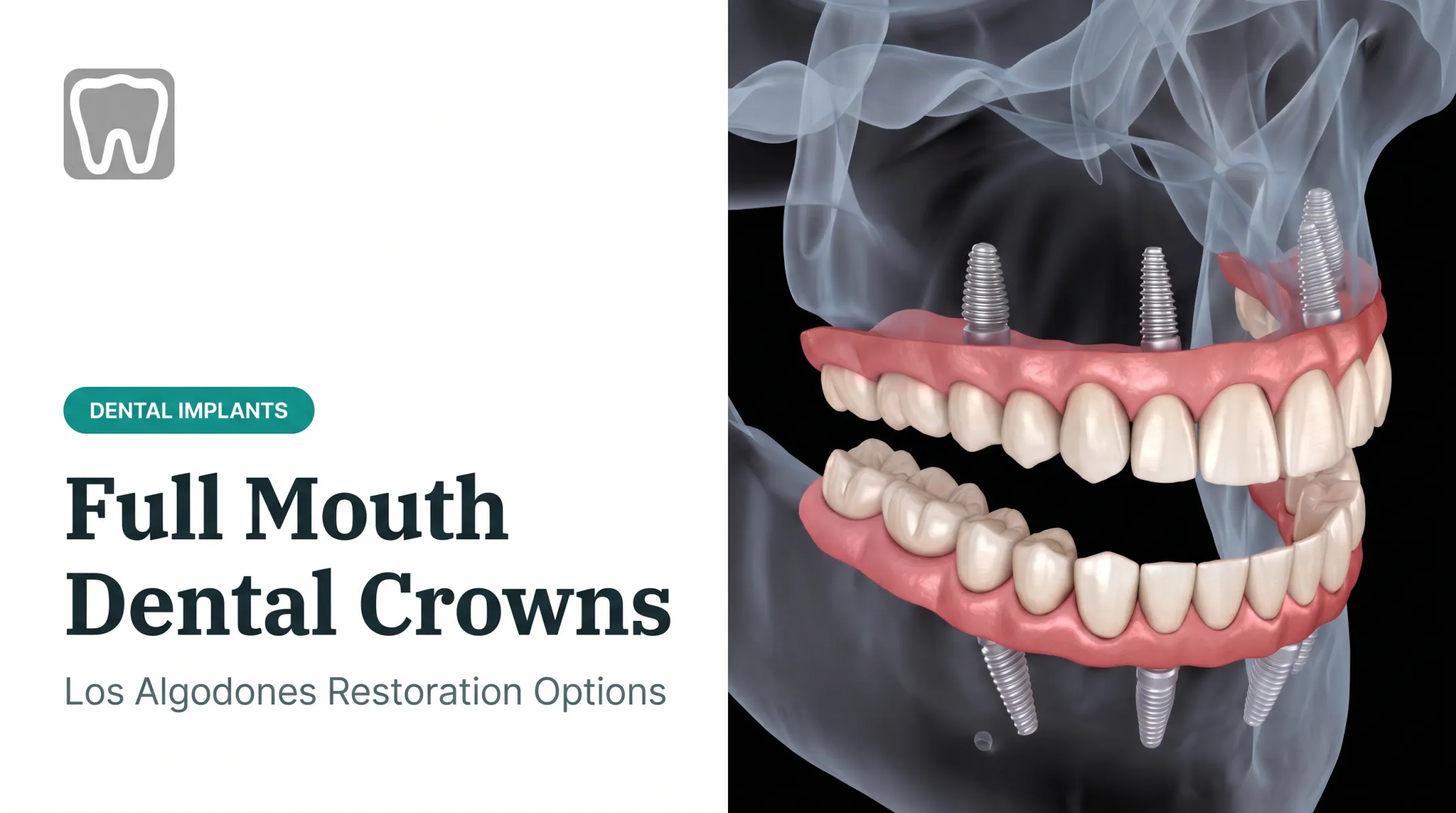
Crowns repair individual damaged teeth. Bridges and dentures replace multiple missing teeth, but the right choice depends on your remaining bone and teeth:
- Removable dentures work when implant placement isn't feasible or budget-friendly
- Implant-supported bridges offer more stability and a closer feel to natural teeth
- Fixed full-arch prosthetics suit patients missing most or all teeth in a jaw
Preparatory and Supporting Treatments
Before implants go in, your foundation often needs work.
Common preparatory steps include:
- Bone grafting: Rebuilds jaw structure with donor bone, synthetic material, or bone from another site on your body. Integration generally takes 3-6 months.
- Sinus lift surgery: Adds bone beneath the upper jaw's sinus cavity when natural height is insufficient. Healing typically takes 6-9 months before implants are placed.
- Periodontal therapy: Clears active gum disease before restorative work begins. Healing usually takes 2-4 weeks.

The Full Mouth Reconstruction Process: Step by Step
Full mouth reconstruction follows a set clinical sequence. Each phase builds on the last so bone, implants, and final teeth work together.
- Initial consultation and diagnostics — 3D CBCT imaging and digital scans map your teeth, gums, jaw, and bite in detail
- Personalized treatment planning — Your specialist sequences procedures based on your specific needs and goals
- Preparatory work — Extractions, bone grafting, or periodontal treatment happen first if needed
- Implant placement and healing — Implants are placed, temporary restorations attached, and osseointegration (bone bonding) begins
- Final restoration and follow-up — Permanent crowns or bridges are fitted once healing is complete, followed by long-term maintenance
At Dental Implants in Mexico, this typically means two clinic visits separated by 4-6 months:
- Visit 1: Diagnostics, extractions, grafting, implant placement, and temporary bridges
- Healing window: Implants integrate with the jawbone before final teeth are made
- Visit 2: Final digital impressions and permanent zirconia restorations, milled in the clinic's own CAD/CAM lab

Recovery, Pain, and Timeline Expectations
Post-surgical discomfort is manageable with the right plan. Local anesthesia keeps the procedure itself painless, and oral or IV sedation can help anxious patients through longer appointments. Afterward, expect:
- Mild dull ache or swelling as anesthesia wears off (NSAIDs typically help)
- Prescription pain medication for more intense discomfort, if needed
- Antibacterial rinse for about two weeks
Timelines vary by tissue type. Soft tissue often heals within one to two weeks, but full implant integration takes much longer.
Research shows osseointegration generally requires 3-4 months in the lower jaw and 6-8 months in the upper jaw, because bone density and healing capacity differ between the two.
Complex cases take longer still. A straightforward two-arch case may reach final zirconia bridges around month six, while sinus lift cases can stretch to seven months or more. Your treatment phasing depends on how much preparatory work your mouth needs.
Cost of Full Mouth Reconstruction and Why Patients Travel to Mexico
Cost depends on several variables: number of implants, materials chosen, and whether grafting or sinus lifts are required. In the US, the American Academy of Implant Dentistry cites a per-tooth cost of $3,100-$5,800 for an implant, abutment, and crown — and that's before multiplying across a full arch or mouth.
This is exactly why so many patients look south. The Academy of General Dentistry has reported that US patients can save 40-65% on dental care in Mexico. Dental Implants in Mexico prices land in a similar savings range:
| Procedure | Starting Price |
|---|---|
| All-on-4 | From $6,000 |
| All-on-6 | From $8,000 |
| 3-ON-8™ | From $15,000 |
| Full Mouth Reconstruction | $16,000-$24,000 |

Beyond price, the clinic also includes:
- Free consultations and transparent quotes with no hidden fees
- Itemized statements and ADA procedure codes for US insurance claims
- Letters of medical necessity when you need to appeal a denial
Experience matters on a case this large. Dr. Moguel has placed over 17,000 implants across 38+ years of practice.
That work is backed by a lifetime warranty on implant hardware (with routine professional cleanings) and a five-year warranty on prosthetic components.
Frequently Asked Questions
How much does it cost to reconstruct teeth?
Costs vary based on how many procedures you need and the materials used. Traveling to Mexico for equivalent care can reduce your total cost by 60-70% compared to US pricing.
How painful is full mouth reconstruction?
Sedation options and local anesthesia keep you comfortable during surgery. Afterward, mild soreness and swelling are normal and manageable with prescribed medication and care instructions.
Is full mouth reconstruction worth it?
For patients dealing with extensive decay, missing teeth, or bite problems, the improvements in chewing function, oral health, and confidence often justify the investment. Results depend on choosing an experienced specialist and following aftercare guidance.
What is reconstructive dentistry?
Reconstructive dentistry is the branch of dentistry focused on repairing or replacing damaged and missing teeth. It restores both function, like chewing and speaking, and natural appearance.
Can I get full mouth reconstruction if I have bone loss?
Yes. Bone grafting and sinus lift surgery can rebuild a stable foundation for implants, even in patients with significant existing bone loss. A 3D CBCT scan determines exactly what's needed.
How long does full mouth reconstruction take to complete?
Timelines range from a single visit for simple cases to several months for complex reconstructions requiring grafting. Most full-mouth cases take about 4-6 months from surgery to final restoration.