
You won't. A fixed temporary bridge is attached to your implants the same day as surgery, so you leave the clinic with a functional, natural-looking smile. This guide covers what those temporary teeth are, how long they last, what you can eat, and how All-on-6 compares to All-on-4 during this healing phase.
At Dental Implants in Mexico, Dr. José Moguel, a board-certified periodontist with over 38 years of experience and 17,000+ implants placed, uses a staged protocol built around predictable, comfortable outcomes.
Key Takeaways
- Temporary teeth are placed immediately after surgery, so you never leave without a working smile
- The provisional bridge typically stays in place 3-6 months while the implants fuse to the jawbone
- Six implants distribute bite force more evenly than four, lowering temporary bridge fracture risk
- Minor chipping, screw loosening, or bite adjustments are common but fixed quickly chairside
What Are Temporary Teeth on All-on-6 Dental Implants?
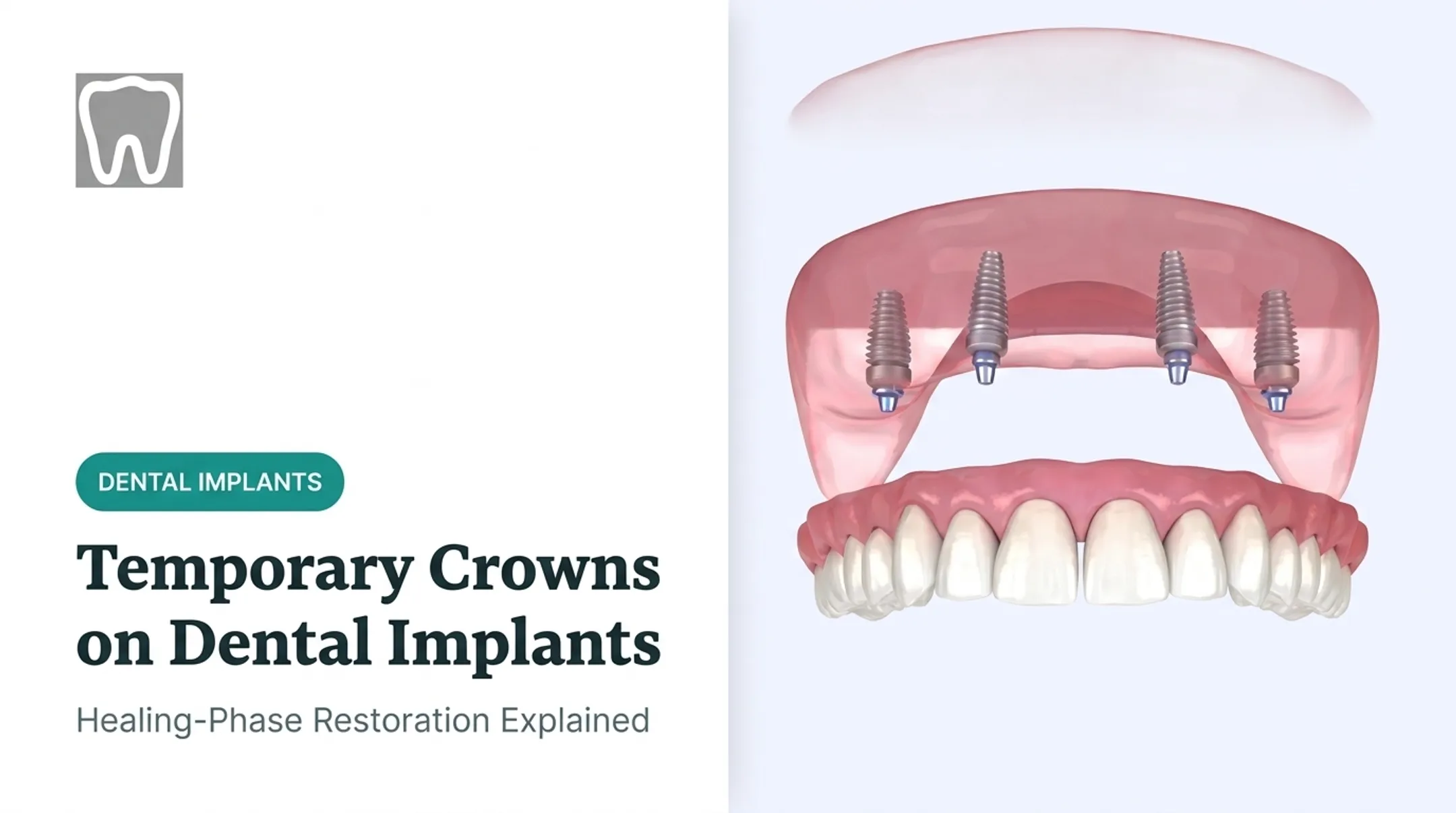
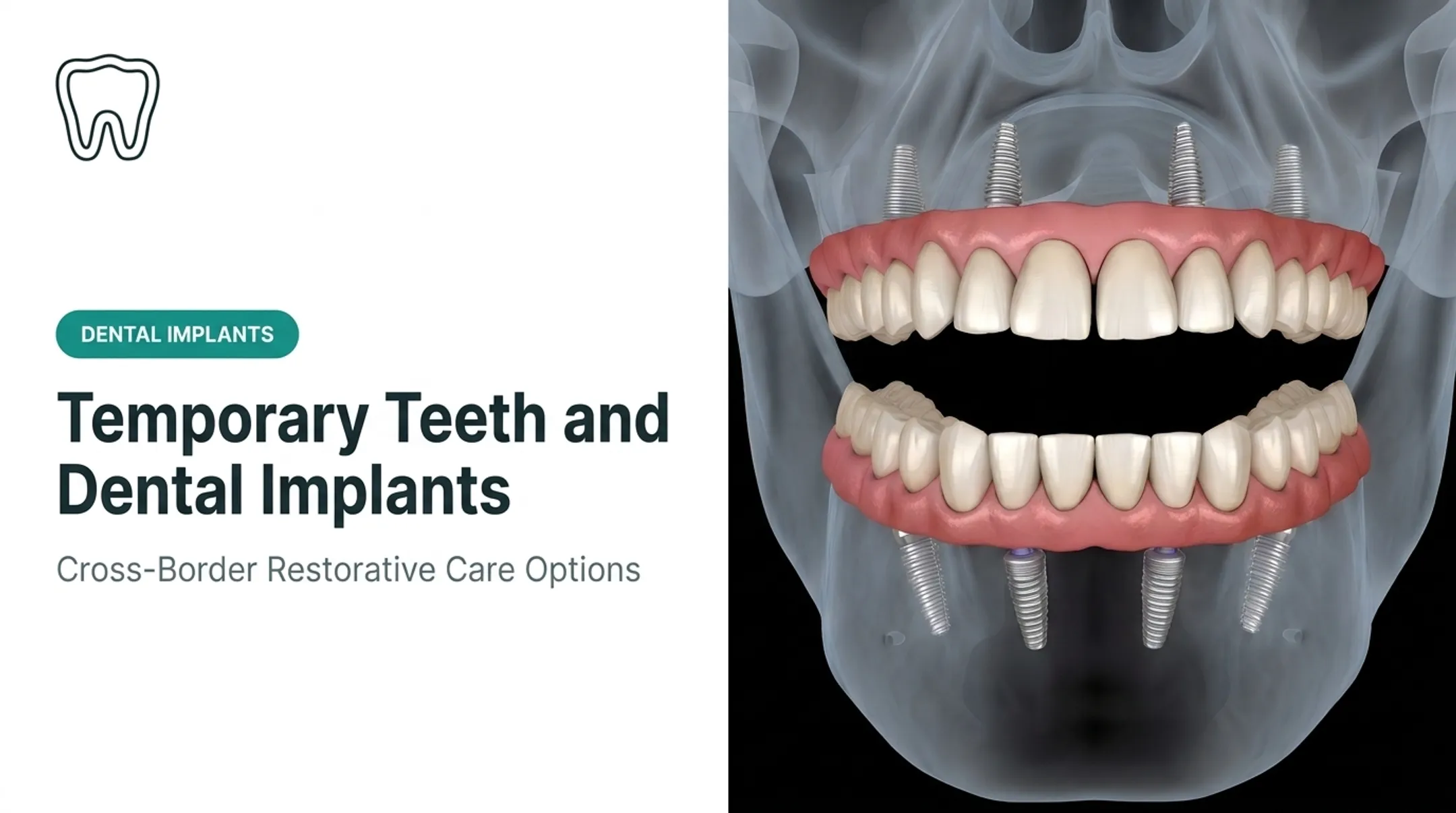
The temporary bridge, also called a provisional prosthesis, is a lightweight acrylic restoration attached to all six implants right after they're placed. Its job is straightforward:
- Protect the surgical site during healing
- Preserve gum shape for the final prosthesis
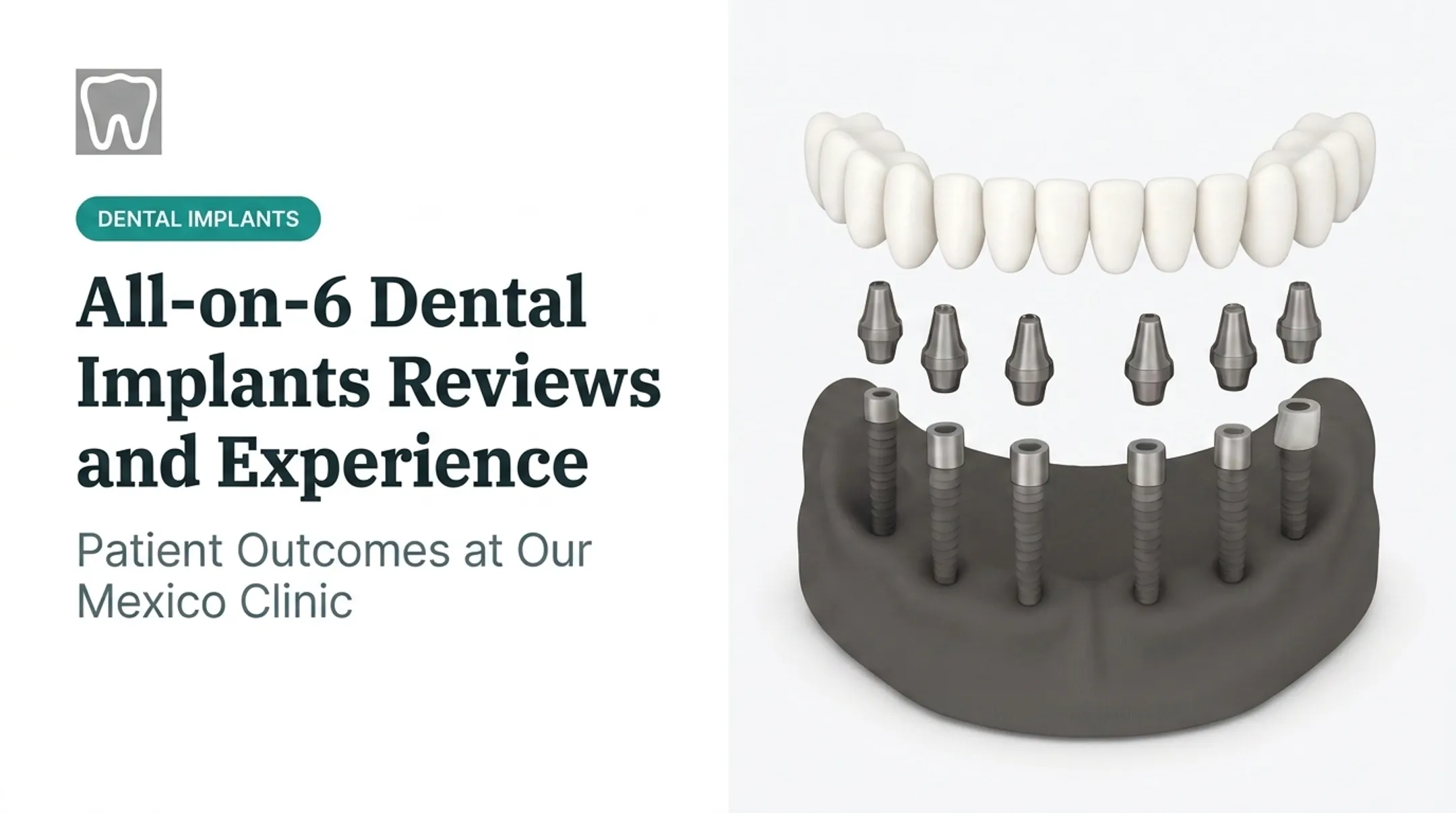
- Give you a full set of working teeth while titanium implants fuse to bone This fusion process, osseointegration, is what makes the final restoration stable. Acrylic (often PMMA) is used for the temporary phase because it's lightweight, adjustable, and easy to repair chairside if something needs tweaking. Research on full-arch restorations confirms PMMA works well as a provisional material precisely because it can be modified without the complexity of milling a new zirconia piece each time. Your final bridge won't be made from the same material. The permanent restoration is typically a custom-milled zirconia or hybrid bridge, denser and more durable than the acrylic used during healing.
Why All-on-6 Reduces Temporary Teeth Problems
Six implant support points create shorter cantilevers than four, which matters more than it sounds. A 2023 finite-element study modeling bite forces found dramatically lower stress concentrations in six-implant designs compared to four-implant configurations under vertical loading, with maximum stress dropping from 438.85 MPa to just 21.80 MPa in the modeled scenario. In practical terms: less stress on the implants during the temporary phase means less risk of your provisional bridge cracking or loosening. This makes All-on-6 a strong option for patients with adequate bone volume who want a sturdier temporary experience. Dr. Moguel's use of 3D Cone Beam CT imaging and digital scanning allows precise mapping of implant position, length, width, and angle before surgery, so the temporary bridge is supported correctly from day one.

From Surgery to Permanent Teeth: The Temporary Phase Timeline
Getting from surgery day to your final smile follows a predictable sequence:
- Assessment and digital planning - CBCT scans and digital models evaluate bone density and map implant positions. The temporary bridge is often designed before surgery.
- Implant surgery and same-day temporary fitting - Surgery under sedation typically runs 2-3 hours. The fixed temporary bridge is then finalized and attached the same afternoon.
- Healing and osseointegration - This stage lasts 4-6 months. The temporary bridge protects the implants and shapes the surrounding gum tissue.
- Follow-up visits - Bite adjustments, screw tightening, or minor repairs are handled as needed during healing.
- Permanent bridge placement - Once imaging confirms the implants have fused, the clinic fabricates and fits the final zirconia or hybrid bridge.
For patients traveling across the border, this typically means two trips. The first covers surgery and temporary teeth (roughly 3-5 days); the second, 3-6 months later, is for the permanent restoration.

Living With Temporary Teeth: Eating, Speaking, and Daily Care
You can eat right away, but not just anything. For the first several days, stick to soft foods: eggs, soups, mashed vegetables, and yogurt.
Hard chewing can overload healing implants and compromise osseointegration before bone fully integrates. Protect the sites while they stabilize.
Avoid these during the healing phase:
- Hard, crunchy, or sticky foods (nuts, chips, caramel)
- Biting directly with your front teeth
- Chewing gum
Speech may feel slightly off for the first few days to weeks as your tongue and lips adjust to the new bridge shape. This resolves naturally with time and use.
Hygiene During Healing
Daily home care protects healing tissue and keeps the temporary bridge clean:
- Use a soft-bristled toothbrush, brushing gently after meals and before bed
- Rinse with warm salt water (½ teaspoon salt per glass) 4-5 times daily, starting 24 hours after surgery
- Avoid brushing directly over the surgical site for the first 48 hours
- Clean beneath the fixed bridge with a water flosser or superfloss once tissue has settled
Regular follow-ups let your dentist catch minor bite or fit issues early, before they turn into bigger problems.
Potential Complications With Temporary Teeth (And How They're Fixed)
Complications during the temporary phase are common enough that you shouldn't panic if one happens to you.
A five-year randomized trial comparing All-on-4 and All-on-6 patients found similarly low issue rates in both groups. Screw loosening and minor acrylic fractures showed up in only a handful of patients over five years, and all were repaired chairside without complication.
Common issues include:
- Bridge chipping or fracture
- Screw loosening
- Discoloration from coffee, tea, or staining foods
- Minor bite misalignment
Most issues are fixed in a single visit—retightening a screw, polishing or repairing a chip, adjusting the bite, or refinishing surface stains. Larger fractures may need a section reprinted.
An in-house digital lab, such as Dr. Moguel's CAD/CAM setup, often means those repairs happen without a long wait for outside lab work.
All-on-4 vs. All-on-6: Which Offers a Better Temporary Teeth Experience?
Both protocols use a fixed temporary bridge and a similar timeline to permanent teeth. The real difference is in support structure.
| Factor | All-on-4 | All-on-6 |
|---|---|---|
| Implants per arch | Four | Six |
| Cantilever stress | Higher (tilted distal implants) | Lower, more evenly distributed |
| Best suited for | Patients with lower bone volume or needing a less invasive approach | Patients with adequate bone wanting broader support |
| Marginal bone loss (5-yr RCT) | 1.71 mm | 1.51 mm |
A 2024 systematic review of over 20,000 implants found marginal bone loss was significantly higher in four-implant groups compared to six-implant groups. Overall implant survival did not differ significantly between the two.

All-on-6 generally shows fewer cantilever-related fractures during the temporary phase. All-on-4 remains a solid choice for patients who lack the bone volume to support six implants comfortably.
Why Patients Choose Dental Implants in Mexico for All-on-6 Treatment
Dr. Moguel brings 38+ years of clinical experience and more than 17,000 implants placed to every case. He is board-certified by both the ADA and ADM. His clinic offers the patented 3-ON-8™ protocol alongside All-on-4, All-on-6, and full-mouth reconstruction. Plans are tailored to each patient's bone condition using premium systems from Nobel Biocare, Straumann, and MegaGen. That clinical depth is why many cross-border patients choose All-on-6 here—and the logistics support the decision:
- Free, no-obligation consultations
- Transparent "from" pricing, starting around $8,000–$12,000 per arch for All-on-6
- Savings of roughly 60–70% compared with equivalent U.S. treatment
- Clinic a short walk from the Andrade border crossing
- Travel coordination for patients staying in Yuma, Arizona
Frequently Asked Questions
What is better, All-on-4 or All-on-6?
Neither is universally better. All-on-6 offers more support and lower cantilever stress when you have adequate bone. All-on-4 suits patients who need fewer implants or have less bone volume. The right choice depends on individual evaluation.
Do you get temporary teeth with All-on-6 implants?
Yes. Your dentist places a fixed temporary bridge the same day as surgery, and it typically lasts 3–6 months during healing. You can eat right away, though soft foods are required to protect the implants.
How painful is the All-on-6 procedure?
Local anesthesia or sedation keeps discomfort minimal during surgery itself. Most patients experience manageable soreness for a few days afterward, controlled with standard pain medication.
Can the temporary bridge break or come loose?
Minor chipping or screw loosening can occur, but your dentist can usually repair it quickly chairside. All-on-6's cantilever-free design generally reduces this risk compared to All-on-4.
How soon can I get permanent teeth after All-on-6 surgery?
Your dentist places permanent teeth once imaging confirms full osseointegration—the implants fused to bone—usually around 3–6 months after surgery. Final fitting is scheduled once healing is verified.
Do temporary teeth look natural?
Yes. The acrylic bridge is custom-shaped and shaded to resemble natural teeth, so your smile and facial support look normal throughout healing.