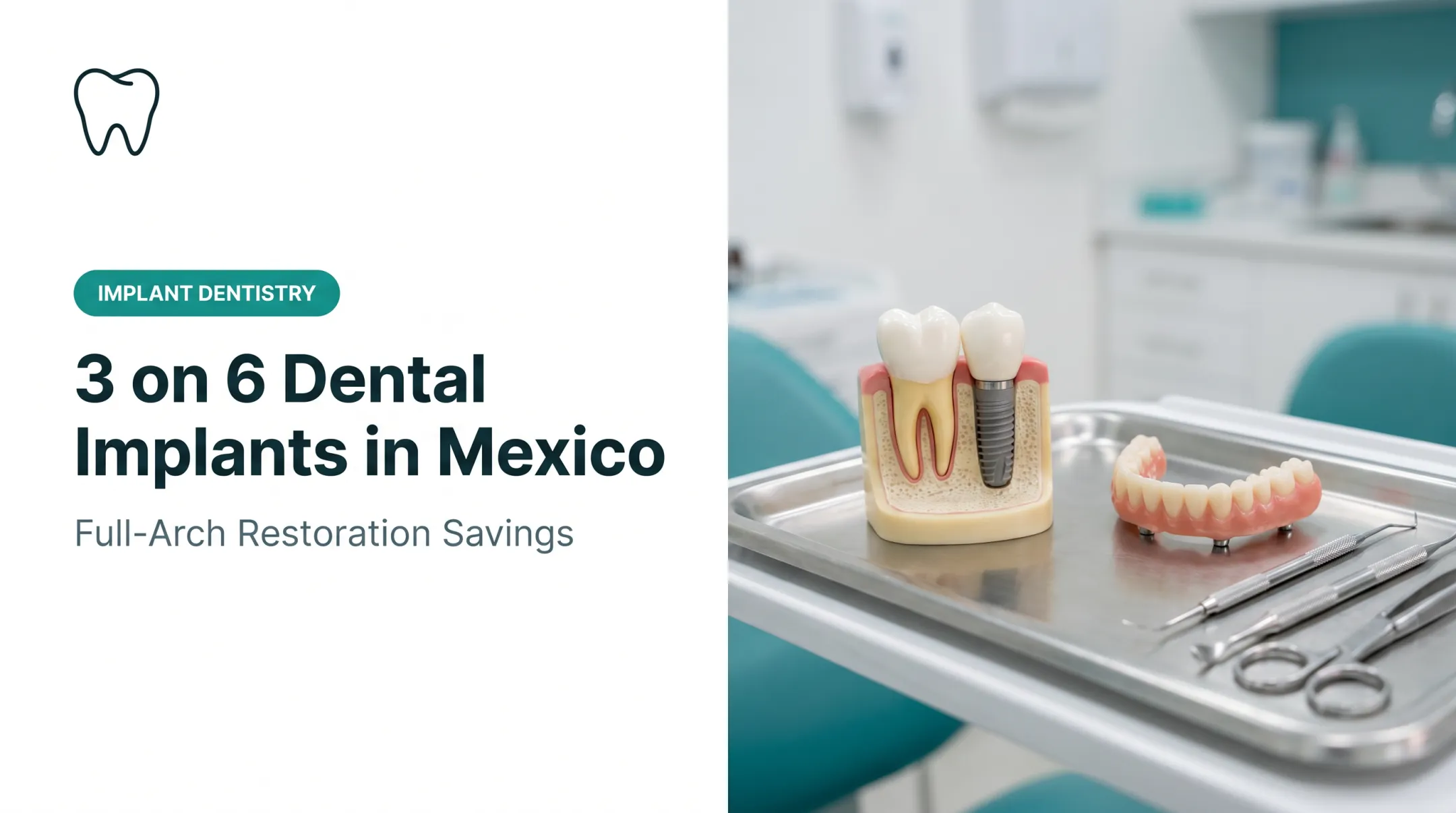

3 on 6 dental implants offer a fixed, permanent alternative. Instead of one bulky plate resting on your gums, six titanium implants anchor three separate, custom bridges per arch, no adhesive, no removing them at night, no slipping mid-sentence.
This guide walks through how 3 on 6 works, who qualifies, how it compares to All-on-4 and dentures, what it typically costs, and what to expect if you're considering treatment across the border in Mexico.
Key Takeaways
- Six implants per arch support three independent fixed bridges, unlike All-on-4
- Best for patients with good bone density who want a permanent alternative to dentures
- Patients traveling to Mexico can save roughly 60-70% compared to typical US pricing
- Osseointegration takes several months before the final bridges go in
What Are 3 on 6 Dental Implants?
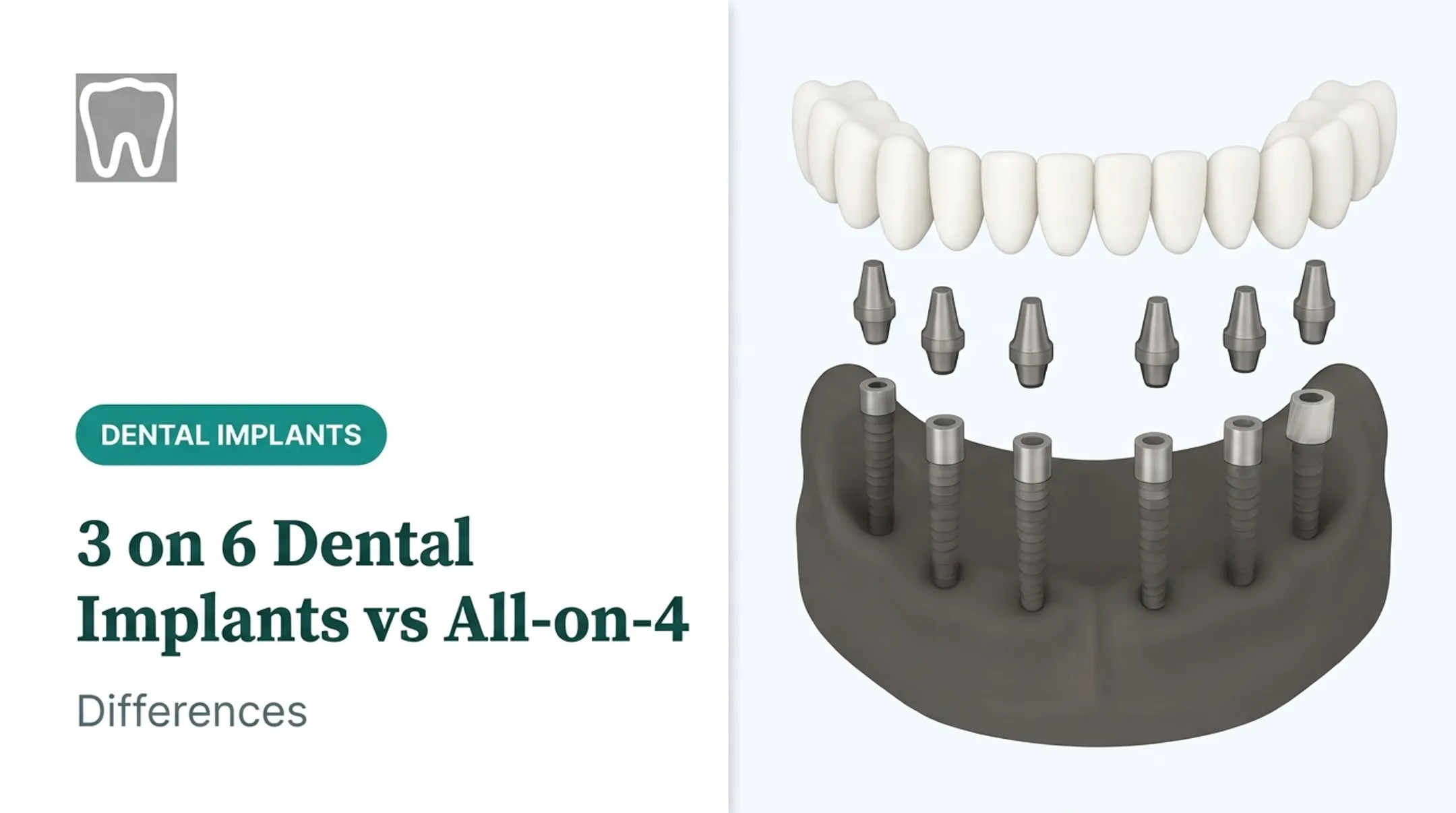
The concept is straightforward: six titanium implants are placed per arch, spaced to support three separate bridges, typically one covering the front teeth and two covering the back segments on each side.
That segmentation matters more than it sounds. A one-piece prosthesis usually needs a strip of pink acrylic to bridge gaps and hide the transition to gum tissue. Three independent bridges can sit closer to the natural gumline, which tends to look more lifelike and lets each bridge be shaped individually.
Each bridge is typically milled from zirconia or porcelain, custom-shaded to match natural tooth color and translucency.

What the Research Actually Shows
There isn't a large body of peer-reviewed research on the exact branded "3 on 6" protocol specifically. The closest available data comes from broader six-implant, full-arch studies:
- A systematic review of maxillary four- and six-implant restorations found 97.0% implant survival and 99.6% prosthesis survival with six implants over a mean 4.5-year follow-up
- The same review found lower marginal bone loss with six implants (0.46mm) versus four (1.02mm)
These numbers support six-implant full-arch treatment generally. They're not a guaranteed outcome for every 3 on 6 case, and long-term data specific to three-segment designs is still thin.
For patients who need more support than six implants can offer, some clinics, including ours, also offer the 3-ON-8™ protocol, developed by Dr. José Moguel. It uses eight implants per arch to support three independent bridges, adding structural redundancy and allowing a single segment to be repaired without touching the rest of the restoration.
3 on 6 vs. All-on-4 vs. Traditional Dentures
Comparing to Traditional Dentures
Removable dentures rest on the gums and depend on suction or adhesive to stay put. Over the years, they contribute to bone loss because there's nothing stimulating the jaw underneath. That bone loss is what causes the sunken, aged facial appearance many long-term denture wearers notice.
3 on 6 implants change that equation:
- Six implant points stimulate the jawbone directly, helping preserve its shape and volume
- Fixed prosthetic—no daily removal, adhesive, or clicking when you talk
- Bite force is distributed across multiple implants instead of resting entirely on soft tissue
Comparing to All-on-4
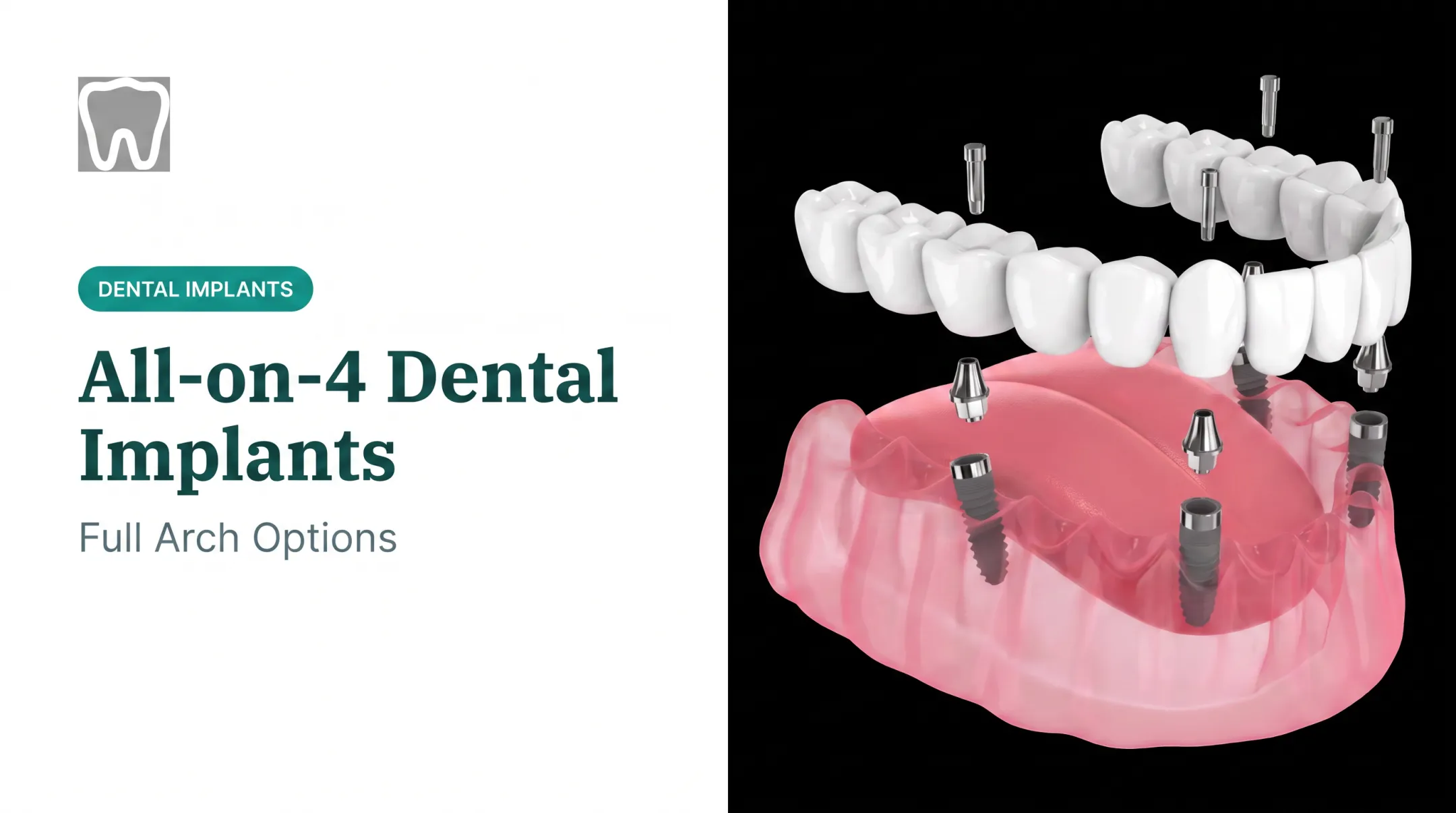
All-on-4 uses four implants supporting a single, splinted prosthesis. It typically requires more acrylic gum material to fill the arch and distributes force across fewer implant points.
3 on 6 generally requires more available bone volume than All-on-4, since it uses more implants and a segmented design. That makes a proper bone evaluation essential before committing to either option.
A 2015 randomized trial comparing All-on-4 to All-on-6 over five years found no statistically significant difference in implant survival or complications. That study looked at single splinted prostheses rather than segmented bridges.
When might a periodontist recommend one over the other?
| Factor | Favors All-on-4 | Favors 3 on 6 |
|---|---|---|
| Bone density | Lower bone volume | Adequate to good bone volume |
| Budget | Lower upfront cost | Higher investment for added support |
| Aesthetic priority | Acceptable acrylic gum line | Natural gumline appearance matters |
| Repair flexibility | Whole prosthesis replaced if damaged | Individual segment can be repaired |

Who Is a Candidate, and What Does the Process Look Like?
Good candidates for 3 on 6 typically have:
- Multiple missing or failing teeth in one or both arches
- Adequate jawbone density to support six implants
- Good general oral health, with periodontal disease controlled
- Non-smoker status, or a genuine willingness to quit before and after surgery
Factors that may require additional treatment first:
- Severe bone loss (bone grafting may be needed before implants)
- Uncontrolled diabetes, generally managed by keeping HbA1c under 7%, according to a peer-reviewed review of diabetic implant patients
- Active, untreated advanced periodontal disease
- Smoking, which one systematic review linked to a 140% higher implant failure risk
Once candidacy is confirmed, treatment moves through four clear stages.
The Consultation and Surgical Process
- Imaging and planning - A 3D Cone Beam CT scan maps bone density, width, and depth so implants can be positioned safely, clear of nerves and sinuses.
- Surgical day - Your surgeon places the implants and attaches a fixed temporary bridge the same day.
- Osseointegration - The jawbone fuses with the implants over 3 to 6 months. A soft-food diet is recommended during healing.
- Final bridge placement - Once integration is complete, your dentist permanently secures custom-milled zirconia or porcelain bridges.

We use implant systems from Nobel Biocare, Straumann, and MegaGen, all FDA-approved. Implant hardware carries a lifetime warranty; prosthetic bridges carry a five-year warranty with routine professional cleanings.
Cost of 3 on 6 Full Arch Restoration and Why Patients Travel to Mexico
Full-arch implant pricing—including 3-on-6 and All-on-6 style restorations—depends on implant count, bridge materials, bone grafting needs, and how many arches are treated. No single flat rate fits every case.
Case-specific quotes matter more than list prices. As a transparent full-arch benchmark, our 3-ON-8™ protocol is priced from $15,000, generally $16,000–$20,000 per arch. Bone grafting, when needed, typically runs $400–$800.
Why Mexico?
The Academy of General Dentistry has reported that US patients can expect savings of 40-65% by seeking dental treatment in Mexico. Our patients generally see savings in the 60-70% range compared with US pricing.
A board-certified periodontist performs treatment using the same implant brands and CBCT imaging technology found in US clinics—without US overhead costs.
Making the trip easy:
- Hotel coordination in Yuma, Arizona, or Los Algodones itself
- Local shuttle assistance arranged through bilingual coordinators
- Clinic location roughly a three-minute walk from the Andrade, California border crossing
- Free, no-obligation consultations with transparent price quotes before you commit

Longevity and Aftercare
Implant fixtures themselves tend to hold up well over the long term. Full-arch implant literature generally reports survival rates around 92–95% at 10 years.
Bridges and prosthetic materials may still need repair or replacement over time, regardless of the implant technique used.
Daily care that protects your investment:
- Brush twice daily with a soft-bristled toothbrush
- Clean beneath the bridge using a water flosser or super floss
- Avoid excessively hard or sticky foods that stress the prosthetic
- Attend regular professional checkups so the team can catch issues early
Consistent hygiene and follow-up visits do the most to keep a full-arch restoration lasting for decades. Pair that routine with a lifetime implant warranty, and the fixtures themselves are backed for the long haul when recommended care is maintained.
Why Choose Dental Implants in Mexico for Your 3 on 6 Restoration
Dr. José Moguel has placed over 17,000 implants across 38+ years of clinical practice. He's board-certified through the ADA and ADM, earned his DDS from UNAM, and completed postgraduate training in Periodontics and Oral Implantology. At his Los Algodones clinic, full-arch treatment—including 3 on 6 restorations—uses American-standard technology at about 60–70% less than typical U.S. pricing.
Patients also get:
- Personalized treatment planning based on your own CBCT scan
- Bilingual coordinators who handle scheduling, travel, and questions in English or Spanish
- Transparent pricing with no hidden fees
- Clear education on your options before you commit
If you're weighing your options, a free consultation is the easiest way to confirm whether you're a candidate and get a quote built around your case.
Frequently Asked Questions
How much does a 3 on 6 full arch restoration cost?
Cost depends on the materials used, whether grafting is needed, and how many arches are treated. Mexico-based treatment often costs 60–70% less than comparable US pricing.
How long do 3 on 6 full arch restorations last?
Implants can last decades with proper care and often include a lifetime warranty. Bridges typically carry a five-year warranty and may need repair or replacement depending on wear and hygiene.
Which is better: 3 on 6 full arch restoration or All-on-4 dental implants?
Your bone density, budget, and aesthetic goals determine the better fit. A professional evaluation with 3D imaging is the only reliable way to choose between them.
What is the recovery time after 3 on 6 implant surgery?
Initial soft-tissue healing takes about one to two weeks. Full osseointegration, when the implants fuse with the jawbone, generally takes 3 to 6 months.
Am I a good candidate for 3 on 6 dental implants?
Good candidates have adequate jawbone density, good overall oral health, and are non-smokers or willing to quit. A CBCT scan during consultation confirms candidacy.
Is traveling to Mexico for dental implants safe?
Yes, when treated by a board-certified periodontist using American-standard technology and sterilization protocols. Los Algodones clinics routinely treat US and Canadian patients with the same FDA-approved implant brands used in the United States and Canada.